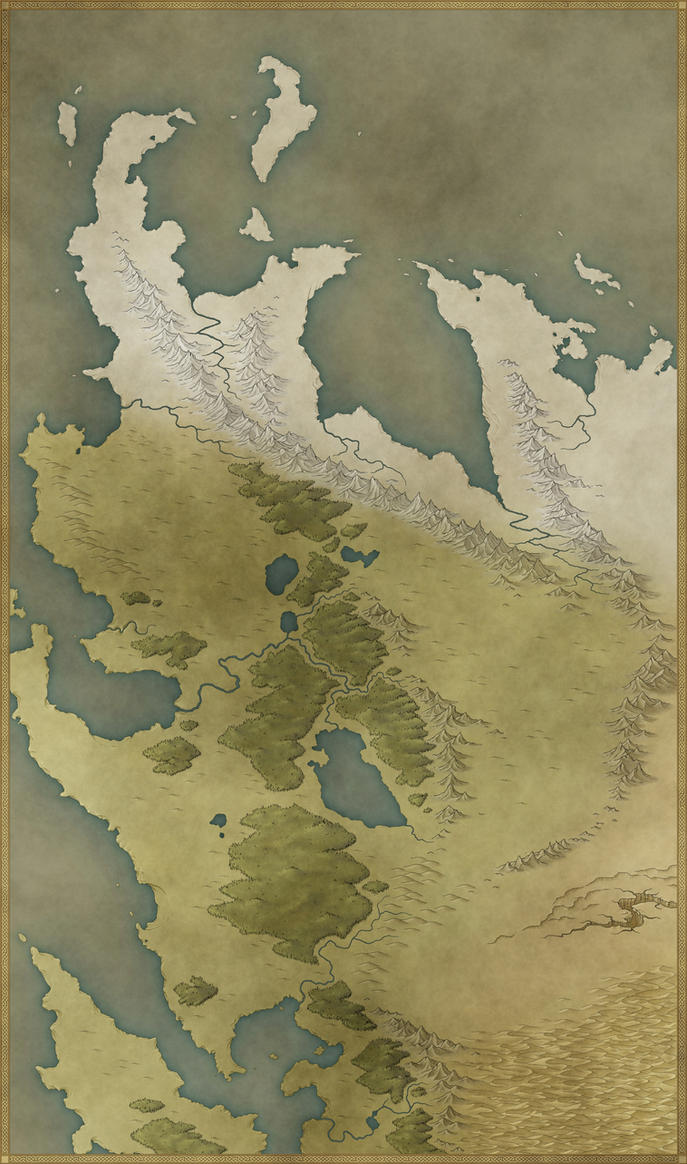
There needs to be a current threat/problem/general mentality when making this universe. Is a great prophecy about to take place? Are we slipping into a new ice age? Are political feuds the norm?
Honestly, I wouldn't like it if we went all edgy GoT-style on this. I'd prefer a more mystical universe, but one that is losing its touch - as if we live in a period directly after the golden age of magic and adventuring.
Indeed. Haithorost could be the Elvish name for the Northern Reaches. I wonder how the human attitude towards their extremely pragmatic culture would be, though. Indifferent? Consistent with their own?
@The Harbinger of Ferocity Would you be interested in implementing the Snow Elves in your history? Given their secluded geography, Altgarde could have also been a rebel state against Khaver.
@Oak7ree I understand where you're coming from, but sometimes one really has to generalize when describing entire races, for the sake of brevity. Most non-human races will probably roughly fit into a stereotype (though that stereotype may be unjustly bestowed). As for Americans, a great deal of them do like baseball, though not every single American will fit into a cookie-cutter personality like that. However, what I do have planned for the races here is for the negative traits of their race to be more apparent, e.g the humans are overbearingly imperalist instead of merely ambitious, and the generic elvish mystery found in most universes becomes full-blown racism. I'd want to eliminate the notion of good guys bad guys for entire races (much like how Tolkien generalized all the orcs to be bad), and rather instead instill a sense of flawed humanity in the world. For example - the Lord of the Rings usually paints elves in a distant, but benevolent light. Whereas I imagine this story to be more of the Silmarillion, where the elves are outright rebellious dicks in their specialness.
TL;DR - Yes, I'm going for an edgy deconstructionist feel.
And while you were writing that, I've already kinda sunk my teeth into this. So, introducing the Seers!
The Seers
“We perceive the Will.”
Known as among the last few to truly sense the will of the gods in Kaledan, the Seers (or the Order of the Seers) are a magic order who are committed to maintaining a stable means of communing with those Beyond. They have hunted down fell beasts and men alike, discovered things of unspeakable power, and have spoken with the gods themselves. They usually only accept young children as initiates, but besides that, their ranks are by no means exclusive - any sentient race capable of wielding magic has a place within the Seers. Though they are enigmatic, they are most certainly respected.
The Seers began as a secret order of elven mages in the Age of Mist, who decided to pool their forces in order to keep the presence of the Gods alive in Kaledan. The founder of the Seers was an elderly wood elf called Thonnen Lavarion ’the Great’, one of the most powerful mages to ever exist, and who had reputedly seen the face of the Great Tree. As of that time, the dwarves warred with the orcs in the mountains to the south, and humans had yet to land on Kaledanic shores - so it was natural that this secret order was exclusive to the elven race. At first, they served none but the Prince of Anor, the ruler of the wood elves, and helped him consolidate his power over the Anorian Wood. However, when the first man to land on Kaledan felled the first tree of Anor, heralding the end of the Age of Mist and the beginning of the Age of Blood, the Prince ordered his Seers to carry out unspeakable acts of war on whomever dared cross the Secret Wood. Many humans, dwarves, and orcs fell at the hands of the ancient Seers. It is for this reason that at the end of the Age of Blood, the Seers were able to break away from the Princedom of Anor and went into hiding into what is now known as the Silver Tower, concealed by magic so that no mortal can reach it save with the guidance of a Seer himself. The subsequent dominion of the Khaveri Empire cemented the Seers’ oath to swear fealty to no one but those who lie Beyond. It is for this reason that Seers refuse to advise any mortal rulers nor command any army.
The Seers, of course, spearheaded the Golden Rebellion in opposition to the Khaveri Empire. Though they communicated seldom with other rebel leaders and refused to hold territory, the Seers certainly were of enormous help to the greater revolution. The devastating fireball attacks that razed entire city blocks earned the Seers the nickname of ‘Dragon-men’ amongst the ruling and working class alike. The man who killed the Emperor of Khaver, the humble peasant knight Moren Dolevolt, was said to be assisted by an elderly Seer in his quest.
After the war, the Seers yet again retreated back into their secret bases and towers, and now spend the majority of their time in deep meditation, attempting to call back the gods. The world of Kaledan is large, and her people in danger - but the Seers will not let the gods abandon the realm, no matter the cost.
---
The Seers only accept children as initiates, preferably below the age of five. They spend their entire adolescent lives within their Cloister, learning the basics of the arcane. When they have come of age, they are given a choice - either to stay within the walls as a Mystic, communicating with the gods, or to venture outside as a Magus, safeguarding the realm in the absence of the divine. At first the Seers only held elves within their ranks, but with their secession from the Princedom of Anor, all manner of race can be found here.
It is to be noted that the Seers do not have an official ranking system - Seers do not believe in such petty political affairs, and a Seer can already magically sense the seniority of another. The Seers do not have a supreme leader - they do have a Grand Council composed of nine appointed members who deliberate on actions and decisions taken by the Order as a whole.
The Seers are unique from most other groups within Kaledan in that they do not punish gross misconduct or incompetence with death or exile. A Seer’s spirit can never truly rest, due to his strong connection with the gods, and neither can one let a misbehaving Seer wander Kaledan unrestrained. So what the Order usually resorts to is magical imprisonment: this usually involves the offending Seer being condemned to live in a pocket dimension for a certain amount of time - in the gravest cases, eternity. Within these pocket dimensions, the Seer is practically immune to death, making it a living hell for gross offenders.These dimensions often take the form of earthly prisons like towers, mazes, or even dungeons.
Given their massive role in shaping the history of Kaledan, the Seers are often granted the unoffical status of ‘local problem-solvers’ by ordinary mortals, much like the Istari of Middle-Earth. Many magic groups from dwarven runemasters to orcish shamans respect the Order, or at the very least fear it. The Seers, however, refuse to claim authority over any of the aforementioned groups.
~i'm pushing the line here with a quadruple-post, I know~
Extra idea:
- The world could be divided into ages, with the first being the Age of Stars, when the gods walked the earth. To make it even edgier, we could have the resulting ages represent the five stages of grief.
- Denial could be the mortal races still communing with the gods, albeit not in physical form, but eventually their divine intentions become murkier and murkier. This could be a false golden age, where magic seems to be at its peak, yet decay starts to entrench itself.
- Anger could be an all-out Age of Blood, where the mortal races war with each other, blaming each other for drawing away the gods.
- Bargaining - one empire eventually does dominate the others, and is built upon communing with a dark, unstable deity - a deity who happens to still be the closest to the mortal realm. This age would end with this empire getting overthrown.
- Depression - this is the current age, where magic is dying and the gods drift further and further away from mortal affairs. Magi are ostracized at best, and hunted down at worst. Many of the other races dwindle in number.
- Acceptance - Certain sects of society are determined to not let this age come to pass. All across Kaledan, heroes strive to gain favor from their divine patrons. Magi submerge themselves in study to commune with the gods. The mortal realm will not let the gods leave Kaledan - without a fight.
Actually, stories could be set in any of these ages, for greater plot opportunities. But the main theme of the setting is that the world has seen better days.
Extra idea part 2:
- The elves could be Kaledan's native race, inhabiting a continental forest which the early human settlers cut down. This creates an age-long hostility between the two races.
- The humans could have come from 'a land of dark shadow' in history books.
- Orcs regularly war with the dwarves and are seen as vermin to be exterminated by humans.
- Halflings are greedy assholes and con men.
- Elves are antisocial.
- Humans are supremacist.
- Dwarves are socially and mentally rigid.
- Orcs are either warring themselves into extinction or enslaved by humanity.
Wait, I actually kinda backtrack on what I said earlier. Magic and a divine pantheon could certainly be universal, but actual communication with the gods would be extremely hard to do. The gods should influence the world in little ways mere mortals can only glimpse at. So we get the idea that they exist, but we're not quite sure what they're doing. Seers or oracles would then become extremely valuable.
Also, in order for a universe to be implemented gracefully in storytelling, there needs to be an overarching theme with the world. Tolkien was all about the gradual decay of the world and the sinfulness of mankind. George RR Martin wanted to illustrate power-lust and what it did to people and society. George Lucas wanted to show how hope could prevail even in the darkest of times. I saw in this thread a while back about dragons heralding great events of some sort, so probably this universe should be all about prophecy, turbulent times, and how people cope with change. We therefore should go about formulating great events that have triggered change in the world.
Long ago, ere the first man beached his wooden long-boat on the shores of Kaledan, a great happening arose in the North. Suvei Malthorion, youngest prince of the King of the Wood Elves, had fallen in love with a mysterious spirit. This spirit allegedly hailed from the northern icy wastes where none dared pass then, and around her a harsh cold would swirl. But young Suvei could not contain his love for this spirit, and when their love was found out, he was bidden to go out from his father’s presence and never return. Seeing no place to go but his wife’s homeland, Prince Suvei prepared himself for a lifetime in the ice. It is said that the children of the fallen Prince and of the icy spirit are now what we call the anor’suvei - the children of Suvei, the snow elves.
PHYSICAL APPEARANCE
The snow elves are markedly different, both in countenance and bearing, from their wood-elven kin. Their hair and skin are a natural frosty white, a possible result of evolution for camouflage in the wastes of Haithorost. Their eyes are a piercing icy blue, or in some rare cases almost completely gray. The latter are often seen to be blessed by the Goddess. Snow elves also have an inhuman - indeed, almost magical - tolerance for the cold. To put it in perspective, a snow elf would probably feel rather comfortable in a two-piece bathing in the waters of Antarctica. This is why many snow elves tend to dress rather sparingly when in warmer climates. Snow elves are also rather carnivorous in their diet, favoring polar bear, whale, seal, and occasionally, khakoric snake, able to forgo lifetimes of not touching a single vegetable.
CULTURE
The top priority of a snow elf was, is, and will always be sheer survival. Surviving subzero temperatures and carnivorous polar wildlife leaves little time for the niceties of books, poetry, or music their siblings in the south enjoy. Besides delegating the portions of a hunt after a long day and yelling warnings of hungry polar bears behind unsuspecting travelers, snow elves rarely speak - let alone write. A snow elf seldom thinks beyond his next meal, his next place to sleep, and whether he will awake alive the next morning. For some, this way of life may be uncultured,uncivilized, and devoid of any deeper meaning, but for the snow elf, it is merely practical.
Snow elves are divided into tribes that wander Haithorost on caravans of sledges following the migratory patterns of great whales or polar bears. However, these tribes are not always bound by family - in fact, they rarely are. The governing rule of snow elven society is simple - you are a liability unless proven otherwise. For snow elves, whether you can contribute to the continued existence of the tribe or not is far more important than familial blood, gender, or age. This is why snow elves struggle to grasp with the idea of family and the conventional notion of friendship. An ailing old grandfather and a weak young child are both reduced to the same thing in the eyes of a snow elf - a hindrance to be discarded. Because of this, snow elves tend to not be bound by blood, but whether they can keep each other alive. This belief may seem cold and heartless to the outsider, but without it, the anor'suvei would not be around today. There is also a flip side to this dogma - if you happen to save a snow elf's life, the resulting bond will run deeper than any family member. Snow elves are not heartless - they just happen to value tangible safety more than ideals and concepts.
One of the more unique traits of snow elven culture is ‘mavokal’ - literally ‘to cast out’ in Elvish. There are three types of mavokal. The first type - ‘sohleri’ - occurs when a snow elf is deemed incompetent by a tribe. Sohleri snow elves are simply cast out into the icy wastes with a few supplies to fend for themselves and hopefully find another wandering tribe. However, when these exiled elves manage to find another tribe in the frost, they are often given a hero’s welcome for having proven their worth and having earned their second chance. The second type of ritual is ‘dai’haga’ - often administered to youths coming of age. The dai’haga means being separated from the tribe at least a month to survive on their own. After that month, they are also expected to find their own tribe. The dai'haga aims to stress the importance of society and what it is like to be 'useless'. The last mavokal is the most shameful one - the ‘yurai’. One who counts himself among the yurai has probably caused several deaths with his blunder. The unfortunate snow elf in question has a cross carved into his scalp and is given either a bottle of khakoric snake venom or a knife to take his own life in the wastes, before the cold gets him first. A yurai will never be accepted by another tribe or any snow elf worth his salt. Indeed, a yurai will probably never speak again to another living thing out of sheer shame.
The snow elves, for all their practicality, can be very superstitious. For what else could keep you alive in the wastes than divine intervention? The snow elves pray to Haithora - the bride of Suvei Malthorion - for warmth, a good physical sense of direction, and luck, most commonly before and after hunts. However, her priesthood is nigh nonexistent, and the training of youngsters in the arcane arts is seen as a waste of time when a trusty harpoon could do the same job as a fireball.
The snow elves rarely have dealings with outsiders or foreigners. A snow elf outside the wastes is most probably a yurai, or adopted. Most races regard them with wariness, but for all the hospitality and understanding of the wood elves, they are one of the only races in Kaledan who truly hate the anor’suvei. It is not uncommon to see the kindest of wood elves physically and verbally lashing out at snow elves in social interactions. In the eyes of the anor’mulia, the children of Suvei were, are, and will always be traitors to the elven race. This is why snow elves rarely venture south, for fear of dying of the heat, or being lynched by their wood-elven brothers.
Also, I would prefer a more mysterious feel to the magic system - very little practitioners exist, the ones that do are well into old age, and are left alone at best, and ostracized at worst. Right now, the magic system feels like a science - a systematic study. I personally think it would be better if it were respected as an esoteric art, an expression of the self. Magic would seem more 'random' and in the heat of the moment to the untrained eye, rather than a clear application of a spell.
I'd also like a more conflicting feel to the religious system - divine magic may exist, but no one is entirely sure where it's coming from, or how to gain it in the first place. People war over whose god exists, not whose god is better.
We folks here at the Guild take pleasure in writing out dramatic, epic backstories for our characters. Now, it's not always in the sense that your character is the Chosen One (though in many cases it is), but it is often in a tragic nature. We find many characters on the Guild with dead parents, dead siblings, dead mentors, dead friends, psychological problems, family problems, problems with society (i.e outcasted, often in a dramatic manner), or very heavy life problems in general. Now, this is exceptionally healthy for main characters of a story, because it of course offers more opportunities for growth.
However, in my case, I'm making a character for a Minecraft* roleplay server, which only offers one universe to make our own stories. There are a multitude of characters in the world, and making your character 'special' or forcing them into a main character role is usually frowned upon, as it detracts from the growth of other characters. Focusing the story on your own character's problems will often box out the hundreds of other characters in the world. So, what I'm looking for is to make a unique character with his own story and his own problems to overcome, but I'm also not looking for a 'special snowflake' backstory that will overshadow other characters.
Can anyone help me strike a balance?
This can also apply to anyone making a character for a one-universe roleplaying medium with multiple other characters.
*And before anyone takes a jab at this, I'll have you know that the communities on whitelisted roleplay servers are generally more mature than the average playerbase.

 Rekkuza
 Iwannabeyours
 Vec
Vec Frettzo
 Cyclone
 Lord Zee
 Timemaster
 SkyeOfStars
 TokyoPewPew