[OOC] Chronicles of Minadra
- Large Group
- Fantasy
- Casual
- Medieval
- GM Dyelli Beybi Co-GM Pragia12 Co-GM Bingelly
Join Status:
Apply
GM

Dyelli Beybi A prince among men
Member
Seen
22 hrs ago

Welcome to Chronicles of Minadra, a High-Fantasy RP set in the world of ‘Minadra’. In this RP you will take on the role of an adventurer in a party put together to recover an ancient treasure, though this will turn into something more epic, with the fate of all of Minadra in your hands…
Because we want to craft an excellent experience for you, there is quite a bit of Lore here, however, for the purposes of creating a character app, reading the ‘Primordial History’ then looking at the information about the race you want to app for will give you enough information to get started.
I’d also highly recommend you join our Discord so we can discuss character concepts!
Finally, there is no 'cap' on characters in the thread and you are welcome to join, even after launch.
The Grey Mountains, near the City of Ardbenn Solas
Year 4017 of the Age of Steel, three months ago...
Year 4017 of the Age of Steel, three months ago...
It was the rockfall that first caught Aderynel’s attention. It was nothing too unusual in these parts, a natural part of the process of snow falling, melting, then falling again. This rockfall was no different, though perhaps it had been covered by snow the last time she had flown this way.
It was then that she noticed the door. Ancient, wooden with bronze hinges weathered green by decades, or perhaps centuries of neglect. It was tall, very tall, 20 or more feet from the bottom to the top. It lay atop the fallen stones like a sled on a snowdrift.
Curious.
Aderynel circled the valley where the rockfall lay, letting herself slowly drift down on her black wings, flapping slightly to slow her descent as she dropped to her feet alongside the door. As she folded her wings behind her back, she studied the door with curious blue eyes. Now she was closer, the wood looked truly ancient, dark, weathered and shrunken. She stepped forward, placing a hand on the edge of the door as wind whipped at the edges of her fur lined tunic, tugging at the pins that held her amber-coloured hair back in a tidy bun for flight.
Where have you come from?
She glanced up, eyes tracing the route of the rockfall and, there, hidden below an overhang that would not have been visible to one of the winged Sylpharim who inhabited these hills, hung the door’s twin and, just to the right, like a smile with a missing tooth, an opening into the mountainside.
The Sylpharim were naturally curious creatures and Aderynel was no exception to the rule. The gap cried out to be explored. It would have been a steep climb for one of the other races, barely manageable, but for Aderynel it was little trouble. She spread her wings, beating them to aid her as she scrambled up the slope, coming to rest, a couple of minutes later, on a small jutting ledge in front of the door.
She paused, to catch her breath, staring into the dark as she let her eyes grow accustomed to the dark interior.
If only I had a torch.
There were forms in the darkness. Tall, hulking, massive stone forms. Cautiously, Aderynel stepped across the threshold, cocking her head to one side as she listened for anything that might be a threat, though all she heard was the crunch of her boots in the ancient dust. The forms were statues, massive statues, 18, 20 feet tall. Huge, bearded figures with long limbs and wiry muscles chiselled from stone.
She paused, staring up at one. The doorway into the cliffside was the sort of place that might have been built by the dwarves, possibly at the start of the age before they left these mountains, but the figures were too big, too elongated for the squat little dungeon dwellers.
She stepped forward to the nearest statue, the one most clearly illuminated by the sun creeping in through the fallen door. At the feet of the gigantic figure was an inscription. She ran a hand across it, feeling the edge of the huge letters. It was a script she didn’t understand, huge angular letters, cracked into the surface of the stone with monumentally sized chisels. There was something about them that seemed to speak directly from the elements, as if the earth itself were trying to communicate with her.
Aderynel looked up at the statue again.
Could it be?
Once the thought dawned on her it became clear what she was looking at. Far from an ancient dwarf hold, she was gazing up at the weathered features of some ancient Turakindi… one of the giants of the Silver Age. Who knew what ancient treasures lay deeper in the mountain?
A shuffling noise behind her drew Aderynel out of her reverie with a heart-lurching jolt.
She spun, hand reaching for the seax at her belt. There were shapes in the darkness, small, hunched shapes, moving, circling. She drew the long knife, cautiously stepping back towards the entrance. There were murmurs, a snarl as the creatures realised they had been spotted.
They wore little more than scraps to cover their pallid, wretched bodies, crabby hands clutching crude spears. Heart racing, Aderynel continued to step back towards the doorway.
She heard the shuffle behind her and reacted instinctively, spinning and slashing at the little troglodyte as it reached for her. There was a splash of blood and a squeal of pain and in the corner of her eye she saw the others surge forward. Throwing caution to the wind she spun, flapping her wings as she launched herself clumsily towards the doorway.
She felt a hand claw at her leg, trying to drag her back, but they couldn’t find purchase and she tore from their grip, tucking her wings in as she sped through the doorway like an arrow.
She lost control as she did, yelping as she tumbled down the slope in a small avalanche of loose dust and rocks to come to rest atop the huge wooden door that had first caught her attention. She groaned, rolling over onto her back as she searched for where she had dropped her seax in her fall. In the doorway a good dozen troglodytes stood hooting and waving their primitive weapons at her though they were reluctant to advance from their dark lair, out into the daylight.
“Little bastards,” Aderynel growled, drawing herself up to a sitting position as she dusted herself off, grimacing at the grazes on the palms of her hands.
Clearly she wasn’t going to be exploring this place on her own. She’d need to come back with a torch, with some proper weapons and with a party. She groaned, drawing herself up to her feet as she spotted her seax in the dirt. She reached for it, sheathing it as the troglodytes slunk back into the old Turakindi ruins.
For a moment she considered continuing her journey to Ardbenn Solas, but it was only a moment. Despite the wings that made most humans in these parts assume she was from Ardbenn Solas, Aderynel was different, one of the Northern Sylpharim. The Southern Sylpharim tended to keep to themselves in their mountain towns and villages, though in the North the Sylpharim lived closely with humans, sharing culture, songs and a language. Humans had strengths Sylpharim did not. They were stronger for a start and didn’t have a huge pair of fragile wings which, in a place like the Turakindi ruins she had just entered, were likely to be a hindrance, more than a help.
It wasn’t like the local Sylpharim had any claim of ownership of the ruins. She paused, looking skyward, then with a kick and a flap of her wings, launched herself upwards from the valley floor, making for the city of Ealdormuda where, doubtless, she would find some people willing to risk the journey to the mountains in search of gold, glory, artifacts or ancient knowledge…
NB: When opening the Hiders keep an eye out for Hover Text to help explain some things!

A Few Significant Places
The Plains of Morgador: The Plains of the Morgador ('Plains of Battle' in the Sidfirian language) have an ancient and significant history dating back to the Golden Age where the area was once the heart of Sidfir civilisation. During the Apocalypse, the place was the site of the Final Battle of the Apocalypse where the Graced Peoples defeated Brethnor's servants.
In the Silver Age, the Turakindi built their civilisation upon the ruins of the old Sidfirian cities in this same place, only for their civilisation to similarly be destroyed in the First Cycle War.
Now the Morgador is a place of ancient ruins, largely abandoned, home to ancient secrets and terrible dangers.
The Domain of Vaurinth: This is the place where Vaurinth lurks, surrounded by foul creatures. Nobody who crosses the Raxanor Mountains has ever returned.
The Taurethil Forest: A great forest filled with strange magical creatures and the hidden cities of the Fair Folk. Unless you have been invited and have an escort (or are one of the native races), venturing into the Taurethil Forest is ill-advised and very dangerous.
The Grey Mountains: The Mountain range where Aderynel, a young Sylpharim Scout, has just found an ancient Turakindi ruin that you are setting out to explore...
Ealdormuda: A pleasant coastal city of thatched wooden houses and long halls surrounded by a low stone wall and a dyke. Ealdormuda is the seat of the King of Eaham, who lives in the Great Stone Hall built atop the central hill, guarded by his Housecarls. This is the location where your party is assembling before setting out...
Primordial History
The Time Before Time
In the beginning, there was no space and there was no time. There was only Eruherion. Then, Eruherion breathed and breathed life into the first of its creations, a being of its own likeness without form, and it named the creation ‘Brethnor’. And Eruherion and Brethnor dwelt \in the primeval darkness.
Then Eruherion breathed life into other beings in the darkness. All were beings of pure spirit without shape or form, yet not rivalled Brethnor in its strength or power. These beings became known as the ‘First-Born’ in the ages to come.
Then Eruherion created the world, set the boundaries between heaven and earth, and made all the creatures that dwell in the sky, in the sea, on the earth and beneath it. Eruherion named the world ‘Minadra’ and the First Born descended from the Heavens, took on form and dwelt upon it.
But Brethnor did not take on physical form. In Brethnor’s pride, Brethnor asked Eruherion which of its creations Eruherion loved the most, for Brethnor was the most powerful. Eruherion answered that it loved all its creations equally and for the first time, Brethnor felt anger and jealousy. And on that day, evil was born into the world.
The Golden Age and the Apocalypse
Then Eruherion created the Golden-Age races the Jinn and the Sidfir.
The Jinn were people of the elements – earth, fire, water and air. They were solitary beings that went to dwell in places where they could be near the element of their affinity. The Sidfir, meanwhile, were a people of mind, magic and spirit who built cities of beauty upon Minadra that have never been surpassed in the ages since. There was no death amongst the Jinn or the Sidfir and Eruherion walked amongst its people under the guise of many faces and Eruherion was pleased with its creation.
It was then that Brethnor took on corporeal form and moved amongst the races. And Brethnor spread temptation and corruption amongst both the First-Born and the Golden-Age peoples, never creating but twisting and perverting. Many First-Born fell to Brethnor’s temptation while the Jinn and Sidfir who fell became known as the Gorthaz and Fomori.
In the parts of Minadra under the gaze of Eruherion, all appeared well, yet in the darkness, evil grew, until the time came when Brethnor’s followers thought themselves powerful enough to destroy the Graced people of Minadra and rebuilt it in Brethnor’s twisted image. In the place now known as the Plains of Mordagor, the vast hosts met and fought and for the first time, blood was shed on the fields on Minadra. The losses were countless on both sides, but eventually the Graced peoples triumphed and those twisted First-Born, Gorthaz and Fomori who survived fled into the dark and hidden places of Minadra.
The Golden Age lasted 14,840 years.
The Silver Age and the First Cycle War
Eruherion saw the suffering and death that had come upon Minadra and created Nalmarin – a place beyond the reach of Brethnor’s corruption, where its Creations could go. And Eruherion set the First-Born ‘Hirlome’ to guard the gates of Nalmarin so that no creature might enter that would bring corruption to it. Nalmarin is the place where the souls of the righteous travel after death.
On Minadra, the lines of the Jinn and the Sidfir gave the shoots of new races. The Turakindi (who are now known as giants), the Gwylfinn (who are now known as the Fae of the Seelie Court) and the Valindor (who are the ancestors of humans).
The races of the Silver Age were not immortal like the Jinn and Sidfir – they aged and died and the souls of the righteous among them travelled to Nalmarin. Similarly, the world was not free of strife, as the Golden Age had been, yet they built great cities and tended the forests and Minadra healed from the wounds of the Apocalypse.
Yet in the darkness, the Evil beings that had survived the Apocalypse of the Golden Age began to multiply and their corruption began to spread among the races of the Silver age. From the Tarakindi came the race known as the Durgorim, the Unseelie court of the Gwylfinn was founded and the Valindor were corrupted into the Thaurindor.
And in the dying days of the Silver Age, the Hosts of Darkness spewed forth onto the land, fighting a war that lasted for 20 years and left Minadra in ruins once again. Ultimately, the Graced people triumphed for a second time though a mere handful of the First-Born and few of the Golden-Age people survived to remain on Minadra after the First Cycle War. And the evil creatures retreated into the dark places once again, led by one of the last First-Born on Minadra, a being known as Vaurinth.
The Silver Age lasted for 13,440 years.
The Age of Steel and the Coming Cycle War
The Steel Age races sprung forth from the line of the Silver Age races. The races of the Age of Steel are shorter lived and lack the magical talents of the Silver Age peoples, yet they have multiplied and spread across the face of Minadra, rebuilding again, though not with the same majesty as the races of the Silver Age though in places the cities of the Valindor, the glades of the Seelie Court and the last bastions of the Sidfir remain to provoke awe.
It is now the year 4,017 of the Age of Steel and in the shadows, a darkness is moving again. Vaurinth has revealed himself after millenia in hiding and a Second Cycle War is now all but inevitable…
The Unmasking: Recent History
The Nemrozan Invasion - 3769 AS
In the 3,769th year of the Age of Steel, the people from the deep south, known as the Nemrozan invaded the Empire of Varadaban. The Nemrozan (whom the Mitradaevaka viewed as primitives) had lived peacefully alongside the Mitradaevaka for centuries and the invasion came as something of a surprise.
The young General Vahumisa, was sent to confront the Nemrozan and raised the Southern levies. Despite realising he was outnumbered 30,000 to 20,000, Vahumisa was confident of victory, assembling his forces on the Artavara plains South of the Casm-Dahyu. In the opening phases of the battle, Vahumisa ordered his cataphracts to charge the Nemrozan light cavalry (who formed the largest part of their forces), which they did, though the Nemrozans refused to stand and led Vahumisan’s forces back and forth across the plains until, heavily armoured and riding under the heat of the Southern Sun, they were, exhausted, parched with thirst, scattered and disorganised. Then, and only then, did the Nemrozan turn to attack. Vahumisa’s cavalry was destroyed in the ensuing fighting. Witnessing the unfolding chaos, many of the levies turned and fled, only to be cut down by Nemrozan horsemen. Vahumisa was slain by an arrow while trying to rally his men.
As the Nemrozan force marched North, looting and pillaging as they went, terror gripped the Mitadaevaka people, many of whom fled to their Capital of Ap-Vio. Emperor Dahyusah, whom history would remember as ‘the Wise’, commissioned General Zaranaka to call together the Northern levy and also sent word to King Calion of the Sidfir, pleading for his aid.
The Sidfir were not generally given to interfering in the ways of the Steel Age peoples, but given their long friendship with the Mitradaevaka, Calion decided to send 2,000 of his finest soldiers to support Zaranaka’s army. The news of the Sidfir’s support gave hope to the Mitradaevaka army who continued their preparations for battle with renewed zeal. Traveling with the Sidfir host (led by King Calion) was the Valindorian mage, Calanthor, who at 427, had been studying magic amongst the Sidfir for the best part of a century.
Zaranaka assembled his host South of Ap-Vio in the place known as Navavasta, to await their Sidfir allies. Few Cataphracts had survived the Battle of Artavara and Zaranaka’s force was mostly made up of levy soldiers and a few horse archers.
Perhaps, sensing the danger the Sidfir force presented (it was commonly thought that one Sidfir warrior was equivalent to a score of humans), the Nemrozan rode hard to strike Zaranaka’s army before the Sidfir could arrive. Realising the danger, Emperor Dahyusah personally led forth his Royal Guard - the finest spearmen of the Empire, helmets wrapped in purple cloth against the heat. Upon reaching the field and realising the Sidfir were still some way off, Emperor Dahyusah yielded command to the experienced Zaranaka, who placed the guard on the right flank of his host of infantry.
As evening fell the night before the battle, Dahyusah and Zaranaka received word that the Sidfir expected to reach them by the next evening. Zaranaka’s army numbered no more than 10,000 men, yet they chose to take their stand on the field with prayers to Eruherion for the deliverance of their people.
Shortly after dawn, the Nemrozan attacked. And through the morning, under a withering hail of arrows and javelins, Zaranaka’s army stood firm. Sensing his men would not break, the Nemrozan charged, engaging the Mitradaevaka in vicious hand to hand fighting.
For several more hours the Mitradaevaka held until finally, in the late afternoon, the Sidfir were sighted in the West: rank upon rank of riders on white horses with armour that gleamed like the sun.
Many of the Nemrozan fled at that point and the Sidfir came upon them with an unstoppable force, sweeping those that had not fled from the field amidst great slaughter. The Battle of Navavasta has since gone down in History as the battle that saved the Empire of Varadaban and marks the last time the Sidfir took the field.
Thousands of prisoners were taken that day and after oaths never to make war upon the Mitradaevaka again, were released to return home. The Mitradaevaka guard their southern border to this day, but the Nemrozan have never since proved to be so dangerous.
Before their release, Calanthor spoke to many of the prisoners, hoping to discern the reason for the seemingly unprovoked Nemrozan aggression. Quickly, Calanthor began to realise that Vaurinth had been moving amongst the Nemrozan, spreading Envy of the wealth of the Mitradaevaka people and Contempt for their peaceful society. Darkness, it seemed, was spreading across the lands once again. Seeking further wisdom, Calanthor rode back with King Calion to consult with the Sidfir mages.
The Prophecy of Ilmareon - 3790 AS
Calanthor’s message was received gravely by the Sidfir mages. For many years they pondered what Calanthor had observed and messages were sent to the Kings of the Age of Steel warning of the coming of a Second Cycle War. Yet few heeded the messages for the threat seemed far off and the thoughts of the peoples of the Age of Steel are fixed in the present.
21 years after the defeat of the Newrozan at Artavara, the ancient seer, Ilmaereon received words of prophecy which he relayed to the other Sidfir mages;
When the seventh dawn shall rise
Upon the golden hills of Arventia,
And the seventh daughter draws her first breath
Beneath the whispering elm of twilight,
An unborn son shall open his eyes to the unseen.
He shall bear the Sight,
A vision unclouded,
And in his gaze shall shine the path
To the Eternal Light,
Who shall wade through shadow and flame
To break the darkness that lies upon the world.
The daughter shall not dwell in marble halls nor in gilded keep,
But where the river bends thrice, and the moonlight kisses the reeds.
Seek her where the night flowers bloom,
And the owl calls thrice before the dawn.
The mages set about the task of deciphering Ilmaereon’s words concluding that at some point in the future a leader known as ‘the Eternal Light’ would be born to unite the peoples against the coming darkness. But to find that leader they would need to find the ‘Son who bears the Sight’, who was yet unborn, with the prophecy lending information as to the location of his mother.
The exact location she was to be found, or indeed when, remained obscure in the words, yet it would be somewhere in the Regnum Arventia. Equipped with missives from King Calion, Calanthor rode to the Regnum in search of the woman.
The Division of the Regnum Arventia and War of Arventian Succession - 3791-3803 AS
At that time the Regnum Arventia was ruled over by Rex Sebastianus V Camillus, though he was in his 81st year and his health was waning. While Sebastianus received the missives of King Calion graciously, he gave little aid to Calanthor save allowing him access to the Royal Library.
Sebastianus had two sons who still lived (having originally had five and three daughters). Isidorus, who at that point was already 58 years of age, was the first-born and due to inherit the throne. Isidorus Camillus was a wise and just Prince who was a skilled diplomat and administrator. His younger brother, the youngest of Sebastianus’ sons, Quintus Camillus, was 30 years of age, a skilled and brilliant military commander, handsome and friend of many in the military. Quintus harboured a deep resentment towards his brother, seeing him as a decadent wastrel, unfit to rule the Regnum and had begun to speak openly to this effect as his father’s health waned.
Knowing the risk of civil war, Rex Sebastianus decreed that upon his death the Regnum would be split between the Northern Coast (the lands now known as ‘Skeroparalia’), which Quintus Camillus would rule, and the Southern Arventian heartland, which would go to Isidorus.
In 3792 AS, Rex Sebastianus died, Rex Isidorus II was crowned, Quintus rode north to take possession of his dominion and for two years peace reigned.
In 3794 AS, Calanthor’s studies were disturbed by the news from the Kingdom of Elarion that Gurzat warbands had been sighted in the Tuarethil Forest. Suspecting that Vaurinth was at work once again, Calanthor temporarily abandoned his quest for the ‘seventh daughter’, riding north to meet King Oronhir of Elarion and provide what counsel he could.
King Oronhir welcomed Calanthor as one who had studied with the Sidfir mages, hoping that Calanthor could help in driving the darkness out of Tuarethil. Calanthor tracked the Gurzat back to the caves under the Windy Mountains. Realising that the Gurzat from these mountains could raid as easily into the domain of Quintus Camillus as they could into Elarion, he road South, around the coastal road with the hopes of uniting Quintus Camillus and Oronhir in a common cause.
To Calanthor’s dismay, however, upon reaching Skeroparalia it became clear that driven by hatred and Envy, Quintus Camillus had chosen to serve Vaurinth, allowing the Gurzat and other foul beings of darkness to establish themselves in the Windy Mountains. In exchange they would join forces with his own people in conquering the Regnum Arventia.
Narrowly escaping capture and death, Calanthor fled South to warn Rex Isidorus, at his capital city of Segestia. He was joined here by emissaries from Nimrithil, Calenoril, Stormfjellheim and Binn Nechtain, whom King Oronhir had also sent messengers to, warning of the impending darkness.
In 3795 AS, the Grand Alliance of Segestia was formed to oppose Quintus Camillus and the coming darkness. It was the first and, thus far, only Alliance formed between humans, Firindor, Gundrukan and Sylpharim.
Theoretically, Quintus Camillus ought to have been easily defeated but a number of factors played to his favour. The first was the slowness of the Gundrukan armies to mobilise. The second was disagreement over the right course of action; the humans and Sylpharim favoured forcing the Sea Pass and driving North into Skeroparalia to dethrone Quintus. The Firindor, however, favoured prioritising the defense of their woodland realms. The Gundrukan sat on the fence. Finally, the Sea Pass itself provided a narrow avenue of assault on Skeroparalia which promised to be costly for the Alliance.
Finally though, in 3802 AS, the Alliance forced the Pass in the Fourth Battle of the Sea Pass and the following year Quintus Camillus took his own life as Alliance forces marched up the coast.
To this day, there are still Gurzat in the Windy Mountains though they do not pose the same threat they once did.
The Segestia Conclave and War of Gallus Nasica 3803 AS
Sadly the Grand Alliance did not last long. As the tired soldiers returned home, Calanthor held a conclave of mages in Segestia to decide on the next course of action as it was becoming increasingly clear that Vaurinth’s influence on the Nemrozan was not an isolated incident, but part of a larger strategy.
Relying on the memory of the Gwylfinn and Sidfir, it was decided that an expedition should be mounted to the Frozen North where Vaurinth had fled after the First Cycle War and where Gurzat raids had been a problem since the second millenia of the Age of Steel. Vaurinth, it was feared, was building up his forces once again.
This mission, however, was temporarily delayed by the outbreak of the War of Gallus Nascia which shattered the Grand Alliance.
In the aftermath of the war, Rex Isidorus had settled many retiring soldiers on the border with the Kingdom of Elarion. Traditionally this land had been more-or-less deserted due to the danger of clashes between humans and Firindor. Rex Isidorus assumed that his veterans, having fought alongside the Firindor for several years, would be able to avoid confrontation. However, this was not to be. Veterans began logging on the edges of the Tuarethil Forest which concerned the Elarions who regarded the forest as the walls of their Kingdom. Arguments broke out, threats were levelled and on one inauspicious morning, the body of a man named ‘Gallus Nasica’ was found on the edges of the forest, killed by a Firindor arrow.
Passions were inflamed on both sides and war broke out. Skirmishes on the edge of the Tuarethil Forest went the way of the Elarions. Isidorus’ General in the North, Galerius Vocula, realised the only way to defeat the Elarions was to push through the forest. Vocula led a force of 7,000 men through the fringes of the Tuarethil, into the Kingdom’s sheltered farmland, to confront King Oronhir’s army of 5,000 at the Battle of the Valinel Fields. The battle was bloody and inconclusive, with around 1,000 Arvenses killed or wounded and 500 Elarions. The Arvenses retreated to their camp, while the Elarions withdrew to their city.
In the aftermath of the Battle, diplomats were able to negotiate an end to the war and the Arvenses withdrew from the Kingdom though mistrust between the peoples remains to this day, particularly amongst the long-lived Firindor, where many veterans of the Battle still live.
The Council of Sovetnyj Monastery (3806 AS) and the Bran Eruherion (3807 AS)
Amongst the Segestia Conclave was a mage from the Kingdom of Ledosever by the name of Velimir Volkhiv. Following on from the Conclave, Volkhiv was dispatched to return home to organise the expedition to the Frozen North, stopping in Caryandor on the way, where he picked up an escort of several Valindorian knights.
King Bogoslav received Volkhiv graciously and lent him the services of several fine knights to journey Eastwards to discern if Vaurinth was raising the Host of Darkness in the Frozen North.
In the spring of 3805 AS they set out, returning six months later with the dreadful news that Vaurinth was, indeed, forming an Army to the East.
Alarmed, Bogoslav called for a council of nobles, monks and mages, and in the spring of 3806 AS, they came together in at the Sovetnyj Monastery to decide on a course of action. Volkhiv called for a ‘Bran’ (the Ledoseveran word for a Holy War) and though the delegation from Caryandor cautioned them to wait, insisting that Ledosever alone was not enough to defeat Vaurinth, their words were lost in the enthusiasm to drive the corruption from the land.
In 3807, King Bogoslav set forth with a host of 17,000 men, intent on destroying Vaurinth. Of that host only one man returned to inform the world of the Battle of the Zurbathul Pass where King Bogoslav had been cut off, surrounded, and his men slaughtered, with just the one man allowed to return to tell of the disaster. Both Bogoslav and Volkhiv were numbered among the dead on that day.
The messenger returned with promises of peace from Vaurinth provided he was left undisturbed. While Gurzat raids have continued in the North, the Host of Darkness has not spilled forth and, while it is known Vaurinth is active, there has been no appetite for further warfare in the North. The threat seems far off and the thoughts of the peoples of the Age of Steel are fixed in the present.
The Prophecy of Ilmareon Fulfilled - 3977 AS
In Segestia, Calanthor stayed on to advise Isidorus and his descendants. Many fine men and women took up the title of Rex or Regina, ruling the land with wisdom and the Arvenses continued to flourish though in the North, the shadow of Vaurinth remained. Through his years as an advisor, Calanthor never forgot his original mission, to find the ‘Seventh Daughter’ prophesied by Ilmareon all those years before. He studied hard in the libraries, yet it was by pure chance that, 170 years after the death of King Bogoslav, that he happened to be staying at an inn in the village of Ripae Floriferae.
Ripae Floriferae is a small village in the crook of a riverbank that is shown on no maps. It was, however, to the eye of the ancient Valindorian mage, a place of incredible beauty with banks covered in wildflowers, attended by a lazy court of bees rising from slow, reed filled waters. Feeling the place was a respite for his weary soul, Calanthor decided to stay a week. It was on his final day, walking amongst the moonflowers at night, the seventh night, that he heard the owl call, then again and on the third call he met a young maiden walking the other way, and he understood who she was.
The young maiden’s name was Atronia Arius. She was tall, with golden hair, which was uncommon amongst the Arvenses and Calanthor decided to befriend her to ensure she remained safe from Vaurinth's minions, not telling her why he was doing so or who she was.
Yet within weeks of coming to Ripae Floriferae, Calanthor realised that a dark presence was lurking in the nearby woods - a Fomorian - a being of terrible, dark power, well beyond his own, was here. Without needing to be told why, Calanthor instantly knew it had come for Atronia.
With the sun at its highest, a time when the Fomorian would hide away, Calanthor took Atronia and fled Ripae Floriferae, spiriting her away into hiding in the West, in Eaham, where she would not stand out amongst the tall, fair, Western folk.
Religion
While Eruherion is a distant creator in the Age of Steel, this has not always been so and there are entities still alive today who have had very real experiences with the deity, although these are exceedingly scare: a handful of djinn and ancient Sidfir.
Because of this, however, there is no debate as to the reality of Eruherion or how he would prefer his creations to behave - with Prudence, Justice, Fortitude, Temperance and Honour. Good and evil are inherent aspects of existence and while there is no formal worship of Eruherion, most peoples attempt to live in his ways. Those who do are referred to as ‘Graced’ people. Those who do not are referred to as ‘Fallen’.
Amongst the Graced peoples, particularly in the races born in the Age of Steel who have no contact with Eruherion in life, there are some (particularly in some human cultures) who choose to devote their lives to contemplation of the deity, living in secluded monastic communities. These monks, while usually peaceful, will gladly take up arms against ‘Fallen’ creatures.
In the Golden Age, Brethnor moved amongst creation, tempting peoples away from Eruherion and asking them to worship Brethnor in his place, promising that he could create a world from the ashes of Minadra, where the every-desire of his faithful would be met. Brethnor tempts by appealing to Lust, Gluttony, Greed, Sloth, Wrath, Envy and Pride. Those who choose to worship him are, over time and generations, transformed into a twisted version of their former self, driven by impulses to kill and destroy.
Since the Gloden Age, Brethnor has not walked upon Minadra, but he still has many creatures to do his will in the world. The most powerful of these is the entity known as ‘Vaurinth’, a First-Born from before the creation of Minadra.
Those who have met Vaurinth describe him as exceedingly beautiful, though his exact appearance shifts between encounters. From accounts of the 1st Cycle War and Apocalypse, Vaurinth is also unimaginably dangerous on those few occasions he chooses to take the field.
Monastic and Holy Orders
As mentioned, Monasteries are a part of everyday life in Minadra. Ledosever, Eaham and the Samotrekan Principality are particularly famous for their monasteries and abbeys, though they exist everywhere.
For the most part, monks or nuns live simple, austere, celebate lives devoted to prayer and contemplation of Eruherion. Abbets and Monasteries tend to own substantial amounts of land and in some places have become quite wealthy with the buildings themselves transformed into grand statements of faith.
While peaceful, some monks have been known to take up arms against the Host of Darkness and this is not seen as contrary to their monastic vows. In the Samotrekan Principality, Abbots are expected to provide and arm professional soldiers for the defense of the realm though in other places the monks and nuns remain outside of the affairs of the secular kingdoms.
Jugkrai, and to a lesser extent, Ledosever also host a number of Holy Orders, which is to say bands of Knights sworn to defense of the Graced people against the Host of Darkness. These Orders draw willing volunteers from across Minadra. They are led by a ‘Grand Master’, with ‘Priors’ leading the individual chapter houses. Knights may be ‘Brothers’, who live the life of a monk outside of combat, or ‘Half-Brothers’, who have pledged to join the Order for a certain period before returning to their normal life.
In Jugkrai, most of the Orders have aligned with the Southern Sviatolev dynasty.
Death, the Afterlife & Ghosts
Prior to the Apocalypse that ended the Golden Age, there was no death amongst Eruherion’s children. This was changed in the events that ended the Golden Age. Though the souls of all the races of Minadra remain immortal, their bodies do not and can be destroyed, whether by violence, the weathering of time, or in the case of the younger races, the ravages of disease.
With the Apocalypse though, the Djinn and Sidfir cried out for a place to go away from the suffering and destruction of Minadra. So Eruherion created Nalmarin; a place where the souls of the righteous would travel after death, through the Vale of Mist (or the ‘Nandehise’ to the Sidfir) in the South of Minadra. Eruherion set Hirlome, the Lord of Mists, to guard the Vale and ensure no unworthy soul should enter.
Sidfir, uniquely, are able to enter the Vale without first tasting death, though they can never return.
Unworthy souls, meanwhile, cannot enter Nalmarin and instead fall into the outer, primordial darkness where their master, Brethnor dwells.
Some souls choose to remain on Minadra after their time, usually if they feel they left business undone. Living in the cold shadow these souls become corrupted by malice towards the living while the memories and personality they once had drain away into nothingness. These beings become the ghosts, wights and liches of legend. While hostile, the dead are not creatures of Brethnor, and are as hostile towards Brethnor’s servants as they are to the people of Eruherion.
Magic
Magic is a strange and powerful supernatural force that flows directly from Eruherion, though this does not mean it can only be used for good means and like Eruherion’s creations, it can be corrupted. A few beings, particularly those of the elder races are capable of mastering it in various forms. Certain beings may also be capable of imbuing magical properties on objects such as doors, gates, weapons and armour though in the age of steel magic, in all its forms, is increasingly rare.
Magical Beings
There are a variety of creatures, both sapient and otherwise which are imbued with magical abilities which allow them to circumvent the laws of nature. The Sidfir and Gwylfinn are able to move across a landscape and leave no trace of their passage, almost as if they were weightless, while the Djinn are composed, in part, of the elements to which they have an affinity.
Spells and Natural Powers
Some creatures are able to use magic in a variety of ways, though with the exception of the First Born and Djinn this is generally in subtle ways that require incantations and arcane rituals, such as the spells that the Gwylfinn use to hide their settlements from the outside world.
While most of the peoples of Minadra have an innate capacity for magic, it takes many decades of study to master the simplest of spells and the longer-lived races such as the Sidfir, Gwylfinn or Valindor tend to produce the most competent mages. One might expect a mage from one of these societies to be able to produce light in the darkness, manipulate the emotions of others, imbue an object with magical properties, create an illusion with some degree of efficacy, or engage in a battle of wills with their Fallen counterparts to cast or interrupt another mage while they attempt to cast a spell. In addition, some races excel at certain forms of magic, e.g. the Gwylfinn excel at illusions.
Djinn possess tremendous magical ability, especially in relation to their native elements. Able to manifest great storms, earthquakes, tsunamis and similar, that can alter the landscape around them. They can similarly imbue objects, and even individuals, with elemental abilities.
Magical Objects
Objects such as weapons, armor, doorways etc. can be enchanted (or cursed) to produce an effect in the presence of certain people. Curses are generally the domain of evil beings. A weapon might be enchanted to glow in the presence of creatures of the Host of Darkness, or cursed to produce festering wounds or a sense of dread and foreboding. A door might be enchanted to only open for a person able to speak a pass-phrase.
The physical characteristics of objects can also be manipulated by an enchanter. Weapons and armour can be hardened to a supernatural level. Weapons can also be enchanted to slice through armour more easily. If an enchanted weapon strikes enchanted armour the outcome is dependent, in a large part, on the skill of the enchants who did the work.
Languages of Minadra
Most languages in Minadra belong to the ancient ‘Sidfirian’ language group, descending over countless generations from the language spoken by the Sidfir people in the Golden Age (and still spoken by the Sidfir now).
Chart of the Sidfirian languages

Other than the Sidfirian group there is one other, much smaller language group, the ‘Sylpharim’ language group.
‘North Sylpharimese’ is spoken in the Bodeira Mountains and amongst the human population of Truynum Gorleuini.
‘South Sylpharimese’ is spoken in the Grey Mountains and the Ambarones.
The other two languages are Turakindian (spoken by the Turakindi) and Gundrukanian (spoken by the Gundrukan).
In the last three centuries, due to the rising prominence of the city of Segestica, ‘Arventian’ has risen to become the lingua franca of Minadra. Most of the more prominent members of society, especially anyone who intend to travel and people who are likely to interact with them (e.g. Innkeepers) will have passable ‘Arventian’, though most peasants will only speak their own local dialect.
Mages, nearly all of whom aspire to be as close to the great Sidfir mages, also tend to have a grasp of the Sidfirian language.
Traders will also often have a grasp of multiple languages.
Interbreeding between the Peoples
While Intermariage between the different peoples of Minadra is extremely rare, it does occur. Turakindi and Gundrukan generally don’t produce offspring with the other races, however those descended from the Sidfir can interbreed.
In the event of a child being born to parents of different peoples, they will assume the traits of one people or the other, rather than becoming something in the middle. The most common pairings happen between Humans and Sylpharim in the Truynum Gorleuini, though Humans/Firindor and Humans/Valindor pairings also occur occasionally.
Human-Sylpharim Offspring
In the event that the father is Sylpharim, all sons born will be human (with no capacity to pass on Sylpharim heritage) and all daughters Sylpharim. These daughters, in turn, will produce offspring who may be either.
In the event that the mother is Sylpharim, all children will be Sylpharim (the sons will have no capacity to pass on human heritage). Daughters born of this pairing may produce offspring of either heritage.
Human-Firindor/Valindor Offspring
In the event that the father is Firindorian/Valindorian, all children will be human, though if a daughter of this pairing has a child with a Firindorian/Valindorian man, half of their offspring will be Firindorian/Valindorian.
In the event that the mother is either Firindor or Valindor, the sons will be Firindor/Valindor and the daughters human. If these daughters have a child with a Firindorian/Valindorian man, half of their offspring will be Firindorian/Valindorian.
Weapons
The standard infantryman of the Age of Steel tends to go into battle with a spear, a sword or handaxe, a shield, and some form of open-faced helmet.
Two Handed Weapons and Polearms
Atgeir: A polearm with a side mounted single edged blade with a point. Can be used for cutting or stabbing. Used by some wealthier troops in Borearion armies.
Bastard Sword/ Longsword:A large two handed sword with a blade of around 40 inches in length and grip of 6-12 inches. Used amongst the Occidarions (particularly the Treuring) and, to a lesser extent, Borearion cultures.
Kontos: A long, two-handed lance used by cataphracts in the Regnum Arventia and Varadaban Empire.
Lance: The long single-handed spear favoured by mounted Knights of many culture groups.
Long Axe: A two-handed axe that can be over five-foot long. Popular amongst the Huscarls of Eoham.
Sovnya/Fauchard: A polearm with a curved blade at the end allowing it to be used for cutting and thrusting. Used by some wealthy Treuring and Borearion soldiers both mounted and on foot.
Spear: A ubiquitous battlefield weapon, used extensively by cavalry and infantry alike.
Hand weapons
These are normally used as a sidearm.
Arming Sword: A short double-edged sword with a cruciform crossguard. Up to around 30 inches long. Used extensively by Treuring, Hrankrajanie and Samotrekan knights, but not much outside of that. An effective weapon, but definitely designed as a sidearm.
Axe: One-handed axes are used extensively, often as a sidearm by poorer soldiers who use the weapon to cut wood as well as fight.
Mace: Maces are commonly used by the Cataphracts in the Empire of Varadaban, but not in most of the rest of the world.
Military Flail: An unusual and uncommon weapon used mostly by the Prathmava but also, occasionally by Treuring and Samotrekan cavalry. The weapon itself is one or more spiked balls on the end of a length of chain. Hard to parry and unpredictable making it dangerous to both the enemy and the wielder.
Seax: A long, single-edged, fighting knife (sometimes up to 20 inches long). Quite common amongst the Occidarion and Borearion cultures.
Spatha (Sword): The straight, long, double-edged sword that most cultures use. It can be up to 40 inches long. Infantry usually use a variant with a sharp, stabbing point. Cavalry tend to use a variant with a rounded point to avoid stabbing themselves in the foot.
Thrown weapons
Javelin: A light, throwing spear.
Thowing Axe: A small axe that can be thrown with devastating effect. Used extensively by the Stromfolc.
War Dart: A short, fletched, dart with a lead weight on the end. Used extensively by the Arvenses.
Ranged weapons
Sling: A simple weapon made of rope and a small pouch that flings ‘bullets’ (small stones etc.) faster than the eye can see. Deals a surprisingly large amount of concussive damage and can outrange a shortbow.
Staff sling: A sling attached to a wooden staff. Useful for aiming at targets at high angles (such as people on walls). Also, you can beat people over the head with the staff.
Shortbow: The most common bow in Minadra. Three to four foot long, the short bow is a simple-to-make, effective hunting weapon that is also quite dangerous on the battlefield.
Composite bow: A short, compact, powerful recurve bow, originally designed for horse archery and used by the Prathmava. The use of this bow has since spread to the Arvenses, Skeropalians and Mitradaevaka.
Longbow: A 6 to 7 foot long bow with a heavy draw strength. It takes extensive amounts of time to build up the muscle power to use this bow properly. Used by the Fair Folk, Valindor and Pellmorwyr culture.
Crossbow: The slow-firing but powerful ranged weapon preferred by the Gundrukan and Treuring.
Armour
While plate armour is a thing in the setting, it is usually only worn by the ancient Sidfir and Valindor peoples. Humans wear mail or scale.
Shields
Round Shield: A round wooden shield with a metal boss, usually around 36 inches in diameter. This is the basic shield of most soldiers.
Oval shield: A larger shield used in amongst the Arvenses and Skeropalians. It is of a similar design to the normal round shield but is an oval, a little wider than a round shield, and up to four feet tall.
Kite shield: A long, narrow shield with a rounded top that tapers to a point at the bottom. Usually only around 20 inches with but up to five feet tall. Originally this was used by Treuring knights, but has also been taken up by the Stromfolc, Eahamingas, Hrankrajanie and Samotrekan peoples. In recent years the Firidor have also begun using this shield.
Helmets
Conical Helmet: A tall cone-shape helmet designed to deflect blows away from the head.
Click for an image or another.
Enclosed Helm: The Helmet favoured by elite Treuring Knights and Nobles. Unlike most other designs, the Enclosed Helm covers the face with a steel plate.
Click for an image or another.
Firindorian Kettle Helmet: An open faced helmet with a short brim and, sometimes, an ornamental crest.
Click for an image
Nasal Helmet: A type of conical helmet with a bar down the front to protect the nose. Made of a single piece of metal, making it stronger than ridge helmets and spangenhelms.
Click for an image or another.
Ridge Helmet: A bowl shaped helmet with cheek and neck guards. The individual pieces are joined together along a prominent ridge along the centre-line of the helmet.
Click for an image or another.
Spanghelm: A cheap but effective helmet made of multiple sheets of metal held together with metal braces. Sometimes has cheek flaps, a nose guard or spectacle guard.
Click for an image or another.
Body Armour
Aventail: Chain neck armour. Can connect up to the helmet, covering the lower face for extra protection.
Boiled Leather: Cheap, light armour. Used to make helmets and breastplates that can be worn over mail for added protection or just on its own. Sylpharim tend to wear boiled leather in preference to heavier armour so they can still fly.
Gambeson: A padded jacket worn under mail or scale to soften blows or sometimes as a cheap form of armour, all on its own.
Greaves: Protection for the shins. Usually made of lamellar.
Hauberk: A full-length coat of mail or scale.
Haubergion: A short male or scale shirt.
Lamellar:Pieces of armour made of small plates of steel or bronze. Cataphracts and Prathmava cavalry often wear lamellar vests over their mail.
Spaulders: Metal plates to guard the shoulders. Mostly only worn by cataphracts.
Surcoat:A colourful piece of fabric worn over mail or scale. Serves the purposes of telling everyone who the wearer is, keeping metal armour out of the sun and looking stylish.
Gender Relations in Minadra
Gender relations in Minadra are generally more equitable than one might expect in the Middle Ages. Women can, and do, train as mages and scholars. Outside of a few cultures, however, women do not generally participate in warfare. They are not expected to join levies, are not allowed to become professional soldiers.
The exceptions to this are the Sylpharim (who generally fight as light skirmishers) and the Prathmava human culture.
When it comes to inheritance laws, most cultures follow a variant of the ‘Sidfir Laws’ that give preference to legitimate male offspring in inheritance and assumes that live within a Tribal/Extended-family unit. Married women are understood to move, with marriage into the Tribal/Family unit of their husband, while any unmarried daughters become the responsibility of their oldest living brother upon their father’s death as does the father’s widow.
This is in contrast to ‘Sylpharim Laws’, which are only practiced amongst the Sylpharim towns and in the Truynum Gorleuini. Under this legal system all offspring inherit equally regardless of gender or legitimacy. Older offspring keep any indivisible titles (which is more relevant in the petty principalities of the Truynum Gorleuini than the Republican Sympharim cities) but land is otherwise split up and a bereaved spouse will usually retain all property until their death. While fairer, this system can lead to infighting between embittered rival siblings.
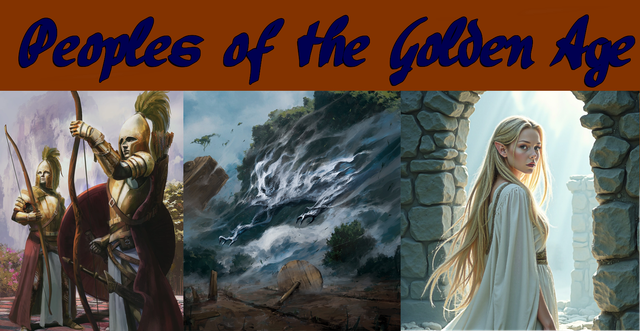
The Sidfir (High Elves)
Main Language: Sidfirian
In the first day of the Golden Age, the Sidfir were formed from the clay of Minadra, by the hands of Eruherion, who breathed life into its creation.
Immortal, graceful, and fair, the Sidfir stand taller than most of the other races, with the men rarely under 6’6’’ and the women seldom under 6’. They have fine features, pointed, leaf-shaped ears with grey eyes and fair hair. A magical race, the Sidfir leave no footprints where they tread, have exceptional low-light vision, but also have considerably more strength than a human of a similar size, the reflexes of a cat and can surpass a human in all five senses. Sidfir are not all mages, but those that are are the most powerful to have ever lived upon Minadra, some of the more legendary of whom have rivalled the First-Born for power. All Sdfir are naturally gifted in the use of magic and, as the eldest of the ‘Fairfolk’, Sidfir can communicate telepathically with one another.
On the other hand, Sidfir fertility is extremely low with siblings often born centuries apart. Sidfir also develop extremely slowly, with a Sidfir only being fully developed at 50 years of age.
In the Golden Age, the Sidfir spread across Minadra, building cities of beauty and grace, unsurpassed in the ages since. Their Capital was the white city of Telepimas though many other Sidfirian cities rivalled it for beauty. Telepimas became the heart of art, culture, magic and philosophy.
Despite this, the temptation of Pride lured many Sidfirians to rebel against their maker and embrace the ways of Brethnor, becoming the first Fomori.
In the first days of the Apocalypse that ended the Golden Age, Telepimas was utterly destroyed, with no trace remaining of her or her people. Occasionally artefacts from her are unearthed, although these are dangerous, as often afflicted by Fomorian curses as they are not.
After the destruction of the city, the Sidfir, Jinn and Graced First-Born, rallied and in the place now known as the Plains of Mordagor, the two armies met. The Battle of Mordagor was bloody beyond comparison with magic deployed in a manner never seen before or since. Few survived and in the aftermath, when the Fomori and other enemies had fled to the dark places, many Sidfir cities were left unpopulated and fell into gradual ruin before being lost to time.
The Sidfir population never recovered, though in the Silver Age of Minadra, they remained a significant force, guiding the development of the Silver Age races (the Turakindi, the Gwylfinn and the Valindor), while their Golden Age brethren, the Jinn, remained solitary beings. When the forces of Darkness rallied again, in the First Cycle War, the Sidfir led the Graced peoples in their resistance against the darkness.
Once again, the war decimated the Sidfir people. Those who remained retreated to three surviving holdings, Calaquesse, Lomendil and Gwaedhros. In the wake of the First Cycle War, many Sidfir sages were left feeling that Minadra is hopelessly doomed and that actual hope lies only in ascending to Nalmarin. Uniquely, Sidfir magic allows them to pass through the Vale of Mist (which they call the Nandehise), travelling to Nalmarin without first dying. Many Sidfir do so every year, leaving Minadra behind, never to return.
The Fomori
The immortal Fomori are one of the most terrible of the Cursed races who succumbed to the temptations of Brethnor though, thankfully, in the Age of Steel, their numbers are few. Fomori are most usually found acting as generals in the Hosts of Darkness or as agents.
The Fomori have all the strength, grace and magical ability of their Sidfir brothers and sisters and retain their natural beauty, though their eyes have gone from the characteristic Sidfir grey to deep, black pits, without a trace of white. Those who have looked into the eyes of a Fomor describe it as peering into a black, bottomless pit. As one of the most corrupted of the Fallen races, the Fomori project an aura of despair and darkness around themselves.
The Fomori see themselves as superior to all other races and are particularly known for their cruelty and sadism towards captured enemies or, indeed, their own underlings if the fancy takes them.
The Djinn
Main Language: Telepathic with no natural spoken language.
In the first days of the Golden age, Eruherion created the Djinn. In those first days there was little to set Djinn and Sidfir apart, but unlike the Sidfir the Djinn made no attempts to modify nature or build cities. Instead they lived, and continue to live, solitary lives. The Djinn show a preference for one of the four elements, Fire, Earth, Water and Air and tend to dwell in places where this element is present (the Djinn’s ‘place of power’), perhaps at the mouth of a river, on a high hill top, deep in the earth or in the cauldron of a volcano.
The Djinn are immortal, semi-corporeal beings, with their bodies seemingly partially formed of the element they are made up of. They are gigantic, often towering 20 feet or more above the landscape, when they choose to emerge from their place of power, which is rare. The Djinn are magical beings, with powerful abilities to manipulate the element they have an affinity for.
Due to their solitary nature, almost no Djinn have been born since the first days of the Golden Age, though many of the Silver and Steel Age races are of Djinn lineage. Preferring their own company, the Djinn do not typically engage with the affairs of the other races though can become stirred to action if their place of power is endangered.
Like the Sidfir, the Djinn are a race prone to pride and, prior to the Apocalypse, the Fire and Earth Djinn, in particular, often fell to the temptations of Brethnor becoming the creatures known as the Gorthaz.
In the deep darkness of subterranean caverns and the shadows of volcanoes, guarded by Fallen Djinn, the hosts of Darkness built up to spill out onto the lands. Always comparatively few in number, the Djinn were decimated by the Apocalypse. Those Djinn still loyal to Eruherion retreated to their places of power, while the Fallen Djinn did the same.
Few Djinn participated in the Cycle War, most remained in their isolated places, though those that did proved to be powerful, and terrible allies of the Silver Age races.
In the Age of Steel, Djinn still exist in places of elemental power though they are exceedingly rare and rapidly fading into myth. The days when every river had a Djinn are gone, remembered only by those few remaining Sidfir, who were born before the apocalypse.
The Gorthaz
It is almost impossible to tell if an elemental entity is a Graced Djinn or a Fallen Gorthaz, yet those that do take delight in destroying those Graced people foolish enough to enter their domain. In the deep, dark parts of the world, the Gorthaz have had a pivotal role in guarding the places the Hosts of Darkness have used to rebuild after the Apocalypse and the First Cycle War.
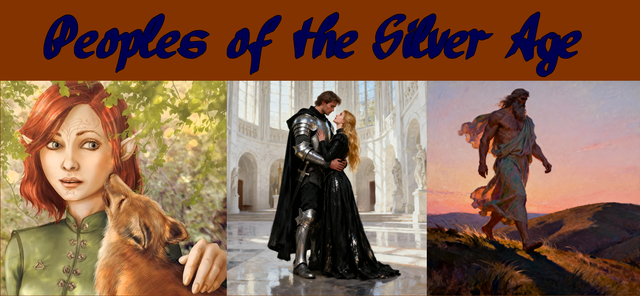
The Gwylfinn (Fae or Wood Elves)
Main Language: Sidfirian
The Gwylfinn, or ‘Fae’ as they are called by the Steel-Age peoples are the diminished descendants of both the Sidfir and the Jinn. While similar looking to the Sidfir (including the leaf shaped ears), the Gwylfinn are slightly smaller than their immortal cousins, with men standing at an average of 6’2’’ and women at an average of 5’8’’. Gwylfinn also have a greater variety of hair and eye colours, with a variety of darker shades being seen (though no Gwylfinn has black hair). Gwylfinn tend to show a natural aptitude for magic and as one of the line of ‘Fairfolk’, can communicate telepathically with one another.
While being immune to diseases and poisons the Gwylfinn are not immortal and will naturally age and die, though their average lifespan is around 7,000 years. While Gwylfinn still only reach their majority at 50 years, fertility is also higher than the Sidfir, with Gwylfinn able to produce a child around every 100 years, though after 5,000 years of age, they are usually no longer fertile.
Gwylfinn form affinities for particular types of nature, either the subterranean world (underworld Gwylfinn), the land (forest Gwylfinn), the water (water Gwylfinn) or the creatures of the sky (mountain Gwylfinn) and like-minded Gwylfinn will build small settlements in these regions. Gwylfinn mages are gifted in the control of familiars (associated with their form of nature) and illusion magic, which they use to shelter their settlements from unwanted intrusions.
Forest Gwylfinn can tread as stealthily as the Sidfir on land, Water Gwylfinn can swim indefinitely while floating high in the water, while Underworld Gwylfinn have exceptional low light vision. All kinds are every bit as graceful, though they lack the strength or magical prowess of the Sidfir.
The Gwylfinn will occasionally come together to form a Court to decide on collective action. Since the fall of many of their number to the temptations of Brethnor, the court of the Graced Gwylfinn has been known as the ‘Seelie Court’, while that of the Dark Gwylfinn is known as the ‘Unseelie Court’.
The Gwylfinn took on a major role in the First Cycle War, though in the years since, they have retreated to their secret settlements and are seldom seen in Minadra unless they wish to be. Few settlements are found near those of other races, most being found on rugged, uninhabited shorelines, in deep forests or in the depths of ancient cave systems.
The Unseelie
The Unseelie Fae are driven by an insatiable Envy of their immortal Sidfir progenitors. Gifted by a twisted form of Immortality by Brethnor, the Unseelie appear haggard and drawn, sacrificing their natural beauty for an eternity in the darkness.
Unlike their Seelie siblings, the Unseelie are not affiliated with nature, but can still control the dark and twisted creatures of Brethnor. The Unseelie have lost their capacity to create illusions, but have magic capable of cursing the ground they dwell upon and creatures that live upon it, spreading Brethnor’s filth throughout the natural world.
The Turakindi (Giants)
Main Language: Turakindian
Of the lineage of Djinn, and to a lesser extent, Sidfir, the Turakindi were the first race to try to truly tame Minadra and while their cities were never as beautiful of the Sidfir, the Turakinda were the first to clear forests, damn rivers and carve paths through the treacherous mountain paths.
Turakindi stand tall, taller than that of any of the other Silver age races, with men standing at an average of 12’ and women at an average of 11’. Turankindi are wiry, muscular creations and while they do not typically cast spells in the manner of the Gwylfinn or the Valindor, they have a unique and unparalleled ability to infuse magic into their creations, creating weapons and armour of the finest craftmanship. As descendants of the Djinn, over centuries dwelling in a place, the Turakindi will begin to take on the elemental nature of their environment.
The Turakinda live for around 2,000 years, reach their maturity at 50 years and are able to conceive again about every 50 years, once the previous child has reached maturity.
Prior to the Cycle war, the Turakindi built the most prestigious kingdoms of Minadra, building out over the ancient Plains of Morgador and the surrounding territories. Those that fell from Grace and became the Durgorim were tempted both by Pride at their accomplishments and Rage directed at those who dared to attempt to imitate their greatness.
During the Cycle War, the Turakindi formed the bulk of the forces of the People of Grace and paid a disproportionate toll for their involvement in the fighting. Many of the arts and construction techniques of the Silver Age Turakindi were lost. Cities were abandoned, forming ruins which can still be seen millenia later, faded but still standing despite the ravages of time - a testament to their ancient skills.
Small communities of Turakindi can be found in the ruins of their ancient cities or in other isolated communities, trying to relearn the techniques lost to time and rebuild their former glory. In some regions, Turakindi lead communities of humans or dwarves. All remain fundamentally opposed to the forces that destroyed their Kingdoms of Old.
The Durgorim
The Fallen Turakindi are creatures of Pride and Rage, hating both the natural world for its perceived imperfection and the creations of ‘Inferior’ races. The Durogrim are creatures of pure destruction, who have lost all of their creative potential in their fall from Grace though they have retained their ability to imbue magic in objects and many of the fouler curses, that unwary people fall trap to, are the creation of the Durgorim.
An Durgorim is typically stronger than one of the Turakindi, though coincidentally more uncontrollable and they form some of the more dangerous creatures in the Hosts of Darkness.
The Valindor
Main Language: North Valindorian
During the height of the Silver Age, the Valindor were the most numerous race in Minadra. They stand the same height as the Gwylfinn (an average of 6’2’’ for men and 5’8’ for women) though they lack the leaf shaped ears and in the world today are easily confused with humans (who are their descendants). Valindor are the direct descendants of the Sidfir, with no Jinn blood and like their forefathers are immune to diseases and poisons, though similar to the Gwylfinn are not immortal and will naturally age and die, though their average lifespan is also around 700 years. While Gwylfinn still only reach their majority at 50 years, fertility is also higher than Sidir or Gwylfinn, being able to produce a single child around every 30 years, though after 450 years of age, they are usually no longer fertile. Similar to Gwylfinn and Sidfir, the Valindor are typically a fair race, though they have all the hair and eye colours seen amongst humans.
Valindor lack the grace of the Sidfir, though they possess their strength and are typically much stronger than any Silver or Steel Age race with the exception of the monstrous Tarakindi. The Valindor produce some offspring with strong magical potential though these are few in number and are not as powerful as those with Sidfir or Gwylfinn heritage, though with the exception of the Firindor, no Age of Steel Mage can usually equal a Valindorian.
During the Silver Age the Valindor spread out across the fertile plains of Minadra, building cities that reminded the Sidfir who saw them of the cities of the Golden Age, though they were never quite able to capture the same glory. More so than any other race of the Silver Age, the Valindor were ready to do battle against the Host of Darkness. Alongside art and culture, the Valindor have always pursued the military arts, though violence is always restrained by a strict code of Justice, Mercy and Honour.
Like the Gwylfinn, the Valindor fought in the First Cycle War and like the Gwylfinn took catastrophic losses from which they have never recovered. Cities that were not destroyed in the fighting were abandoned to fall into ruins. The Valindor, however, did not despair of the world. While the Valindor withdrew to their more remote strongholds, in these citadels they have found a sense of strength and purpose, celebrating the beauty of Eruherion’s creation while remaining steadfast and ready to take up arms again in the defence of the Graced peoples.
Of particular significance to the realms of the Steel Age peoples is the Kingdom of Thangolad and the great citadel of Caryandor which stands vigil against the gathering darkness in the North. When the Second Cycle War comes to Minadra, it will first break upon Caryandor.
The Thaurindor
The Thaurindor form the elite divisions of the Host of Darkness. They are physically more muscular than Valindor with bestial features and skin that ranges from a dark, burned appearance to pallid and corpse like.
The Thaurindor are creatures of Rage and have sacrificed most of their intellect, developing a massive bestial strength in the process.

The Firindor (Fading Folk or Low Elves)
Main Language: Firindorian
The Firindor, who are often called ‘Low Elves’ by the other races are the diminished descendants of the Forest Gwylfinn and the youngest of the ‘Fairfolk’. While similar looking to the other Fairfolk (including the leaf shaped ears), the Firindor are not much taller than humans with the men standing an average of 6’ tall and women an average of 5’7’’. Unlike the other Fairfolk, the Firindor have all eye and hair colours one might see amongst humans although they remain pale in complexion. While the Firindor do not show an especially strong aptitude for magic (though greater than other Steel Age races) they have retained the ability to communicate telepathically with one another and can still move as silently as their Forest Gwylfinn ancestors, leaving no trace of their passing.
While suffering little disease, the Firindor are not immune to poisons with an average lifespan of only 350 years. Like other Fairfolk races, Firindor grow up slowly and reach their majority at 50 years, though Firindor fertility is high and they are able to produce a child around every 4 years, becoming infertile after around 250 years.
Firindor retain much of the grace of their Fairfolk counterparts, though are no stronger than a human. Like the Forest Gwylfin, the Firindor prefer to remain in deep woodland, building their communities there. These tend to be larger than Gwylfinn communities and the Firindor will clear land for farms, though they almost always leave several miles of woodland as natural camouflage to hide their settlements. While lacking the Gwylfinn aptitude for large-scale illusionary enchantments, when they do take the time to train in the magical arts, Firindor tend to excel at illusion magic.
Firindor are more likely to be found near the settlements of humans and other peoples and are willing to trade and negotiate. Armed conflict between Firindor and humans tends to be the result of logging Firindor ‘barrier woods’ (Most recently between the Firindor Kingdom of Elarion and the Arvenses in the War of Gallus Nasica in 3803 AS).
The Firindor are known as bow skirmishers, often employing ‘hit and run’ tactics in the woodlands they call home. They also have some of the finest, heavy spearmen of the Steel Age races, fighting in dense, well coordinated formations. Firindor Spearmen wear heavy mail hauberks and helmets (usually kettle or ridge helmets). They carry large kite shields in their offhand, while each warrior also carries a long spear and sword (most commonly a falchion). These troops are only encountered, however, if the Firindor are forced into a pitched battle, which they try their best to avoid.
While Firindor settlements are found throughout the vast Tuarethil Forest, their cities are mainly located South of Lake Calmenen. The most prominent of these are the cities of Nimrithil and Calenoril, and the Kingdom of Elarion.
Sample Archetypes: The Ranger, The Diplomat, The Steward
Gurzat (orcs)
Gurzat is a general term for the hordes of ill-disciplined and frequently cowardly, deformed creatures that make up the bulk of the Host of Darkness. Believed to be twisted Firindor and Humans, Gurzat prefer darkness to daylight and, where it is an option, will time their attacks for after nightfall. Gurzat have poor armour and weapons, are slightly smaller than their Graced cousins, are not especially intelligent, though they are cunning. Gurzat are filled with an incredible capacity for cruelty and are well-known for torturing and devouring anyone unlucky enough to fall into their clutches.
The Gundrukan (dwarves)
Main Language: Gundrukanian
The Gundrukan (meaning stone raisers in their own language) are the oldest of the Age of Steel races, having been born to the world on the eve of the Cycle War and are seemingly not of the lineage of any of the earlier races. The Gundrukan, while small in stature, are known for their creativity and adventurous spirits, building impregnable bastions in their mountain homes that burrow as deep into the mountain sides and they extend above them.
With their affinity for construction, the Gundrukan attracted the notice of the Turakindi in the final days of the cycle war, who hoped that their smaller brethren would be helpful in preserving the legacy of their guardianship, though over the course of the first millennium of the Age of steel, the relationship between the two peoples soured due to the perception, on the part of the Turakindi, that the Gundrukan were thieves intent on stealing their ancient techniques, while conversely, the Gundrukan began to feel that the Turakindi saw them as little more than slaves.
Gundrukan males stand an average of around 4’6’’ tall, while the women stand, on average around 4’4’’. Gundrukan are stoutly built, muscular and strong for their size. Like the Turakindi, Gundrukan magic tends to revolve around enchantment of magical objects and they fashion the finest weapons and armor of the Age of Steel. The lifespan of one of the Gundrukan is around 210 years. They reach their majority at around 40 years of age, produce a child around every 2.5 years, and are generally past reproductive age at around 150.
The Gundrukan live in several large and well defended cities in the mountains on either side of the Morgador plains and the old Turakindi realms. These cities usually go as deep into the mountain as they extend below and are often the gateway to massive and complex mining operations. The most prominent of these are Fjallborg to the West of the plains and Stormfjellheim to the East. From these cities the Gundrukan frequently mount expeditions to the ancient Turakindi cities in search of lost treasure and technology. This often brings them into conflict with the remaining Turakindi.
In combat, the Gundrukan tend to favour a mixture of light infantry armed with javelins and crossbows in support of densely packed formations of heavy infantry militia.
In their quest of treasure and secret knowledge, some Gundrukan have succumbed to the temptations of Brethnor, often brought down by their Avarice.
Sample Archetypes: The Steadfast Defender, the Fortune-Seeker, the Craftsman/woman
Fallen Gundrukan and Troglodytes
Most Fallen Gundrukan have retained largely similar physical characteristics to their Graced cousins and are equally adept in the same areas (save for a tendency to place terrible curses rather than benign enchantments). These creatures are known as ‘Fallen Gundrukan’ though a few have become twisted into something entirely different - the Troglodytes of the deep places of Minadra.
Those Gundrukan who have become Troglodytes have lost most magical and creative capabilities. Their bodies have become twisted, hunched and animalistic. Their noses have widened and expanded while their eyes have shrunk. Gundrukan craftsmanship is reduced to a mere parody with troglodyte forces armed with but a few crude weapons and wearing only the simplest of clothing. They are, however, terrifyingly strong, and while their sight poor, can track by scent and sound, making them terrible adversaries in the deep places of the world.
The Humans
The first humans were born from the lineage of the Valindor and dwelt initially in the Plains of Tridanu. More curious and adventurous than any race before them, the humans spread from their birthplace and can be found from the frozen lands of Ledosever in the far north, to Varadaban by the Vale of Mist in the South and from Truynum Gorleuini in the West to far beyond the Eastern reaches of the Kingdoms of Jugkrai.
Humans are varied in their appearance and culture. They are generally divided into six main groups (named by scholars at the University of Segestia), who speak similar languages/dialects:
Eldarions: The first humans.
Borearions: The Northern peoples.
Oriarions: The Eastern peoples.
Austarions: The Southern peoples.
Occidarions: The Western peoples.
Sylpharions: Those who speak the Sylpharim language.
The Prathmava of Tridanu (Eldarions)
Main Language: Central Valindorian
The Prathmava see themselves as the first humans and still speak a variation of the ancient ‘Central Valindorian’ language. They are tall people, tanned in appearance with blonde, or reddish hair and fierce, pale eyes. They live a nomadic lifestyle in the plains of Tridanu where they raise the finest horses in Minadra. They sell these mounts to many of the other human peoples and in return purchase weapons and armour. The Prathmava nominally owe loyalty to their King, Ardaros, though in practice the tribes only assemble under the King’s banner in times of peril for all. The Prathmava are unusual in that, like the Sylpharim, their women fight alongside their men. The Prathmava are born to the saddle and are the finest horsemen in all of Minadra.
The Prathmava are known for wearing colourful caftans, embroidered sashes and felt hats. Prathmava knights cover themselves in heavy chain, scale or lamellar armour.
Sample Archetypes: The Horse-Lord, the Herdsman, the Shieldmaiden
The Hrankrajanie of the Divided Kingdom of Jugkrai (Borearions)
Main Languages: North Jugkaraian in the North, South Jugkraian in the South.
Many centuries ago, the Kings of Ledosever became aware of orcs in the Rzhagomir mountains. Concerned about them spreading South, they sent message to the Rex of the Regnum Arventia who sponsored an expedition to establish fortresses along the Southern border of the Rzhagomir range. The land to the South, was good, however, and many settlers followed, eventually establishing, around 600 years ago, the ‘Kingdom of Jugkrai’.
Jugkrai quickly eclipsed the motherland in wealth and prestige. Though in the last fifty years the country has fallen into a dynastic civil war between branches of the ruling Sviatolev dynasty. Few realise that the Northern Sviatolevs have fallen under the sway of Vaurinth, who preyed upon their Envy and Lust for power, though the Holy Orders that once held the border castles have nearly all aligned with the South. As it stands, the Southern Sviatolevs are led by Prince Eruherislav, while Prince Voysislav leads the Northerners. Many long, brutal battles and sieges have been fought, with no end in sight.
The Hrankrajanie have been influenced by the fashion of the Treuring Kingdoms and their men usually wear a long, woolen tunic and hose, while often also wearing a wide, intricately embroidered belt. Women will usually wear a dress, which, depending upon the wealth and status of the wearer can be colourfully dyed and intricately embroidered. For the most part, the Hrankrajanie are a fair, ruddy people, often with blonde hair and blue eyes.
The Hrankrajanie infantry fight in a shield-wall, much like the Ledosevertsy, though they prefer the kite shields and round shields of the Treuring to the square shields of the Ledosevertsy. Due to the ongoing war, professional soldiers and mercenaries are common in the shieldwall, as well as forming companies of archers. These soldiers wear mail and usually either a spangenhelm or conical helmet. Hrankrajanie Lords can also draw on feudal levies and armies may also have a body of poorly armed feudal levies armed with spears, short bows and farming implements. Like the Treuring, the knights are the core of the army and are every bit as fierce as their Western cousins. Nobles wear colourful surcoats over their mail, mostly to identify themselves in battle.
The Hrankrajanie are great castle builders and still has many prosperous towns in the South, though many areas have been devastated by the war between the Sviatolev princes. Beggars and refugees are a common sight on their streets.
Sample Archetypes: The Paladin, the Mercenary, the Disinherited Noble
The Ledosevertsy of the Kingdom of Ledosever (Borearions)
Main Language: Ledoseveran
Ledosever is a harsh frozen land with long, dark winters where the rivers freeze over and short summers. It is an unforgiving land though starkly beautiful with mysterious lights that shimmer in the skies in the depth of winter.
The people, meanwhile, are known for their warmth, hospitality, storytelling and kindness towards strangers. The Ledosevertsy make their homes from timber, digging them partially into the earth to provide natural insulation in the harsh winter. Monasteries are a common sight in the land and often form the seed of a small town. The Eastern border of Ledosever, the Vostoritsa river, is dotted with small, wooden fortifications, which they call ‘Strazhovitsa’ (Sentinel Towers) to guard against the Host of Darkness.
The Ledosevertsy are tall, often blonde, ruddy people. They tend to favour simple woolen clothing supplemented with furs against the biting cold of their homeland. Fur hats are almost universally worn in winter.
The Ledosevertsy tend to fight in a shield-wall. They carry rectangular shields decorated with civic symbols and images of Saints. The body of the shield wall itself is a mixture of their tribal, warrior class (whom they call the ‘Voiny’) and less well armoured militia. The Voiny tend to wear a mixture of scale or mail armor, or sometimes just a thick gambeson. Helmets are usually either spangenhelms or conical helmets. Weapons are usually, a spear and a sword/axe though archers are also a common sight. While the Ledosevertsy have few cavalry, those whom they do are highly regarded lancers. These troops form the elite, mounted companions of the Nobles and are known as the ‘Sviatodruzhina’ or ‘Holy Companions’.
Sample Archetypes: The Paladin, the Storyteller, the Warrior Monk
The Samotrekan of the Samotrekan Principality (Borearions)
Main Language: South Jugkraian
South of Jugkrai are a people known as the Samotrekan. Until the civil war in Jugkrai, the Prince of Samtrekan pledged fealty to the King of Jugkrai, though when war started, the Prince decided not to participate and the Samotrekan have been left to their own devices for the past 50 years. The principality is a fertile, densely populated land with many cities and castles along the coasts and rivers that has grown wealthy through trade which they ply on the coasts, riverways and Bekhazun Lake in clinker built cogs, often guarded by a detachment of marines.
The Samotrekan are tall people with reddish hair and blue or green eyes. They dress similarly to the Ledosevertsy - the men usually wear a long, woolen tunic and hose. Women will usually wear a dress, which, often with bead jewelry to ornament it.
The Samotrekan do not levy peasants into their armies but rely on the wealthiest amongst the nobles and abbots to raise and maintain ‘Banners’ of professional soldiers when necessary. This means that their armies tend to be mostly cavalry, with large bodies of lightly armoured cavalry armed with spears and javelins, screening a heavy body of knights. Those infantry they do field tend to be of high quality. Kite shields, mail or gambesons, spangenhelm or conical helmets are all commonly used. Surcoats are usually in the heraldic colours of the noble or abbot who raised the ‘Banner’. Infantry will usually be either bowmen or heavy spears.
Sample Archetypes: The Abbot-Knight, the Veteran, the Marine
The Arvenses of the Regnum Arventia (Oriarions)
Main Language: Arventian
The Regnum Arventia is a large, peaceful Kingdom in the South of Minadra. The people there are generally olive-tanned skinned with darker hair and eyes than their Northern counterparts who live in well-planned cities studded with soaring domes and marble pillars. The Arvenses are an industrious people, producing large amounts of luxury goods that makes life within the towns and olive groves of the Regnum is the envy of many.
Because of the fact the Regnum has faced few threats, the Arvenses are poor castle builders, tending to build little more than an earth rampart topped with a low wooden (or occasionally) stone wall in places where they feel a defensive structure is needed, treating them as temporary affairs, rather than structures built to last the ages, as their cities are.
The Arvenses wear brightly coloured dresses and tunics (white is a favourite colour, though hard to keep clean), embroidered with intricate geometric patterns along with small fur caps. Most Arveni men choose to be clean shaven. The Arvenses prize learning and their capital of Segestia is well known for its University.
The industrious nature of the Arvenses has brought them into conflict with the Firindor in the past (most recently in the War of Gallus Nasica in 3803 AS), when they have encroached on the edges of the Taurethil Forest, though generally they are a peaceful people.
Unlike many of the Northern Kingdoms that rely on levies in warfare, the Regnum’s (small) army is made up entirely of professional soldiers who carry a large oval shield and are issued with mail or scale armour, a ridge helmet, throwing darts, a long sword and a spear. Screening the main body of troops, the Regnum will employ skirmishers armed with javelins or compound bows. Cavalry come in a variety of forms from light horse archers through to heavily armed cataphracts in banded plate and scale. Shields are painted in regimental markings while troops are trained to respond to trumpet signals and follow their regimental dragon standard which is carried next to the ‘Ordinarius’ who commands the Regiment. While often inexperienced, the Regnum’s soldiers are well equipped and have always given a good account of themselves in battle.
Sample Archetypes: The Tactician, the Veteran, the Scholar
The Skeroparalioi of the Skeroparalia (Oriarions)
Main Languages: Arventian in the Southern towns, South Jugkraian in the Northern towns
The Skeroparalioi live on the coast North of the Regnum Arventia and were, at one point, seen as the same people as the Arvenses, both living under the rule of the Regnum Arventia. There is, and has only ever been one long, lonely coastal road linking Skeroparalia with Arventia and this led to the Skeroparalioi diverging from their Southern neighbours in language and culture, though to look at them, the two peoples appear much the same.
Once, Skeroparalioi was a land of great cities, much like that of Arventia, but the land suffered greatly during the war of Arventian Succession just over 200 years ago and the Skeroparalioi now live mostly in small, but heavily fortified fishing towns and villages that cling to the coast. There is no central ruler, rather the land is divided up between many petty Kings and Princes.
While Arventia once ruled over the Skeroparalioi, the wounds of the war run deep and the Arventians have not sought to reimpose their rule. The Skeroparalioi tend to view the Arvenses as the architects of Skeroparalioi demise, while, in turn the Arvenses see the Skeroparalioi as rebels both against the Regnum and Eruherion.
The Skeroparalioi fight in much the same manner as the Arvenses though with more skirmishers and less cavalry (and no cataphracts). Skeroparalioi foot soldiers are organised as militia for their respective towns. They are not as well equipped as their Arvensian counterparts, usually carry javelins in place of war darts, favour the spangenhelm over the ridge helmet, and, since they are required to purchase their own gear, often don’t wear mail, relying only on their helm and shield for protection. These shields, rather than bearing regimental insignia, are decorated with the insignia of their home town.
Sample Archetypes: The Citizen-Soldier, the Spy, the Sailor
The Mitradaevaka of the Empire of Varadaban (Austarions)
Main Language: Mitradaean
The Mitradaevaka (or ‘Friends of the Ancient Fair Ones’) migrated in Millenia past to settle around the last homeland of the Sidfir and the Vale of Mist. The Mitradaevaka view themselves as the friends, pupils and protectors of the Sidfir. The Mitradaevaka are an honest and plain people, who teach their children to value truth above everything and have a deep respect for history and tradition.
The Mitradaevaka have olive-tanned skinned, curly dark hair and dark eyes. The men wear long, brightly coloured robes over trousers favouring yellow and purple dye (where it can be afforded). Women tend to wear long flowing dresses and bejewelled headwear and heavy earrings.
The Mitradaevaka build cities dotted with painted domes, gardens and water features. While a pale comparison, they are inspired by the Sidfir cities of old.
There is no knightly class amongst the Mitradaevaka, though like the Arvenses they make extensive use of professional soldiers. Most Mitradaevaka nobles and soldiers fight mounted, either as cataphracts on horse or camel or as lightly armored horse arches. Cataphracts usually also carry bows, along with their lances, curved swords and small round shields. Some guards will also fight in the manner of Arvensi infantry, with a spear, sword or mace, and a large round shield. These men form the backbone of the infantry which is otherwise made up of poorly armed levies. Occasionally, a Mitradaevaka army will also field one or two of the colossal monsters known as ‘elephants’ which they drape in heavy armour and use to trample their foes.
Sample Archetypes: The Scholar, the Noble Warrior, the Veteran Soldier
The Eahamingas of the Kingdom of Eaham (Occidarions)
Main Language: Eahamish
The Eahamingas are the descendants of a tribe of Treuring who crossed the Sturmsund Straights 1,000 years ago, at the same time as the Stromfolc, continuing further west along the coast, settling at the mouth of the River before spreading South over time to the Northern fringes of the Varadaban Empire.
Close contact with the Gundrukan of Fjallborg over the centuries has given the Eahamingas a deep interest in metalwork and their brooches and other jewelry are prized across Minadra while their swords and war axes are also regarded as being of an especially high quality.
The Eahamingas appear much like the Treuring (tall, powerfully-built people, often with blonde or red hair and blue eyes) and dress similarly, but with more jewelry (men usually wear a long, woolen tunic and hose. Women wear dresses, which, depending upon the wealth and status of the wearer can be colourfully dyed and intricately embroidered). The Eahamingas also tend not to fight mounted (though they do use some light cavalry), instead forming a dense infantry shieldwall of men armed with spears and javelins. Noble Eahamingas and their knights (whom they refer to as ‘Housecarls’) fight on foot, usually carrying a huge two-handed axe and a sword and often begin a battle by challenging their opponents to honourable, single-combat between the armies.
Eaham is home to many monasteries dedicated to the worship of Eruherion. These are peaceful places, often filled with beautiful tapestries and illuminated manuscripts.
Sample Archetypes: The Housecarl, the Chronicler, the Warrior-Monk
The Stromfolc of the Kingdom of the Strommark (Occidarions)
Main Language: Stromish
1,000 years ago, two Treuring tribes migrated across the Sturmsund Straights, one of whom went on to found the Kingdom of the Strommark. The Stromfolc are skilled sailors and shrewd merchants whose shallow-bellied, swift ships trade along the coasts of Minadra from Varadaban to Ledosever. These ships typically have a single square sail and a bank of oars.
The Stromfolc appear much like the Treuring from whom they are descended: tall, powerfully-built people, often with blonde or red hair and blue eyes. In battle they prefer to form dense shield walls with a mixture of kite shields and smaller round shields. When charging, or receiving a charge, a Stromfolc battle line will hurl a volley of thrown axes and javelins before closing.
Stromfolc men usually wear a long, woolen tunic and hose. Women wear dresses, which, depending upon the wealth and status of the wearer can be colourfully dyed and intricately embroidered.
Sample Archetypes: The Warrior-Sailor, the Merchant, the Shield-Bearer
The Three Kingdoms of the Treuring (Occidarions)
Main Language: Treurish
The Kingdoms of Schwarzdorn, Drachenfels and Eisengrund are the home of the Treuring. The Treuring are a tall, powerfully-built people, often with blonde or red hair and blue eyes. They are a settled people who build cities and castles along the coasts and rivers of their domains and farm the land extensively
Treuring armies tend to be made up of a core of fierce knights and well-equipped nobles (usually wearing mail hauberks with spangenhelm, nasal helmets or very occasionally an enclosed helm) armed with lances, large kite shields and a variety of other hand-held weapons. These men are supported by professional crossbows and heavy soldiers and, often, a large body of poorly armed feudal levies armed with spears, short bows and farming implements. Nobles wear colourful surcoats over their mail which both helps protect from the heat and identify the wearer
Treuring men usually wear a long, woolen tunic and hose. Women will usually wear a dress, which, depending upon the wealth and status of the wearer can be colourfully dyed and intricately embroidered.
Sample Archetypes: The Knight Errant, the Lady of the Court, the Mercenary
The Pellmorwyr of Truynum Gorleuini (Sylpharions)
Main Language: North Sylpharimese
The Pellmorwyr people arrived to the West of the Republic of Republic of Bryncaer around 2,000 years ago and while they had once been a seafaring people, upon landing on the shores of the place now known as Truyum Gorleuini, the Pellmorwyr burned their ships and settled.
The Pellmorwyr are a tanned people, usually with dark hair and eyes. Their men trim their beards into long, drooping moustaches. Their tunics, dresses and cloaks are often woven in intricate plaid patterns and while they are happy to trade with passing Stromfolc, they rarely venture far from shore in their fishing vessels and, aside from the odd wandering troubadour, tend to keep to themselves in the isolated castles and towns of their peninsular.
After centuries of isolation alongside the Republic of Bryncaer, the Pellmorwyr have taken to speaking the Sylpharim language. Poetry, music and song are valued highly in Pellmorwyr culture. They do not have a single Kingdom, rather a number of Petty Princes vie for power and internecine warfare is relatively common.
Bryncaer knights largely arm themselves in the manner of the Treuring, carrying lances and kite shields and wearing long mail hauberks, though they favour the ridge helmet for head gear. They ride short, rugged horses, smaller than those in the south. The rest of their armies are typically made up of lightly armed levy spearmen and and large numbers of archers who pepper the enemy with arrows at the start of a battle before retreating behind the lines of spears. Bryncaer archers are well regarded, being seen as the best human marksmen in Minadra and use the longbow extensively.
Sample Archetypes: The Ranger, the Knight Errant, the Troubador
Gurzat (orcs)
Gurzat is a general term for the hordes of ill-disciplined and frequently cowardly, deformed creatures that make up the bulk of the Host of Darkness. Believed to be twisted Firindor and Humans, Gurzat prefer darkness to daylight and, where it is an option, will time their attacks for after nightfall. Gurzat have poor armour and weapons, are slightly smaller than their Graced cousins, are not especially intelligent, though they are cunning. Gurzat are filled with an incredible capacity for cruelty and are well-known for torturing and devouring anyone unlucky enough to fall into their clutches.
The Sylpharim (Skyborn)
Main Languages: North Sylpharimese in the Bodeira Mountains. South Sylpharimese in the Grey Mountains and the Ambarones.
The Sylpharim are of the line of the Air Djinn and mountain Gwylfinn and like most of the races of the Age of Steel, have limited magical aptitude, although they have retained a supernatural ability to tame birds and where they have taken the time to perfect a magical craft, tend to show aptitude in the fields of Domaturgy (the binding and control of wild animals), which the Sylpharim themselves call ‘Cuivethir’, and Aeromancy, which the Sylpharim call ‘Súlendur’.
Sylpharim look much like humans, though they also have a large set of wings sprouted from their backs, usually feathered in either black or white, though a variety of brown shades also exist. Sylpharim can fly and are extremely agile, even when standing on the ground, having lighter bones than most other peoples. They are also slightly smaller than humans, with the men standing an average of 5’7’’ tall and the women and average of 5’2’’. This in turn means they don’t tend to be especially strong and can break bones easily. Sylpharim live and develop in much the same manner as Humans.
The Sylpharim view themselves as a free people and their society is unusual in that there are no noble classes. Rather, their citadels, built in the high places of the earth, are governed by elected officials. Also, unusually, Sylpharim women are found in their militia and warbands.
Sylpharim warriors tend to wear only light armour and will attack an enemy force by flying above it and peppering it with thrown or dropped weapons before deciding to either retreat or, if the enemy are sufficiently disorganised/demoralised, diving on them to engage in melee combat.
Perhaps because of their descent from the Air Djinn, despite their freedom loving nature the Sylpharim have not fallen into darkness any more than the other races born in the Age of Steel.
Sylpharim are divided into two groups, the Northern and Southern Sylpharim. The Northern Sylpharim founded the Republic of Bryncaer, where most Northern Sympharim still dwell, while their Southern brethren founded the twin Republics of Ardbenn Solas and Binn Nechtain on either side of the plains of Mordagor and the ruined cities of the Turakindi.
Sample Archetypes: The Liberator, The Magpie, The Renegade
Harpies
Those Sylpharim who have succumbed to the temptations of Brethnor, are known as Harpies. Harpies have descended closer to a bestial form, sometimes losing their arms or acquiring talons or beaks. They can be a terrible threat to travellers who inadvertently wander into a place where they have made a home.
The Vinyalie
Main Language: None. Gifted at language acquisition.
The Vinyalie (or ‘People of New Growth’) stand as creatures of endless renewal and curiosity. First seeded from the Gwylfinn, the Vinyalie are travellers first and foremost, going out amongst the world and its peoples to tell tales and sing forth the truths of creation.
They take a humanoid form typically, though the plant-like structures of their bodies can lend themselves to abnormal shapes as well. Each Vinyalie is formed from a heart, a seed-like thing perhaps four inches in diameter. From this seed, vines form in sinuous structures bristling with leaves, flowers, thorns, and otherwise. Their faces house facsimiles of human sensory organs, and often they will shape their bodies to possess some abnormal traits and stylings. They possess uncanny senses, able to see in the darkest night and take in all that the world has to offer in its fullest.
The Vinyalie are theoretically immortal, though in reality they undergo a renewal approximately every 40 years. In this renewal, the Vinyalie recedes into their seed pod and emerges with no clear memory or continuity of identity with who they were before. They may remember stories, some language, and sensations from past lives, but for all purposes, they are a new person who could pursue entirely new tastes and interests. New seed pods take multiple years to create, and involve the meeting of multiple Vinyalie to contribute to its creation.
There are small communities and conclaves of Vinyalie, but typically they are found interspersed among the other peoples. They are often itinerant, though sometimes they can find a certain attraction to a certain place where they prefer to remain. They universally love to tell stories and produce art of all sorts, with great ballads and works of beauty in their wake.
Sample Archetypes: The Bon-Vivant, The Story-Teller, The Pleasure-Seeker
The Draughlith
The Draughlith (meaning ‘Withered Spawn’ in the language of the Gwylfinn are the result of Vinyalie whose beings have been corrupted by Hubris and other temptations of Brethnor. Their bodies bloom blackened thorns, pallid fungi and trailing, entangling creepers slick with mildew and other filth. On the breeze they carry the scent of damp soil, rot and mould.
Like the Vinyalie, the Draughlith renew every 40 years, burying their twisted seed heart in a mound of slain people and other creatures. They emerge with no clear memory of the past but with renewed hatred for the foes of their past life and seething vendettas to pursue. The Draughlith do not typically appear amongst the armies of Vaurinth but serve his will by spreading fear and suffering, terrorising lonely stretches of road or isolated farmsteads.
The Beastfolk
Over the past century a tiny percentage of human births have, seemingly randomly, been of creatures which seem to be half-human and half of some other animal (the exact animal varies by region). Often ‘Beastfolk’ children are killed, sometimes a parent attempts to raise them themselves. These creatures are generally shunned in human societies even though (at the insistence of the Mages) nearly every Court on the continent has offered them protection. A few have found their way into their own communities, usually in the wild places where few humans will interfere with them.
Sidfir and Gwylfinn scholars believe that this process is result of Eruherion’s creation of a new race of people, the first of the Age to Come. As such, Beastfolk are seen by many as heralds of the end of the Age and the coming of a new Cycle War.
Beastfolk are believed to live short lives, probably no more than 50 years, though relatively little is known of them or indeed, whether they are a single race or many. Typically, Beastfolk are seen as more physically robust than humans, though less intelligent and almost incapable of magic, though only time will tell how true these beliefs are.
As the Beastfolk are such a new race, no twisted form of them exists so far, though their maltreatment by humans has led to no small number falling victim to the lies of Brethnor and Beastfolk are often found scattered amongst the ranks of Gurzat in the Host of Darkness.
Sample Archetypes: The Outsider, The Noble Savage, The Village Guardian
The Scale Folk of the Morgador
Deep in the most blasted regions of Morgador, hidden amongst the towering ruins of long-abandoned Turakindi cities, live a few small villages of Beastfolk known as the ‘Scale Folk’. Unlike most other groups, they have been visited by Valindor mages, who have brought back a sketchy picture of what these people are like.
The Scale Folk have long serpent-like tails, no legs and snake-like faces. They are suspicious and defensive people by nature who will attack those who trespass too close to their settlements but otherwise have never sought trouble with the Nations on the fringes of Morgador.
The Scale Folk have not only survived, but thrived in the harsh climate of central Morgador with its scorchingly hot days, freezing nights and lack of water. The Scale Folk have excellent eyesight, seemingly even able to ‘see’ heat, are highly attuned to vibrations in the sand and rock around them, and possess a venomous bite.
They wear little heavy armor but will use boiled leather where they have access to it. Their small communities don’t tend to employ much metallurgy and most weapons, whether spears or arrow heads, tend to be tipped with stone rather than iron.
Thread Rules
In short, just have common sense and be courteous to your other RPers and we will have no problems! But if you want specifics...
Decisions
My word and the word of any Co-GM is binding. If you don’t like a decision, you can, of course, ask for us to reconsider it. Once. If we made a decision you don’t like, complaining for pages and pages is not going to endear you to anyone. Not me, not the Co-GM and not your fellow writers.
On that note, I intend to run this thread as an anarcho-communist cooperative. This is an unnecessarily complicated way of saying that my word DOES NOT overrule theirs. If there is an appeal and a dispute amongst the Co-GMs we will take a vote on the matter.
Post Quality
I don’t have a problem with short posts but please use proper spelling (I don’t care what regional variant), grammar etc.
Ideally (this is advise, rather than a rule) also try to include a 'hook' when you write a post, which is to say something that gives other people something to respond to. If your post is something along the lines of 'Bilbo Baggins stayed in his room and read a book while the world was ending', don't be surprised if nobody responds to you.
Posting Commitment
Nothing is worse than making an RP only for it to die. Please try to make at least one post every 48 hours or so. If you find yourself unable to post, please let me know in the OOC thread or Discord.
If it looks like you've abandoned a character I might decide to kill them off. Killing characters is great for the plot, makes the villains seem more of a threat! So if you want to avoid it, communicate.
Posting Speed
On the flip side, blitz posting can also be infuriating. So, especially during the important scenes, I recommend giving your fellow players a reasonable time to make a reply. We all have real lives.
That being said, if someone leaves everyone waiting for an annoying length of time, and the rest of the writers are rearing to go, it’s probably reasonable to continue. Talk to me or one of the Co-OPs and we’ll work a way through!
OOC thread Manners
Nothing annoys me more than bad manners on an OOC thread/the Discord. Swearing, passive-aggressive sniping or any other rude behaviour are not welcome. You will be warned once. If you can’t control yourself, slow-downs, temporary bans etc. may be applied on the Discord. If you continue to cause problems these may be made permanent. But we really, really don’t want to do that, so play nice!
IC thread Manners
Remember, we are writing a story together, not playing to win.
Character Death
Player death is possible in this RP, though it will be avoidable if you play to your character's strengths, work with your team and don't do anything too stupid.
As previously mentioned, if you abandon a character, I may decide to kill them off.
Godmodding
Within the context of this thread, some enemies will be flagged as major threats while others can be treated as mooks (Fallen, Age of Steel races are the mooks). It will be clearly communicated which is which and which ones will murder you and wear your spleen as a necklace if you try to tangle with them. Writing that you instantly overcome a dangerous enemy is not okay and I will ask you to change that. Also, if I communicate that there are too damned many mooks for you to deal with and you ignore my prompt, I will give you the same treatment.
Note that I reserve the right to write that your character has taken an injury.
Banning Players
I really don’t want to be doing that but reserve the right to do so if you cannot follow the (hopefully, rather simple) rules above.
There are a few rules to be mindful in creating a character app.
First, we are only allowing you to app as an Age of Steel Race. This is to avoid a character being too powerful. You will encounter NPCs from Silver and Gold Age races though.
Second - No mages unless the Co-OP team know you well, trust you to write well and trust that you understand how magic in the setting works. In practice, if you want to write a mage, we’ll get into a huddle and, if all three of us agree we are happy for you to do that, we’ll give you the go ahead. Show us you understand and we are likely to allow it.
Third - If you’re writing a female character who bucks gender norms for this setting (see the section on Gender relations), try to write it believably. Characters in literature such as Éowyn in Lord of the Rings or Brienne of Tarth in a Song of Ice and Fire are ones who work. They have a reason to act, they struggle, they overcome patriarchal structures through guile, perseverance or sheer bloody-mindedness and carve their own path.
Fourth - Lets keep the names thematic. I really don’t want someone called ‘Blaze Slaughterfest’ or ‘Amethyst Starbright’ randomly strolling into a scene where everyone else has a thematically appropriate name. They break immersion. To help you along, I’ve included some name generators and info to help you construct a name for the different races, below. Most people will use a Patronymic/Matronymic style of naming (e.g. <son’s name> son of <father’s name>/ <daughter’s name> daughter of <mother’s name>), however a few cultures don’t (e.g. the Arvenses).
Name:
Species:
Race/Nationality:
Gender: (N/A if you are Vinyalie)
Age:
Languages:Assume Arventian and your native language. If you are a merchant, scholar or otherwise have a solid reason, you can add some more, but justify why you have these in your backstory.
Appearance:
Personal Effects: (Any personal belongings you have with you - for a warrior this might be your weapons and armour. For a scholar this might be some scrolls... No magical artefacts you haven’t cleared with me or a Co-OP, thanks!)
Role:(Are you a knight-errant? A scholar? A troubador?)
Backstory:
Character Intro: (Write a few paragraphs of your character doing something related to why you are here, in Ealdormuda, looking for treasure. Get into the mind of your character a bit!)
First, we are only allowing you to app as an Age of Steel Race. This is to avoid a character being too powerful. You will encounter NPCs from Silver and Gold Age races though.
Second - No mages unless the Co-OP team know you well, trust you to write well and trust that you understand how magic in the setting works. In practice, if you want to write a mage, we’ll get into a huddle and, if all three of us agree we are happy for you to do that, we’ll give you the go ahead. Show us you understand and we are likely to allow it.
Third - If you’re writing a female character who bucks gender norms for this setting (see the section on Gender relations), try to write it believably. Characters in literature such as Éowyn in Lord of the Rings or Brienne of Tarth in a Song of Ice and Fire are ones who work. They have a reason to act, they struggle, they overcome patriarchal structures through guile, perseverance or sheer bloody-mindedness and carve their own path.
Fourth - Lets keep the names thematic. I really don’t want someone called ‘Blaze Slaughterfest’ or ‘Amethyst Starbright’ randomly strolling into a scene where everyone else has a thematically appropriate name. They break immersion. To help you along, I’ve included some name generators and info to help you construct a name for the different races, below. Most people will use a Patronymic/Matronymic style of naming (e.g. <son’s name> son of <father’s name>/ <daughter’s name> daughter of <mother’s name>), however a few cultures don’t (e.g. the Arvenses).
Firindor: Use Sindarin (LotR) type names, though if you try to give us the name of a famous LotR elf, you’ll be asked to change that for immersion reasons. So please, no Elrond, Glorfindel, Galadriel, Celeborn, Gil-Galad etc…
A name generator
Examples: Romdaer son of Manadhon, Caelel daughter of Estadis
Gundrukan: Use Norse type names, though again, no Norse Gods for immersion reasons.
A name generator
Examples: An Armodsson, Asfrid Svertingdottir
NB: Note the ‘son’ and ‘dottir’ instead of ‘son of’ and ‘daughter of’.
Sylpharim: The Northerners use Medieval Welsh style names. The Southerners use Irish-Gaelic style names.
A Northern name generator : note that the ‘ferch <insert name here>’ names for women give the father, rather than a mother. Roll again to get more female names.
A Southern name generator: Ignore the surnames
Northern Examples: Galan ap Wid, Enid ferch Madwen
Southern examples: Lughan ap Conuil, Sine ferch Fial.
NB: Note the ‘ap’ and ‘ferch’ instead of ‘son of’ and ‘daughter of’.
Vinyalie: Feel free to be more creative with these ones and go for something that seems plantlike… though if you are lacking inspiration:
I have a name generator
Beastfolk: Again, feel free to be creative and tie the names in with the animal your particular brand of beastfolk are mixed with. Or if you feel lazy:
I have a name generator
A name generator
Examples: Romdaer son of Manadhon, Caelel daughter of Estadis
Gundrukan: Use Norse type names, though again, no Norse Gods for immersion reasons.
A name generator
Examples: An Armodsson, Asfrid Svertingdottir
NB: Note the ‘son’ and ‘dottir’ instead of ‘son of’ and ‘daughter of’.
Prathmava: Use Sarmatian type names.
A name generator
Examples: Kasais son of Phaldaranos, Aldi daughter of Borysthenes
Hrankrajanie: Use old West slavic names (Polabian/early Polish/Bohemian etc.). Unfortunately I can’t find a suitable name generator, but you can use something like ChatGPT to spit some out for use if you don’t feel like doing research! This culture uses surnames with male and female variants.
Examples: Milosz Stanek, Dobroslava Stankova
Ledosevertsy: Use old East slavic names (Kievan, Rus etc.). Unfortunately I can’t find a suitable name generator, but you can use something like ChatGPT to spit some out for use if you don’t feel like doing research! This culture uses surnames with male and female variants.
Examples: Radomir Draganov, Bogdana Draganova
Samotrekan: Use old South slavic names (Serbo-Croatian, Bulgarian, Slovene etc.). Unfortunately I can’t find a suitable name generator, but you can use something like ChatGPT to spit some out for use if you don’t feel like doing research! This culture uses surnames with male and female variants.
Examples: Tihomir Petrovic, Milena Petrovica.
Arvenses: Use Roman names but just two names, rather than the classic three for Roman men. When using the name generator, just cut out the middle name for men.
A name generator
Examples: Sextus Vitalion, Aemilia Cato
Skeroparalioi: Use Byzantine type names with a first name and surname.
A name generator
Examples: Callinicus Palamas, Theophilia Lecapena
Mitradaevaka: Use Ancient Persian style names. Unfortunately I can’t find a suitable name generator (plenty for modern Persian names), but you can use something like ChatGPT to spit some out for use if you don’t feel like doing research!
Examples: Vahram son of Ariaspas, Zarvanta daughter of Aspanda
Eahimingas: Use Anglo-Saxon style names.
A name generator
Examples: Arnulf son of Blaecman, Eanflead daughter of Balethiva
Stromfolc Use Frankish style names.
A name generator
Examples: Arnegisel son of Childebert, Herleva daughter of Theodrade
Treuring Use Old High German style names.
A name generator
Examples: Ulrich son of Dieter, Ehrentraud daughter of Belinda
PellmorwyrUse Medieval Welsh style names
A name generator: note that the ‘ferch <insert name here>’ names for women give the father, rather than a mother. Roll again to get more female names.
Examples: Tegyn ap Gryffydd, Sissely ferch Gweirful
NB: Note the ‘ap’ and ‘ferch’ instead of ‘son of’ and ‘daughter of’.
A name generator
Examples: Kasais son of Phaldaranos, Aldi daughter of Borysthenes
Hrankrajanie: Use old West slavic names (Polabian/early Polish/Bohemian etc.). Unfortunately I can’t find a suitable name generator, but you can use something like ChatGPT to spit some out for use if you don’t feel like doing research! This culture uses surnames with male and female variants.
Examples: Milosz Stanek, Dobroslava Stankova
Ledosevertsy: Use old East slavic names (Kievan, Rus etc.). Unfortunately I can’t find a suitable name generator, but you can use something like ChatGPT to spit some out for use if you don’t feel like doing research! This culture uses surnames with male and female variants.
Examples: Radomir Draganov, Bogdana Draganova
Samotrekan: Use old South slavic names (Serbo-Croatian, Bulgarian, Slovene etc.). Unfortunately I can’t find a suitable name generator, but you can use something like ChatGPT to spit some out for use if you don’t feel like doing research! This culture uses surnames with male and female variants.
Examples: Tihomir Petrovic, Milena Petrovica.
Arvenses: Use Roman names but just two names, rather than the classic three for Roman men. When using the name generator, just cut out the middle name for men.
A name generator
Examples: Sextus Vitalion, Aemilia Cato
Skeroparalioi: Use Byzantine type names with a first name and surname.
A name generator
Examples: Callinicus Palamas, Theophilia Lecapena
Mitradaevaka: Use Ancient Persian style names. Unfortunately I can’t find a suitable name generator (plenty for modern Persian names), but you can use something like ChatGPT to spit some out for use if you don’t feel like doing research!
Examples: Vahram son of Ariaspas, Zarvanta daughter of Aspanda
Eahimingas: Use Anglo-Saxon style names.
A name generator
Examples: Arnulf son of Blaecman, Eanflead daughter of Balethiva
Stromfolc Use Frankish style names.
A name generator
Examples: Arnegisel son of Childebert, Herleva daughter of Theodrade
Treuring Use Old High German style names.
A name generator
Examples: Ulrich son of Dieter, Ehrentraud daughter of Belinda
PellmorwyrUse Medieval Welsh style names
A name generator: note that the ‘ferch <insert name here>’ names for women give the father, rather than a mother. Roll again to get more female names.
Examples: Tegyn ap Gryffydd, Sissely ferch Gweirful
NB: Note the ‘ap’ and ‘ferch’ instead of ‘son of’ and ‘daughter of’.
Sylpharim: The Northerners use Medieval Welsh style names. The Southerners use Irish-Gaelic style names.
A Northern name generator : note that the ‘ferch <insert name here>’ names for women give the father, rather than a mother. Roll again to get more female names.
A Southern name generator: Ignore the surnames
Northern Examples: Galan ap Wid, Enid ferch Madwen
Southern examples: Lughan ap Conuil, Sine ferch Fial.
NB: Note the ‘ap’ and ‘ferch’ instead of ‘son of’ and ‘daughter of’.
Vinyalie: Feel free to be more creative with these ones and go for something that seems plantlike… though if you are lacking inspiration:
I have a name generator
Beastfolk: Again, feel free to be creative and tie the names in with the animal your particular brand of beastfolk are mixed with. Or if you feel lazy:
I have a name generator
Character Description
Name:
Species:
Race/Nationality:
Gender: (N/A if you are Vinyalie)
Age:
Languages:Assume Arventian and your native language. If you are a merchant, scholar or otherwise have a solid reason, you can add some more, but justify why you have these in your backstory.
Appearance:
(Feel free to describe with text or put pictures in here. If you are using a picture, I may ask you to change it if it is blatantly anachronistic.)
Personal Effects: (Any personal belongings you have with you - for a warrior this might be your weapons and armour. For a scholar this might be some scrolls... No magical artefacts you haven’t cleared with me or a Co-OP, thanks!)
Background:
Role:(Are you a knight-errant? A scholar? A troubador?)
Backstory:
Character Intro: (Write a few paragraphs of your character doing something related to why you are here, in Ealdormuda, looking for treasure. Get into the mind of your character a bit!)
Character Description
Name: Leofric Aelwinovich syn Otric (The Shieldbearer Leofric, son of Aelwin) aka Leoka
Species: Human
Race/Nationality: Eahamingas
Gender: Male
Age: 39
Languages: Northern Jugkraian(native), Arventian(fluent, heavy Jugkraian accent), Eahamingan(clumsy, though his accent is less pronounced), Sidfirian(broken monastic teachings)
Appearance: Leofric stands around 6’2” with broad shoulders and arms, with a modest if athletic physique. He’s most notable for his long, slightly curled blonde hair and blue eyes.
Personal Effects: Travel kit - including an axe used mostly for firewood, battle worn mail hauberk, splinted greaves, vambraces and gloves, he’s never without a long, sharp dagger. Weathered tunic, hose, furs for cold weather. A fine, but worn travel cloak, with faded religious order heraldry. His most notable possessions are a fine spatha style sword, custom made with an slightly longer grip, and stiffer, more tapered point for thrusting. And his mule, Zapas.
Background:
Role: Swordmaster/Shield-bearer
Backstory:
Leofric, was only six when he was recruited by the Eruheronosetsy pri Ordynskaya Storozha, The Holy Militant Order of the Horde Watch, which for generations had guarded the main pass through the great Rzhagomir Mountains against the orcish hordes. Hundreds of years protecting Jugkrai, only to be stabbed in the backs by the very people they’d been sworn to protect.
The men that took Leofric in were the grizzled survivors of that losing battle, passing through Eahamingas on their pilgrimage south, seeking the benediction of the Sidfir before embarking on their great vision to redeem themselves and their order, and reclaim their holy citadel.
He was raised among these men. On their stories of the desperate fighting in the passes and in the unfamiliar snows. Training with them, as they travelled the land, recruiting, preparing, talking always of the great journey north.
Leofric grew strong among them. Trained as a shield-bearer - a squire - to the knights of noble men the Order took on. The Order taught him many things. He learned to speak northern jugkaraian, until his own native tongue began to feel clumsy and unfamiliar on his lips. He learned how to make camps, how to be a shield-bearer - but most of all he learned that if any of them were to survive they would have to train to fight. He learned and trained, until the mother and father and sister he’d left behind faded into distant dreams and he could no longer recall their faces or names.
Leofric was no knight, but he took to the blade. He trained like his life depended upon it. Trained whenever he could. The knights, who had honed their skills now with some of the finest warriors the world over found it amusing at first, then interesting - then useful. They tested each other constantly, honed their skills together until none could best him with a blade. As a young shieldbearer not yet come into his prime, already he was acknowledged as an emerging master of the sword and frequently began to train both knights and squires.
And then the day came when it was announced they would be returning to Junkai - for Leorfric, the first time, but he was confident. They all were.
Leofric won great renown for his surpassing skill with a blade as a squire in Jugkrai, both an instructor and fighting as a squire in many battles against both orcs and the Northern Jugkrai army. Unfortunately, mostly on the losing side.
Twenty years of fighting, and Leofric, son of Aelwin is done with Jugkrai and its wars, the Ordynskaya Storozha he joined is dead and gone, he’s done with dreams of knighthood, done with the other Eruheronosetsy orders, done with civil war and everything else around it.
He left Eahamingas a boy, with dreams of becoming a great swordsman and left Jugkrai, a bitter and jaded master of the blade after so many years with little ambition left save to continue perfecting the craft he'd taken up in youth - in truth more now from habit and stubborness than any real drive. Crossing half the world, through many trials, he returned to Eahamingas chasing work; a caravan guard while travelling, a deckhand at sea, he'd thought he might retire to teaching young nobles his craft, perhaps finding kindred spirits to follow in his footsteps but quickly found he had no stomach for youthful nobles. Eventually he sought out the half-remembered life and family he'd left behind, only to find them passed with barely a remembrance of the son that might have carried on their line.
Eventually, Leofric found once again as a squire for an aging knight-errant on some quest or another, while Leofric confronts the trajectory of his life.
The men that took Leofric in were the grizzled survivors of that losing battle, passing through Eahamingas on their pilgrimage south, seeking the benediction of the Sidfir before embarking on their great vision to redeem themselves and their order, and reclaim their holy citadel.
He was raised among these men. On their stories of the desperate fighting in the passes and in the unfamiliar snows. Training with them, as they travelled the land, recruiting, preparing, talking always of the great journey north.
Leofric grew strong among them. Trained as a shield-bearer - a squire - to the knights of noble men the Order took on. The Order taught him many things. He learned to speak northern jugkaraian, until his own native tongue began to feel clumsy and unfamiliar on his lips. He learned how to make camps, how to be a shield-bearer - but most of all he learned that if any of them were to survive they would have to train to fight. He learned and trained, until the mother and father and sister he’d left behind faded into distant dreams and he could no longer recall their faces or names.
Leofric was no knight, but he took to the blade. He trained like his life depended upon it. Trained whenever he could. The knights, who had honed their skills now with some of the finest warriors the world over found it amusing at first, then interesting - then useful. They tested each other constantly, honed their skills together until none could best him with a blade. As a young shieldbearer not yet come into his prime, already he was acknowledged as an emerging master of the sword and frequently began to train both knights and squires.
And then the day came when it was announced they would be returning to Junkai - for Leorfric, the first time, but he was confident. They all were.
Leofric won great renown for his surpassing skill with a blade as a squire in Jugkrai, both an instructor and fighting as a squire in many battles against both orcs and the Northern Jugkrai army. Unfortunately, mostly on the losing side.
Twenty years of fighting, and Leofric, son of Aelwin is done with Jugkrai and its wars, the Ordynskaya Storozha he joined is dead and gone, he’s done with dreams of knighthood, done with the other Eruheronosetsy orders, done with civil war and everything else around it.
He left Eahamingas a boy, with dreams of becoming a great swordsman and left Jugkrai, a bitter and jaded master of the blade after so many years with little ambition left save to continue perfecting the craft he'd taken up in youth - in truth more now from habit and stubborness than any real drive. Crossing half the world, through many trials, he returned to Eahamingas chasing work; a caravan guard while travelling, a deckhand at sea, he'd thought he might retire to teaching young nobles his craft, perhaps finding kindred spirits to follow in his footsteps but quickly found he had no stomach for youthful nobles. Eventually he sought out the half-remembered life and family he'd left behind, only to find them passed with barely a remembrance of the son that might have carried on their line.
Eventually, Leofric found once again as a squire for an aging knight-errant on some quest or another, while Leofric confronts the trajectory of his life.
Character Intro:
Leoka squinted into the golden sunlight that pierced his eyes from just above the treeline as he scanned the fallow field that stretched before him, searching for something, anything familiar. He glanced back over his shoulder down the narrow, muddly lane that wound its way down towards the village off in the distance, comparing the track against half recollected memories and dreams.
“Are you lost stranger?”
Leoka turned abruptly enough the weathered, middle aged man standing a distance away took a step back and gripped his pitchfork tighter. The man’s weathered faced regarded him with wary eyes beneath a brow etched with sweat as he planted the haft of his pitchfork in the earth. Leoka’s blue eyes searched the face and features as they’d searched the fields, but there was nothing familiar there either. “I lived here.” He was painfully aware of the thick Jugkrian accent that afflicted what was once his native tongue as he turned back again, searching one last time against the treeline for some trace of the daub and thatch hut he imagined from his youth. “Somewhere.”
The man’s face scrunched in disbelief though his shoulders relaxed and he leaned on his pitchfork, seeming less wary and more amused. “You don’t sound like you’re from around here. I sure don’t recognize you.”
“I was here all the same. My name is Leofric, son of Aelwin.” Leoka waved his hand, vaguely toward the field and back towards the village. “The homestead was here. I remember this. This lane, to the village. It was here.”
“Aye, Aelwin lived here…” The man’s face shifted, the disbelief given way to now searching Leoka’s face for something familiar, struggling to do so. He seemed to give up on the attempt pointing instead towards the distant treeline. “Over there.”
Leoka studied the treeline, the ground of it, trying to fit the fallow field and trees to his memory.
“Aelwin died, about ten years back. Not long after his wife passed if I recall. I don’t know I ever met a son…”
Leoka stood still a moment, and only nodded. He glanced back towards the village. “There was a daughter too. She was my sister…” He tried to remember the name, the face, but somehow it was lost to time. He’d known it once. As familiar as breathing but somehow, somewhere along the line it’d been lost. It hadn’t seemed important then, and now it was gone.
The man took a moment before responding. His previous standoffishness evaporated as something in Leoka’s bearing told him this man was exactly what he seemed. “The lord said she sold the sharecrop back after he passed, and left soon after. Not sure anyone did hear from her. You might ask at the manor house.”
Leoka said nothing, and just inhaled, taking in the smell of wet hay and manure sensing some distant memory linked to the scent drifting just beyond his ken.
“There was a cousin too, I think. Next village over.” The man offered after a fashion then, not getting a response ventured further. “You got a place for the night, Leofric?”
Leoka sensed an offer there, but his hand went instinctively to the pouch on his belt, his thoughts turning to the road, to costs, to how far he could get - his other hand coming to rest on the pommel of his sword. “Aye, I’m well appointed enough. I’d just hoped old Aelwin might take comfort, knowing his son was alive and made something for himself.”
“I am sorry friend.”
“What reason is there to be sorry?” Leoka asked brisquely, turning the faded holy emblem on the back of his weathered cloak to the man, while giving a conciliatory waive of his hand that whatever ill he’d done was forgiven. “This too is Eruharion’s grand Design. Who are we to complain?”
The man said nothing then. A simple grunt of acknowledgement to The Maker.
“Eruhu vamu spasi, good man.” Leoka gave the reign of his mule a tug, and the beast lurched forward following the warrior off, down the road.
The old farmer stood there a time, leaning against his pitch-folk as he watched the holy warrior disappearing into the setting sun. Finally stood upright, took a breath and turned back to his fields, resolved to ask the elders in town whether any among them recalled as son of Aelwin who’d gone off to one of the holy orders.
There followed for a few days among the elders in the village discussions and recollections of the day fine knights and riders, their armors gleaming had come riding through town and that poor old Aelwin had sent his son away with them to become a man.
Not that any of it mattered. The man himself was long gone, and never did return.
“Are you lost stranger?”
Leoka turned abruptly enough the weathered, middle aged man standing a distance away took a step back and gripped his pitchfork tighter. The man’s weathered faced regarded him with wary eyes beneath a brow etched with sweat as he planted the haft of his pitchfork in the earth. Leoka’s blue eyes searched the face and features as they’d searched the fields, but there was nothing familiar there either. “I lived here.” He was painfully aware of the thick Jugkrian accent that afflicted what was once his native tongue as he turned back again, searching one last time against the treeline for some trace of the daub and thatch hut he imagined from his youth. “Somewhere.”
The man’s face scrunched in disbelief though his shoulders relaxed and he leaned on his pitchfork, seeming less wary and more amused. “You don’t sound like you’re from around here. I sure don’t recognize you.”
“I was here all the same. My name is Leofric, son of Aelwin.” Leoka waved his hand, vaguely toward the field and back towards the village. “The homestead was here. I remember this. This lane, to the village. It was here.”
“Aye, Aelwin lived here…” The man’s face shifted, the disbelief given way to now searching Leoka’s face for something familiar, struggling to do so. He seemed to give up on the attempt pointing instead towards the distant treeline. “Over there.”
Leoka studied the treeline, the ground of it, trying to fit the fallow field and trees to his memory.
“Aelwin died, about ten years back. Not long after his wife passed if I recall. I don’t know I ever met a son…”
Leoka stood still a moment, and only nodded. He glanced back towards the village. “There was a daughter too. She was my sister…” He tried to remember the name, the face, but somehow it was lost to time. He’d known it once. As familiar as breathing but somehow, somewhere along the line it’d been lost. It hadn’t seemed important then, and now it was gone.
The man took a moment before responding. His previous standoffishness evaporated as something in Leoka’s bearing told him this man was exactly what he seemed. “The lord said she sold the sharecrop back after he passed, and left soon after. Not sure anyone did hear from her. You might ask at the manor house.”
Leoka said nothing, and just inhaled, taking in the smell of wet hay and manure sensing some distant memory linked to the scent drifting just beyond his ken.
“There was a cousin too, I think. Next village over.” The man offered after a fashion then, not getting a response ventured further. “You got a place for the night, Leofric?”
Leoka sensed an offer there, but his hand went instinctively to the pouch on his belt, his thoughts turning to the road, to costs, to how far he could get - his other hand coming to rest on the pommel of his sword. “Aye, I’m well appointed enough. I’d just hoped old Aelwin might take comfort, knowing his son was alive and made something for himself.”
“I am sorry friend.”
“What reason is there to be sorry?” Leoka asked brisquely, turning the faded holy emblem on the back of his weathered cloak to the man, while giving a conciliatory waive of his hand that whatever ill he’d done was forgiven. “This too is Eruharion’s grand Design. Who are we to complain?”
The man said nothing then. A simple grunt of acknowledgement to The Maker.
“Eruhu vamu spasi, good man.” Leoka gave the reign of his mule a tug, and the beast lurched forward following the warrior off, down the road.
The old farmer stood there a time, leaning against his pitch-folk as he watched the holy warrior disappearing into the setting sun. Finally stood upright, took a breath and turned back to his fields, resolved to ask the elders in town whether any among them recalled as son of Aelwin who’d gone off to one of the holy orders.
There followed for a few days among the elders in the village discussions and recollections of the day fine knights and riders, their armors gleaming had come riding through town and that poor old Aelwin had sent his son away with them to become a man.
Not that any of it mattered. The man himself was long gone, and never did return.

PrinceAlexus necromancer of Dol Guldur
Member
Seen
1 hr ago

Character Description
Name: vashthishtra silent sands. “Vashra” cut down.
Species: Scale Kin Beastmen
Race/Nationality: Scale Folk Clans.
Gender: Male.
Age: 26
Languages:
Arventian
Native language is a hybrid of multiple languages and has naturally evolved in the region. Its become a evolving language of many, and somewhat less advanced, it works for the scale folk...
Loan words and small amounts from other languages but far from fluent.
Appearance:
(Feel
Serpentine typical of the Scale folk and a darkish brown fading into sand tones with stripes and patterns that break up the form instead of one solid colour. Scales are tough yet flexible and protect against natural harm at least.
A number of scars but these mostly show as paler lines of scales more than anything from a lifetime of adventures, fights and scrapes. Has tried snd got better armour since they started.
Personal Effects:
Iron tipped spear.
Seax style war knife.
Bow + arrows.
Leather armour reinforced with scraps of metal like coat of plates, chain mail, and other materials of Bronze, Iron laminar and such. Very much hand made and maintained.
Rough cloak to break up hard lines of silhouette like a gillie cloak
General survival gear.
An old amulet, metal and stone found in ruins. Silvery and unknown if ancient, dropped or just thrown away. On a rough leather cord. Could be cheap or a priceless relic. No one knows.
Background:
Born into the beastmen clans of the morgador wastelands, Scale folk life was harsh and not all survived. Those who did often were highly skilled in survival and taught by the clan elders in unconventional warfare tactics that the reclusive Scale folk favour.
Drawn by a lust for adventure, they began small and sold their services to at first guide those away from the Scale folk clans but also began to lead them to more varied places and complex cases.
Soon drawn to larger adventures, they scavenged, gained better gear and began to gain and learn more languages. This lead them to eventually end up with the party.
Role: Guide, local expertise and skilled in tracking etc like a ranger.
Backstory:
originally part of a former party on another quest with one of the group and acting as a local guide hired when the group approached the local tribe of Scale folk with extreme wariness. In an agreement they decided to join them and also act to direct them away from holy places and other settlements of the reclusive stable beast men race.
They soon upgraded their gear using Scale folk pragmatism and adaptations to embrace metal, using salvaged armour parts to reinforce their own native design they used to..
Learning and picking up gear over time, languages and skills as they adventure. Though they did not be fully trusted by some they have never led the party wrong or took them into lethal danger without warning of unavoidable need.
Joining this party because they want adventure loot and have no other real thing to do right now.
Drawn by a lust for adventure, they began small and sold their services to at first guide those away from the Scale folk clans but also began to lead them to more varied places and complex cases.
Soon drawn to larger adventures, they scavenged, gained better gear and began to gain and learn more languages. This lead them to eventually end up with the party.
Role: Guide, local expertise and skilled in tracking etc like a ranger.
Backstory:
originally part of a former party on another quest with one of the group and acting as a local guide hired when the group approached the local tribe of Scale folk with extreme wariness. In an agreement they decided to join them and also act to direct them away from holy places and other settlements of the reclusive stable beast men race.
They soon upgraded their gear using Scale folk pragmatism and adaptations to embrace metal, using salvaged armour parts to reinforce their own native design they used to..
Learning and picking up gear over time, languages and skills as they adventure. Though they did not be fully trusted by some they have never led the party wrong or took them into lethal danger without warning of unavoidable need.
Joining this party because they want adventure loot and have no other real thing to do right now.
Character Intro:
“Soo. This is real, you want me. This is no trick?” The scale folk leaned back resting a hand on a spear that they had been using to find off an ill timed arrival of a few wild dogs and now the dogs had come off less well. Clad in home made leather armour augmented over time with various materials, a long tail swept out behind them a trusty but worn looking iron spear stained with red slowly that would turn into brown if not cleaned up later. The Scale folk and their appearance was strange, but no stranger than the world they lived in.
“You proved yourself, scales or not, you're reliable. That matters more.” The other said frankly and did not sugar coat things, it had been odd getting used to the serpentine guide, the idea they had a dangerous bite and the sheer silence of their movement compared to a man's footsteps.
“Recover an ancient prize, you say we will be paid well, then I hold you to that.” The Scale folk nodded, bobbing their serpentine body as they did so, always moving that little bit, never perfectly still adjusting for balance. “And you bring back more tales, lands, and information about the world to your kin” The other replied selling the idea, they had worked together and hopefully could continue. Hiring a known factor was better than a fresh face.
“Agreed, I shall slither with you.” He said and nodded, yes he would slither with these into lands unknown and hopefully return to homelands and maybe even claim a clan as his own…or start one and get a few clan wives as a powerful leader. Maybe stay a famed adventurer for a time, gain wealth, maybe just for the fact that right now they had little else to do and plenty to gain on this quest.
“And we shall walk, come on, il show you the map over the ale where we are going.” leading the Scale folk to the rough looking inn they had stood outside and proceeded to be ambushed on this dark and semi maintained back road across the empires that cared little long as you had coins to pay and troubled not the established order. Just walking this road was an adventure, it removed the weak and tempered the survivors.
“You proved yourself, scales or not, you're reliable. That matters more.” The other said frankly and did not sugar coat things, it had been odd getting used to the serpentine guide, the idea they had a dangerous bite and the sheer silence of their movement compared to a man's footsteps.
“Recover an ancient prize, you say we will be paid well, then I hold you to that.” The Scale folk nodded, bobbing their serpentine body as they did so, always moving that little bit, never perfectly still adjusting for balance. “And you bring back more tales, lands, and information about the world to your kin” The other replied selling the idea, they had worked together and hopefully could continue. Hiring a known factor was better than a fresh face.
“Agreed, I shall slither with you.” He said and nodded, yes he would slither with these into lands unknown and hopefully return to homelands and maybe even claim a clan as his own…or start one and get a few clan wives as a powerful leader. Maybe stay a famed adventurer for a time, gain wealth, maybe just for the fact that right now they had little else to do and plenty to gain on this quest.
“And we shall walk, come on, il show you the map over the ale where we are going.” leading the Scale folk to the rough looking inn they had stood outside and proceeded to be ambushed on this dark and semi maintained back road across the empires that cared little long as you had coins to pay and troubled not the established order. Just walking this road was an adventure, it removed the weak and tempered the survivors.

Character Description
Name: Gweirca ferch Gwenllwyfo
Species: Sylpharim
Race/Nationality: Sylpharim
Gender: Female
Age: 18
Languages:Arventian and North Sylpharimese.
Appearance:
Gweirca is slightly taller than your average female Sylpharim, standing at 5’4”. Her time as a carnie has given her an athletic muscular build. Her hair is strawberry blonde and her skin is fair. The large set of wings on her back are as white as snow.
Personal Effects: She has a necklace made from the first flight feather of her best friend/crush. She also has a letter from said person.
Background:
Role: Thief.
Backstory: Gweirca was born to a polygamous group of Carnival folk. Not quite sure who her actual parents are, all of the folk helped raise her. She learned the art of Pickpocketing at her uncle's knee. Her aunt showed her the best way to choose marks and cut purses. Gweirca learned juggling, card counting, and sleight of hand from her Nona who, even with her arthritis, was the best gambler this side of the country.
Gweirca would soon meet her best friend, the daughter of an elected official. The girl, Lliwelydd, had snuck into the carnival tent where Gweirca. The two immediately hit it off, with Gweirca being completely head over heels for her even at such a young age. Not wanting to ruin the friendship, Gweirca would keep her love under wraps, for the most part at least.
As the years went on, Gweirca and Lliwelydd's bond would grow as they spend much of the waking hours together. Still in love with her BFF, Gweirca would occasionally try to woo her with various trinkets taken with her particular skills. Unfortunately, her attempts were continually ignored as Lliwelydd still saw each other as friends.
Lliwelydd would eventually gain the attention of various suitors, prompting the younger Gweirca to take drastic measures. Since the previous attempts to gain Lliwelydd's attention with shiny trinkets have failed, Gweirca decided to take it up a notch.
Hearing rumors of treasure in The Morgador, Gweirca would reach out to expedition teams in Ardbenn Solas. After finding out that she'd have to pay her own way onto a team, Gweirca did whatcshe does best to get coin, stealing. Unfortunately, due to her being new to the area, got caught stealing from the one mpeerson she shouldn't have, the proprietor of the expeditions in the city. Bidding a hasty retreat out of Ardbenn Solas, Gweirca headed to Ealdormunda, to try her luck with the human expeditions. Nothing was going to stop her from getting that treasure and winning the hand of her BFF.
Character Intro:
Gweirca sat on the edge of a cliff, overlooking a distant village. The Sylpharim had her wings fully outstretched to warm in the morning sun. It had been a long journey from home, but she was more excited than ever.
Gweirca had a parchment of paper in her hands, a letter from her now long distant friend. She skimmed the letter, but the same few words stuck with her over and over again. “ Come home again.” Those three words echoed in her mind. It filled her with determination and joy. The next time Gweirca would see Lliwelydd again, she would have a ton of money and her hand in marriage.
Folding the letter up again and putting it in her pocket, Gweirca stood up. She stretched, wings and all, before grabbing her bag. In one fluid motion of her wings, Gweirca lifted into the air and took off.
[/hider]
Character withdrawn
coGM

Character Description
Name: Emanuil Fyodoreth
Species: Human
Race/Nationality: Borearion (Ledosevertsy)
Gender: M
Age: 48
Languages: Ledoseveran, Central Valindorian, North Valindorian,Turakindian, Arventian, High Valindorian, Gundrukanian, Sidfirian
Appearance:

Personal Effects:
A journal and charcoal: Emanuil keeps a hefty book which he claims as a journal, packed with years of notes and stories. He is protective of it to a degree, and has a tendency to speak aloud when journaling. His penmanship is exceptional for one of the Ledosevertsy, betraying a high status.
A suit of gleaming plate armor: Intricately shaped and fitted for him, having runes of protection inscribed on the plates. The armor is clearly from the Valindorians, whether it was given, bought, found, or taken, it provides him a degree of protection that most armor cannot.
A longsword: A long three-foot blade made for a hand and a half. It seems to have an Treuring make with a full guard and notable taper towards the leading edge. Emanuil fights often with an open hand to adjust his grip.
A kite shield: It bears a white star streaking over a field of green, a testament to the land and the guiding light of the faithful. It marks him as a devout knight, sworn to belief rather than a nation or a lord.
Background:
Role: The Knight Who’s Been Everywhere
Backstory: Born the third son of a Sviatodruzhina companion knight, Emanuil was raised and trained in a secluded monastery as a warrior-monk, a highborn calling which he took to naturally as breathing. A zealot ready to take his sword up as his father had against the evil that encroaches, he was recognized as an impressive warrior and wisdom alike, proclaiming the truths of their Lord’s goodness as quickly as he was to curse the evil that lurked beyond the river.
His reputation and potential was such to attract the attention of the freeblade palatine Georgi, known as the Star of the Snow. After a short time, he would announce Emanuil as his squire. The pair would travel the lands of Ledosevertsy vanquishing dark corrupting forces through bitter frost, and it would not take long for their reputation to rise to the halls of nobles. When there was a call for a Bran into the wastes beyond the Strazhovitsa, both were eager to heed the call.
The Bran was called to destroy an army massing in the dominion of Vaurinth, under one of his lieutenants, a terrible Fomori known as Hwinion. It would be an arduous campaign, the land itself seemed allied to the dark one, and many righteous souls perished to sudden frost before blades could even be crossed. By the time that the Enemy had been found, the warriors were thinned, and their foe’s bloodlust was deep. In the battle, Georgi and Emanuil alongside other companions would fight through the twisted monsters to face Hwinion. Only Emanuil would survive this battle, his knight and ten more slain by the ancient evil. With their leader slain, the tide of battle would be turned and the beleaguered crusaders would prevail at grave cost.
When the Bran Hwinion returned to Ledosevertsy, they had perhaps only a quarter of the men they had set out with. The Noble Lords, upon seeing the head of the Fomori, held a great celebration to honor the fallen, and Emanuil was proclaimed the Star of the Snow. The now-knight would take the honor out of respect to his late master, but a Valindor observer from Caryandor would take his humility and provide him a new purpose. He would become itinerant, and do for the lands beyond what he had done for Ledosever.
This new purpose fuelled him for nearly 3 decades. A symbol of devotion and clarity who would travel the lands of Minarda. His travels first took him to the Treuring Kingdoms, where after years of service he unveiled a conspiracy among the nobles against the King of Drachenfels to install a friend of the darkness as lord. He then ascended the mountains and lived among the Skyborn, calming the wrath of a Djinn whose tempests threatened to destroy a mountain roost.
Following a brief consorting with the Valindorians of Thangolad he set off for the great plains of Tridanu and Morgador, learning the old tongues among the ruins of elf, man, and giant alike. Armed with this knowledge, he ventured into the Taurethil, living nearly a decade among the elves, convincing a Sidfir hermit to return to his lowborn counterparts in Elarion. Following this, he destroyed darkbound poachers seeking to stir hatred between the Regnum and the lowborn elves.
Some among the Arventians claim that he had ventured into the lands of the High Elves after living among them, others go so far as to say that he attempted to traverse the mists, but he has not spoken of such things openly. In recent years reappeared among the grey mountains and Strommark, studying the lore of the Dwarves and their Giant forebearers. Now, he has made himself present in Ealdormuda, eagerly lending his sword against the dark that lurks in the woods near the city. Despite his age, he is not yet graying, but he has sought out the business in the ruins, and new heroes to guide into the unknown.
Character Intro: The Kingdom of Eoham was a beautiful place, its pleasant rivers and rolling greens seemed to stretch into infinity. Compared to the more rugged land of Strommark on the other side of the mountains, it was cozy and a far cry from the brutal, sparse land of his upbringing. Even now, twenty-eight years into his quest, it was a blessing from Eruherion himself that this world held places that felt bathed in His light. There was little darkness here, the people reminded him of his home in a way, a joviality that was because of the land, not in spite of it.
Even as he told tales of his travels in the inn, he still considered the news he had heard: that a ruin of the Turakindi had been discovered. It would be only a matter of time before treasure-seekers would be scouring the Greymounts, seeking profit and fame and danger. He knew many such people, but he was lucky enough for one of them to have imparted a name: Aderynel. The name was one he had heard before in the Bodeira rather than the roosts of southern mountains.
The palatine knight would be seeking her at first light. With any luck, she would be able to lead him and anyone else she had found to the ruin before it could be defiled and looted. The secrets of the Giants are tantalizing to many, and the value that such knowledge from past times could bring cannot be allowed to fall to greed.
GM
Dyelli Beybi A prince among men
Member
Seen
22 hrs ago
@Tesserach With Leofric, we were wondering why he was recruited as a six year old? It's also from a country quite a long way from where the order is doing its thing. Was it you were intending he went to work as a page for an Order Knight? I'm guessing it's that... but just wanted to clarify!
Other than that the app is fine.
@PrinceAlexus App looks fine, and I trust you as a writer but it would be nice to chuck in a bit more backstory if you can think of some? It would be cool to hear a bit more about the Scalefolk, how their lives are and some significant events in Vash's life.
@Nach looks grand overall. If you want to add something about why they're here in Eohamingas, rather than in the North, that would be cool.
@Pragia12 Looks fine I guess - I'll accept it :P
Other than that the app is fine.
@PrinceAlexus App looks fine, and I trust you as a writer but it would be nice to chuck in a bit more backstory if you can think of some? It would be cool to hear a bit more about the Scalefolk, how their lives are and some significant events in Vash's life.
@Nach looks grand overall. If you want to add something about why they're here in Eohamingas, rather than in the North, that would be cool.
@Pragia12 Looks fine I guess - I'll accept it :P
PrinceAlexus necromancer of Dol Guldur
Member
Seen
1 hr ago
@Tesserach With Leofric, we were wondering why he was recruited as a six year old? It's also from a country quite a long way from where the order is doing its thing. Was it you were intending he went to work as a page for an Order Knight? I'm guessing it's that... but just wanted to clarify!
Other than that the app is fine.
@PrinceAlexus App looks fine, and I trust you as a writer but it would be nice to chuck in a bit more backstory if you can think of some? It would be cool to hear a bit more about the Scalefolk, how their lives are and some significant events in Vash's life.
@Nach looks grand overall. If you want to add something about why they're here in Eohamingas, rather than in the North, that would be cool.
@Pragia12 Looks fine I guess - I'll accept it :P
I can expand it sure
PrinceAlexus necromancer of Dol Guldur
Member
Seen
1 hr ago
Character Description
Name: vashthishtra silent sands. “Vashra” cut down.
Species: Scale Kin Beastmen
Race/Nationality: Scale Folk Clans.
Gender: Male.
Age: 26
Languages:
Arventian
Native language is a hybrid of multiple languages and has naturally evolved in the region. Its become a evolving language of many, and somewhat less advanced, it works for the scale folk...
Loan words and small amounts from other languages but far from fluent.
Appearance:
(Feel
Serpentine typical of the Scale folk and a darkish brown fading into sand tones with stripes and patterns that break up the form instead of one solid colour. Scales are tough yet flexible and protect against natural harm at least.
A number of scars but these mostly show as paler lines of scales more than anything from a lifetime of adventures, fights and scrapes. Has tried snd got better armour since they started.
Personal Effects:
Iron tipped spear.
Seax style war knife.
Bow + arrows.
Leather armour reinforced with scraps of metal like coat of plates, chain mail, and other materials of Bronze, Iron laminar and such. Very much hand made and maintained.
Rough cloak to break up hard lines of silhouette like a gillie cloak
General survival gear.
An old amulet, metal and stone found in ruins. Silvery and unknown if ancient, dropped or just thrown away. On a rough leather cord. Could be cheap or a priceless relic. No one knows.
Background:
Born into the beastmen clans of the morgador wastelands, Scale folk life was harsh and not all survived. Those who did often were highly skilled in survival and taught by the clan elders in unconventional warfare tactics that the reclusive Scale folk favour.
Life in the scale folk clans began early as soon as the young could slither and learned to control their bodies, born in small clutches though many broods mortality reduced due to the harsh environment of their home lands. Each male gathered a small number of female scale folk, most only one though powerful leaders had several wives and scale folk tended to mate for long term.
There young are taken with the elder and taught from a young age leaving their settlements in the ruins and valleys passing by the gates and simple defences built to mostly keep out predators. Simple walls of sturdy dammed earth and semi cut rock form the defences that exploit natural choke points in the deep ruins and valleys. The native rock and materials also help hide the settlements until one is far too close to not already have a dozen bows aimed at you from a dozen places. A typical settlement is well hidden and off main areas, they do not look for trouble and though seen are usually engaged with on their own terms. Rare people who have been allowed entry found the Scale folk naturally adapted and had no issue with working with their home instead of against it. Likely they postulated the reason the scale folk had become an entire stable offshoot of beast folk, rather than just isolated one offs.
Education is hands-on, practical and Scale folks lean heavily to this, teaching their young as they travel and adventure as guides, gathering and other tasks to sustain the clan. A clan tends to be fairly small though some larger ones exist in more prosperous areas. A dominant male and his female wives form the clan's leaders backed by the various leaders of each smaller family the clan is composed of. The size of a clan is more limited by the environment and when they exceed areas they naturally split and spread to seek new areas to sustain life in the harsh lands they live in..
Vash was born into a settlement built into the ruins of an settlement carved into ancient cliffs, it was accessed by steep slopes and cross back and a narrow valley below marked with a number of skulls placed further in as warning from an old raid attempt. Warning that trespass would not be tolerated and anyone who stayed outside the valley would be left alone. Travelers passing by would be fine, even traded with and guided, trespassing and failing to heed multiple warnings could become a lot more dangerous.
Born into a family among a clutch, he was one of 3 to survive his brood, his sisters. He joined a guide who taught him the lands from the moment he was ready, guiding a caravan of traders across and learned much in a short time. It was to learn or be taken by the desert and not ever my young scale folk returned. This harsh life and landscape is partly why their population has remained smaller compared to others and much smaller than the larger human and other kingdoms.
On passing the test, to head out into the desert alone, to survive and return having learned or found something new the now adult scale folk struck out on his own, returning a portion of his earnings to his home village and bringing back valuable metal and materials from afar. Bartered in payment from those who hired his aid in navigating the wasteland and finding resources in the spartan and challenging landscape.
Drawn by a lust for adventure, they began small and sold their services to at first guide those away from the Scale folk clans but also began to lead them to more varied places and complex cases.
Soon drawn to larger adventures, they scavenged, gained better gear and began to gain and learn more languages. This led them to eventually end up with the party.
Role: Guide, local expertise and skilled in tracking etc like a ranger.
Backstory:
originally part of a former party on another quest with one of the group and acting as a local guide hired when the group approached the local tribe of Scale folk with extreme wariness. In an agreement they decided to join them and also act to direct them away from holy places and other settlements of the reclusive stable beast men race.
They soon upgraded their gear using Scale folk pragmatism and adaptations to embrace metal, using salvaged armour parts to reinforce their own native design they used to..
Learning and picking up gear over time, languages and skills as they adventure. Though they did not be fully trusted by some they have never led the party wrong or took them into lethal danger without warning of unavoidable need.
Joining this party because they want adventure loot and have no other real thing to do right now.
Life in the scale folk clans began early as soon as the young could slither and learned to control their bodies, born in small clutches though many broods mortality reduced due to the harsh environment of their home lands. Each male gathered a small number of female scale folk, most only one though powerful leaders had several wives and scale folk tended to mate for long term.
There young are taken with the elder and taught from a young age leaving their settlements in the ruins and valleys passing by the gates and simple defences built to mostly keep out predators. Simple walls of sturdy dammed earth and semi cut rock form the defences that exploit natural choke points in the deep ruins and valleys. The native rock and materials also help hide the settlements until one is far too close to not already have a dozen bows aimed at you from a dozen places. A typical settlement is well hidden and off main areas, they do not look for trouble and though seen are usually engaged with on their own terms. Rare people who have been allowed entry found the Scale folk naturally adapted and had no issue with working with their home instead of against it. Likely they postulated the reason the scale folk had become an entire stable offshoot of beast folk, rather than just isolated one offs.
Education is hands-on, practical and Scale folks lean heavily to this, teaching their young as they travel and adventure as guides, gathering and other tasks to sustain the clan. A clan tends to be fairly small though some larger ones exist in more prosperous areas. A dominant male and his female wives form the clan's leaders backed by the various leaders of each smaller family the clan is composed of. The size of a clan is more limited by the environment and when they exceed areas they naturally split and spread to seek new areas to sustain life in the harsh lands they live in..
Vash was born into a settlement built into the ruins of an settlement carved into ancient cliffs, it was accessed by steep slopes and cross back and a narrow valley below marked with a number of skulls placed further in as warning from an old raid attempt. Warning that trespass would not be tolerated and anyone who stayed outside the valley would be left alone. Travelers passing by would be fine, even traded with and guided, trespassing and failing to heed multiple warnings could become a lot more dangerous.
Born into a family among a clutch, he was one of 3 to survive his brood, his sisters. He joined a guide who taught him the lands from the moment he was ready, guiding a caravan of traders across and learned much in a short time. It was to learn or be taken by the desert and not ever my young scale folk returned. This harsh life and landscape is partly why their population has remained smaller compared to others and much smaller than the larger human and other kingdoms.
On passing the test, to head out into the desert alone, to survive and return having learned or found something new the now adult scale folk struck out on his own, returning a portion of his earnings to his home village and bringing back valuable metal and materials from afar. Bartered in payment from those who hired his aid in navigating the wasteland and finding resources in the spartan and challenging landscape.
Drawn by a lust for adventure, they began small and sold their services to at first guide those away from the Scale folk clans but also began to lead them to more varied places and complex cases.
Soon drawn to larger adventures, they scavenged, gained better gear and began to gain and learn more languages. This led them to eventually end up with the party.
Role: Guide, local expertise and skilled in tracking etc like a ranger.
Backstory:
originally part of a former party on another quest with one of the group and acting as a local guide hired when the group approached the local tribe of Scale folk with extreme wariness. In an agreement they decided to join them and also act to direct them away from holy places and other settlements of the reclusive stable beast men race.
They soon upgraded their gear using Scale folk pragmatism and adaptations to embrace metal, using salvaged armour parts to reinforce their own native design they used to..
Learning and picking up gear over time, languages and skills as they adventure. Though they did not be fully trusted by some they have never led the party wrong or took them into lethal danger without warning of unavoidable need.
Joining this party because they want adventure loot and have no other real thing to do right now.
Character Intro:
“Soo. This is real, you want me. This is no trick?” The scale folk leaned back resting a hand on a spear that they had been using to find off an ill timed arrival of a few wild dogs and now the dogs had come off less well. Clad in home made leather armour augmented over time with various materials, a long tail swept out behind them a trusty but worn looking iron spear stained with red slowly that would turn into brown if not cleaned up later. The Scale folk and their appearance was strange, but no stranger than the world they lived in.
“You proved yourself, scales or not, you're reliable. That matters more.” The other said frankly and did not sugar coat things, it had been odd getting used to the serpentine guide, the idea they had a dangerous bite and the sheer silence of their movement compared to a man's footsteps.
“Recover an ancient prize, you say we will be paid well, then I hold you to that.” The Scale folk nodded, bobbing their serpentine body as they did so, always moving that little bit, never perfectly still adjusting for balance. “And you bring back more tales, lands, and information about the world to your kin” The other replied selling the idea, they had worked together and hopefully could continue. Hiring a known factor was better than a fresh face.
“Agreed, I shall slither with you.” He said and nodded, yes he would slither with these into lands unknown and hopefully return to homelands and maybe even claim a clan as his own…or start one and get a few clan wives as a powerful leader. Maybe stay a famed adventurer for a time, gain wealth, maybe just for the fact that right now they had little else to do and plenty to gain on this quest.
“And we shall walk, come on, il show you the map over the ale where we are going.” leading the Scale folk to the rough looking inn they had stood outside and proceeded to be ambushed on this dark and semi maintained back road across the empires that cared little long as you had coins to pay and troubled not the established order. Just walking this road was an adventure, it removed the weak and tempered the survivors.
“You proved yourself, scales or not, you're reliable. That matters more.” The other said frankly and did not sugar coat things, it had been odd getting used to the serpentine guide, the idea they had a dangerous bite and the sheer silence of their movement compared to a man's footsteps.
“Recover an ancient prize, you say we will be paid well, then I hold you to that.” The Scale folk nodded, bobbing their serpentine body as they did so, always moving that little bit, never perfectly still adjusting for balance. “And you bring back more tales, lands, and information about the world to your kin” The other replied selling the idea, they had worked together and hopefully could continue. Hiring a known factor was better than a fresh face.
“Agreed, I shall slither with you.” He said and nodded, yes he would slither with these into lands unknown and hopefully return to homelands and maybe even claim a clan as his own…or start one and get a few clan wives as a powerful leader. Maybe stay a famed adventurer for a time, gain wealth, maybe just for the fact that right now they had little else to do and plenty to gain on this quest.
“And we shall walk, come on, il show you the map over the ale where we are going.” leading the Scale folk to the rough looking inn they had stood outside and proceeded to be ambushed on this dark and semi maintained back road across the empires that cared little long as you had coins to pay and troubled not the established order. Just walking this road was an adventure, it removed the weak and tempered the survivors.
@Tesserach With Leofric, we were wondering why he was recruited as a six year old? It's also from a country quite a long way from where the order is doing its thing. Was it you were intending he went to work as a page for an Order Knight? I'm guessing it's that... but just wanted to clarify!
Other than that the app is fine.
I didn't expand on the politics of it, but he was picked up by a band of exiles going around drumming up support all over for their order's return north. He was part of the cash for tots program - sold into what his dirtfarmer parents were told would be a better life.
Page work with order knights was the initial implication, yes.
The exiles basically spend a few years trying to fleece support before meeting up with the rest of their surviving old gang and went north for one last big hurrah. The journey sets up 1) Why he's here and 2) That this sword maniac did train with guys that were picked up all over the world before he spent 20 years at war.


Character Description
Name: Síobhra ferch Aíbhinn
Species: Sylph
Race/Nationality: Binne Nechtain
Gender: F
Age: 36
Languages: South Sylpharimese, Arventian, Firindorian, & Sidfirian
Appearance:

Personal Effects: Síobhra travels light. She carries only the clothes, gambeson, and cloak on her back, two changes of clothes (one being nicer than the other, for occasions such as the feast in Ealdormuda), some needles, thread, a few ribbons and ropes, a hunting knife, a bow and arrows, a dagger, a bowl, a waterskin, and a small collection of provisions and dried medicinal herbs.
Background:
Role: White Mage
Backstory:
Being private and free people, the South Sylpharim have known their share of misunderstandings across history. One such misunderstanding which emerges from time to time is the rumour among some Firindorian traders that Sylpharim women are an easy lay, free of any risk of paternity, for the simple price of a lie: A lie that one will soon return. For their parts, the good folk of Binn Nechtain warn their children of this behavior, and the more sensible of the Firindorian merchants rebuke such deceit. Alas, interest in the novel and exotic often motivate young souls to act against their better judgement. Síobhra is the product of one such unfortunate union. And though her mother’s community always offered their support, loathe as they were to turn their backs on one of their own—no matter the source—there were still realities which nagged at Síobhra from a young age.
Her heritage was never concealed from her. Síobhra, after all, is a common name for children of such parentage as hers. And her mother was never ashamed to admit that she had been lied to by an elven merchant. There is no shame in trust, in faith in the goodwill of others, and so forth. But whenever young Síobhra laid eyes on the distant Taurethil forest, she could not abide by the advice of her elders to embrace her lot and move forward in life at peace with her origins. Somewhere out in the woods lay someone who had caused her existence and yet contributed nothing. An urge tugged at her—one common to many of Eruherion’s creations—that urge to see justice be done and ensure misdeeds not go unpunished.
Children do foolish things. They do foolish things such as acting on their vague, nonsensical ideas of adventure in search of justice; foolish things such as flying out east in the dead of night; and foolish things such as heading towards the Taurethil Forest, assured that their elven blood might protect them.
The search for young Síobhra lasted many days. Her mother and closest kin searched longer still. But no Sylph found her. Indeed, it was perhaps only by grace of her flight that she was found by anyone at all. Upon the southern shore of Lake Calmenen, she was found by some fishermen as they set ashore for the night. Injured as she was, and armed with only a knife and her father’s name, Síobhra was swiftly netted by the elves before she could flee. The elves fed her, tended to her, and the stubborn little Sylph found herself being questioned around the campfire by them in short order. They laughed heartily as they coaxed out the young girl’s plan in broken Arventian and Sylpharimese, and spent some significant part of the evening needling her over every detail. So amused were they that they insisted she stay, taught her to gut and prepare fish with them, and then brought her to market in Nimrithil. And when she arrived, what did young Síobhra do but flit off once again, in pursuit of her father. The fishermen saw no great reason to pursue, for she had neither made off with their wares nor been much more than a matter of some amusement, but did see fit to alert the market’s guards at their leisure. Though she was scarcely a priority, a mere child as she was, her hunt was eventually thwarted by the arrow of a falconer who’d grown increasingly frustrated at her periodic distraction of his birds.
Having endured a rough landing resulting in a number of broken bones, Síobhra found herself neither in the jailhouse nor in an orphanage, but confined to a medical bed. Though she had been exposed to the predominant arts of her people prior, it was here where Síobhra was first confronted in significant measure with the possibilities presented by magic. With little else to do while her bones set and healed day by day, she watched the care others received with growing interest. Even when it hurt, she could not help but to watch in fascination each time hands were laid on her own wounds. By the time she was released, she found herself wanting not to return to her search, but to heal. It is then, according to Síobhra, that she first felt the notion that it was perhaps a sign of Eruherion’s very will that she had found her way there, and that she had been called to pass on the mercy of healing to others. Limited as her Firindorian then was, her attempts to request work as an apprentice fell upon deaf ears at the infirmary. But a worker on wings—one who could be taught more than any mere bird—was not without its appeal, so felt her future mentors at the infirmary.
Síobhra’s term of service began simply, with a basket and simple phrases to recite. She collected alms for the neighborhood’s infirmary faithfully, learning the slightest more each day. In time, her tasks grew. Whether it was sweeping and scrubbing or running errands, Síobhra did as she was told, keenly anticipating each opportunity to observe and listen when the healers performed their work. Eventually, she was at last granted the chance to not only learn by seeing, but learn by doing as well. Síobhra can still recall her first successful cast of a healing spell in vivid detail, and cherishes it to this day. And when she first started to learn by doing, there was no doubt left in her mind that it felt most right and good to her that she practice as a healer. The only question left, in her mind, was what sort of healer she was called to be.
The answer to her next question eluded her for many years. By the time she was permitted to perform healing spells without supervision, she had grown restless. To her frustration, the stretches between healings became suffocating. Though she knew she had more to learn, she could not help but look elsewhere for a different angle. And a different angle she found in the hands of adventurers. Harpy raids had become a cause for concern along the western shore of Lake Calmenen, and Síobhra found her future as a healer for the force rallied to disperse the raiders, familiar as she was presumed to be with the foothills of her homeland. In the foothills of the Ambarones, Síobhra was at once invigorated and shaken. Even as the work she was brought to do felt fulfilling, she could not help but to gaze longingly at the mountains she had once left. She had many times before considered attempting to return, yet each time, she found reason to stay away. She wrestled with the urge for some time, until at last the work was done, and the harpies were not only dispersed, but slain outright. The sight of those who were once like her, twisted into horrors by their own indulgence, unsettled her to no end. She wrestled with many questions in the aftermath, and found no satisfaction in any conclusion she had reached. Looking back to her old home, she could resist no longer. She bid her second life a hasty farewell and set off without waiting for good sense to get the better of her.
Her return home was met with the tears and joy all around, for none had expected her to even have lived. For a short time, Síobhra too could rejoice in reunion and reconnection. Yet, in short order, she became restless again. She could not settle, and found even healing unable to bring her peace. It was not enough. Routine injuries and ailments, she had seen and treated for years. She often recalled her excursion against the harpies, puzzling over what aspect of it truly brought her the sense she sought. It was not until she again volunteered to accompany a band set on achieving similar ends that Síobhra was certain. Her heart was not for mundane healing. She craved to heal warriors, to support the endless line of duty against the Fallen. In short order, Síobhra once again hastily abandoned her home, this time in search of a different sort of justice. Ever since, she has drifted along the periphery of Morgador, scouting out and accompanying an endless procession of adventurers and knights in their efforts to secure the lands of the Graced against the Fallen.
Her heritage was never concealed from her. Síobhra, after all, is a common name for children of such parentage as hers. And her mother was never ashamed to admit that she had been lied to by an elven merchant. There is no shame in trust, in faith in the goodwill of others, and so forth. But whenever young Síobhra laid eyes on the distant Taurethil forest, she could not abide by the advice of her elders to embrace her lot and move forward in life at peace with her origins. Somewhere out in the woods lay someone who had caused her existence and yet contributed nothing. An urge tugged at her—one common to many of Eruherion’s creations—that urge to see justice be done and ensure misdeeds not go unpunished.
Children do foolish things. They do foolish things such as acting on their vague, nonsensical ideas of adventure in search of justice; foolish things such as flying out east in the dead of night; and foolish things such as heading towards the Taurethil Forest, assured that their elven blood might protect them.
The search for young Síobhra lasted many days. Her mother and closest kin searched longer still. But no Sylph found her. Indeed, it was perhaps only by grace of her flight that she was found by anyone at all. Upon the southern shore of Lake Calmenen, she was found by some fishermen as they set ashore for the night. Injured as she was, and armed with only a knife and her father’s name, Síobhra was swiftly netted by the elves before she could flee. The elves fed her, tended to her, and the stubborn little Sylph found herself being questioned around the campfire by them in short order. They laughed heartily as they coaxed out the young girl’s plan in broken Arventian and Sylpharimese, and spent some significant part of the evening needling her over every detail. So amused were they that they insisted she stay, taught her to gut and prepare fish with them, and then brought her to market in Nimrithil. And when she arrived, what did young Síobhra do but flit off once again, in pursuit of her father. The fishermen saw no great reason to pursue, for she had neither made off with their wares nor been much more than a matter of some amusement, but did see fit to alert the market’s guards at their leisure. Though she was scarcely a priority, a mere child as she was, her hunt was eventually thwarted by the arrow of a falconer who’d grown increasingly frustrated at her periodic distraction of his birds.
Having endured a rough landing resulting in a number of broken bones, Síobhra found herself neither in the jailhouse nor in an orphanage, but confined to a medical bed. Though she had been exposed to the predominant arts of her people prior, it was here where Síobhra was first confronted in significant measure with the possibilities presented by magic. With little else to do while her bones set and healed day by day, she watched the care others received with growing interest. Even when it hurt, she could not help but to watch in fascination each time hands were laid on her own wounds. By the time she was released, she found herself wanting not to return to her search, but to heal. It is then, according to Síobhra, that she first felt the notion that it was perhaps a sign of Eruherion’s very will that she had found her way there, and that she had been called to pass on the mercy of healing to others. Limited as her Firindorian then was, her attempts to request work as an apprentice fell upon deaf ears at the infirmary. But a worker on wings—one who could be taught more than any mere bird—was not without its appeal, so felt her future mentors at the infirmary.
Síobhra’s term of service began simply, with a basket and simple phrases to recite. She collected alms for the neighborhood’s infirmary faithfully, learning the slightest more each day. In time, her tasks grew. Whether it was sweeping and scrubbing or running errands, Síobhra did as she was told, keenly anticipating each opportunity to observe and listen when the healers performed their work. Eventually, she was at last granted the chance to not only learn by seeing, but learn by doing as well. Síobhra can still recall her first successful cast of a healing spell in vivid detail, and cherishes it to this day. And when she first started to learn by doing, there was no doubt left in her mind that it felt most right and good to her that she practice as a healer. The only question left, in her mind, was what sort of healer she was called to be.
The answer to her next question eluded her for many years. By the time she was permitted to perform healing spells without supervision, she had grown restless. To her frustration, the stretches between healings became suffocating. Though she knew she had more to learn, she could not help but look elsewhere for a different angle. And a different angle she found in the hands of adventurers. Harpy raids had become a cause for concern along the western shore of Lake Calmenen, and Síobhra found her future as a healer for the force rallied to disperse the raiders, familiar as she was presumed to be with the foothills of her homeland. In the foothills of the Ambarones, Síobhra was at once invigorated and shaken. Even as the work she was brought to do felt fulfilling, she could not help but to gaze longingly at the mountains she had once left. She had many times before considered attempting to return, yet each time, she found reason to stay away. She wrestled with the urge for some time, until at last the work was done, and the harpies were not only dispersed, but slain outright. The sight of those who were once like her, twisted into horrors by their own indulgence, unsettled her to no end. She wrestled with many questions in the aftermath, and found no satisfaction in any conclusion she had reached. Looking back to her old home, she could resist no longer. She bid her second life a hasty farewell and set off without waiting for good sense to get the better of her.
Her return home was met with the tears and joy all around, for none had expected her to even have lived. For a short time, Síobhra too could rejoice in reunion and reconnection. Yet, in short order, she became restless again. She could not settle, and found even healing unable to bring her peace. It was not enough. Routine injuries and ailments, she had seen and treated for years. She often recalled her excursion against the harpies, puzzling over what aspect of it truly brought her the sense she sought. It was not until she again volunteered to accompany a band set on achieving similar ends that Síobhra was certain. Her heart was not for mundane healing. She craved to heal warriors, to support the endless line of duty against the Fallen. In short order, Síobhra once again hastily abandoned her home, this time in search of a different sort of justice. Ever since, she has drifted along the periphery of Morgador, scouting out and accompanying an endless procession of adventurers and knights in their efforts to secure the lands of the Graced against the Fallen.
Character Intro:
Were it not for the King’s call to adventure, Síobhra could scarcely imagine a reason to visit Ealdormuda. The Kingdom of Eaham was, as far as she could tell, a vast expanse of placid farmland. Beyond the hinterland, it seemed to her that the greatest crises of the day in the countryside were incidental interruptions to metal trades and the precise timing of the harvest. From her vantage in the skies, she had observed no fallen, no rallies to battle against the Fallen, and more farming monks than she cared to count. Perhaps it was a reflection of Nalmarin; perhaps it was just a lucky geography—but either way, there was little to do, and to spend the time in to absorb the idyllic landscape in full would be a frivolous indulgence. But putting it all into perspective, it made sense that Eaham would need to summon adventurers from elsewhere. It was guarded on its flanks by hardier folk and rugged mountains. Its grounds were fertile. In short, it was a breeding ground for humble monks and well-fed peasants; not brave souls. Who could blame them? With all of this surrounding them, Brethnor seemed impossibly distant.
It was not without its problems, of course. But she hadn’t yet seen a misdeed that couldn’t be stopped by tripping the perpetrator. Auspicious though it was that there were safe havens such as these, the fact that their abundance did not then seem to yield willing bodies for adventure in similar abundance irked her. The Eahamingas were formidable folk in stature, with strength that could be leveraged to great effect. They were well-fed, well-supplied, and it seemed their garrisons were well-armed. And yet, what did they show for it? What a shame it was. She could only hope, as she headed to Ealdormuda, that the band which assembled there would be more than mere treasure hunters, and would not shirk from clearing the place of Fallen as they explored.
It was not without its problems, of course. But she hadn’t yet seen a misdeed that couldn’t be stopped by tripping the perpetrator. Auspicious though it was that there were safe havens such as these, the fact that their abundance did not then seem to yield willing bodies for adventure in similar abundance irked her. The Eahamingas were formidable folk in stature, with strength that could be leveraged to great effect. They were well-fed, well-supplied, and it seemed their garrisons were well-armed. And yet, what did they show for it? What a shame it was. She could only hope, as she headed to Ealdormuda, that the band which assembled there would be more than mere treasure hunters, and would not shirk from clearing the place of Fallen as they explored.


Character Description
Name: Markiel Sviatolev
Species: Human
Race/Nationality: Borearion(Hrankrajanie)
Gender: Male
Age: 25
Languages: Arventian, North Jugkaraian, South Jugkraian.
Appearance:

Personal Effects: Arming Sword, Seax, Kite shield, Hauberk(scale), Surcoat, journal with writing instrument, necklace with his family's sigil on it(keeps hidden), coin purse, waterskin, travel pack with supplies, and cloak with hood.
Background:
Role: Royal Knight
Backstory: Markiel is the youngest born to the Northern Sviatolev family. Born during the civil war that has ravaged the Jugkrai Kingdom. Markiel's early life was spent in his family's castle, staying safe as his father waged war to claim a title that he felt belonged to him. Learning the art of war and other topics as he grew older and watched as his older siblings endured strict training at the behest of his father. Strict training that he would undergo and find to be demanding and, at times, cruel. For his father wanted his children to be the best at war, so they could aid him in their fight with their cousins in the south.
But as the war drew on and more lives were lost. Markiel started to have second thoughts about the civil war and his father's drive to be king. Thoughts he would share with his mother, who while kept what he thought to herself. She tried to discourage him from such thoughts and to be a good son and support the family's claim to the throne. Markiel would listen to his mother's words, but still became more disillusioned with the civil war. More so, he started to notice that his father was growing more ruthless, and even his older brother, the heir, who was a kind man. Started to seem off to Markiel and was becoming more like his father. Then his other siblings seem to start to follow suit.
Markiel could not find a reason for this, and when his father discovered his thoughts about the civil war. He was brought before him in the throne room for all to see and was chewed out by his father. It lasted a good time, and by the end of it. His father would choose in anger to exile Markiel, and he could only return once he proved himself strong enough to bear the family's name and understand why only their branch can be rulers of the kingdom.
Markiel saw how none of his family stood up for him and let this happen unopposed. He begrudgingly obeyed and left the kingdom so after. But before he left, one of his sisters and his mother gave him gifts to help him on the road, and hoped that once the civil war was over and his father's anger would lessen. That he could return and reconcile with his father. A sentiment that Markiel did not share but chose not to reveal to them. He accepted their gifts and was reminded that some of his family still cared for him. Even if they would not stand up for him when he needed them.
So Markiel, after his exile, made the choice to see the world. Live on his terms and cared little about the requirements of returning home at the time. This brought him some peace as he saw a world that was at peace and not in a continuous war. Opening his mind to new things, he would be happy exploring and seeing the world. Becoming an adventurer, and for years it was like this, and Markiel had no plans of stopping. Though he would keep tabs on the civil war back home. Hoping that once the civil war was over, peace could return to the land, and who knows. Maybe his father would relax, and he could return. But until that day, life on the road was his, and a life of adventure was his life for now.
Character Intro: "So that is Ealdormuda," Markiel said to himself as he gazed at the city from afar. Standing on a grassy hill that gave a good view of the city. He could feel the warmth of the sun on his face as he gazed at the city. He has heard much about the capital of the Eahamingas. Good things, and now it was his next stop.
He had never been to this city, but after his last job as a caravan guard. Markiel had heard enough about the city from the guards and the traders that he should visit the city. At least once, and he could only imagine what he would find there. He has not been in the land of the Eahamingas long and is eager to explore more of the land. Once he was done with the city, that is.
Then, as he finished surveying the city from afar. Markiel had a thought, and he reached for his necklace that was hidden on his neck. Loosely holding it in his hand as he inspected the sigil on it. How would his family think of his travels? Markiel knew the answers to that, or at least what his father would think. Bitter thoughts began to invade his mind. He closed his hand over the sigil and went back to hide the necklace on his person. Expelling the bitter thoughts from his mind in the process.
No, he thought, now is not the time for thinking about his family. More so him, and so with his last thoughts becoming focused on the now. Markiel walked down the hill in a casual manner and with a warm smile. He began his final trek to Ealdormuda. Time to see what the city has in store for him and what tales he will hear. Time for maybe another adventure.
GM
Dyelli Beybi A prince among men
Member
Seen
22 hrs ago
@enmuni@Theyra These both look great!
@PrinceAlexus Could you please weave in some character traits/motivations into the backstory to give us an idea of what this guy is like? Otherwise its fine.
@Tesserach From the Co-OP discussion the 'cash-for-tots' stuff feels like its from a more cynical world rather than a mythic heroic fantasy we're leaning into. If there's an understanding both ICly and OOCly that going to serve with the Orders leads to a better life and the payment to the family is to recompense them for the lost labour then we're okay with it.
We are breaking with the modern George R R Martin tradition of a crapsack fantasy world and going back to the Old Master!
@PrinceAlexus Could you please weave in some character traits/motivations into the backstory to give us an idea of what this guy is like? Otherwise its fine.
@Tesserach From the Co-OP discussion the 'cash-for-tots' stuff feels like its from a more cynical world rather than a mythic heroic fantasy we're leaning into. If there's an understanding both ICly and OOCly that going to serve with the Orders leads to a better life and the payment to the family is to recompense them for the lost labour then we're okay with it.
We are breaking with the modern George R R Martin tradition of a crapsack fantasy world and going back to the Old Master!
@Tesserach From the Co-OP discussion the 'cash-for-tots' stuff feels like its from a more cynical world rather than a mythic heroic fantasy we're leaning into. If there's an understanding both ICly and OOCly that going to serve with the Orders leads to a better life and the payment to the family is to recompense them for the lost labour then we're okay with it.
We are breaking with the modern George R R Martin tradition of a crapsack fantasy world and going back to the Old Master!
For what it's worth Leofric is objectively both materially and socially advanced for having joined the Holy Orders. I'd say under normal circumstances, a better life is almost certainly the idealized intent of both parties but obviously the civil war in Jugkrai isn't exactly situation normal, being as it is a frozen land having spent the last 50 years fallen under the shadow of literal evil... and there's a civil war on.
Leofric's character is something of a dialogue with Tolkien's conception of good vs evil.

InfamousGuy101 Infamous Fella
Member
Seen
17 hrs ago

Character Description
Name: Jair son of Rensar known also as Jair So’Ren
Species: Human
Race/Nationality: Prathmava of the Wayfarers of Azure (Tridanu Plains)
Gender: Male
Age: 32
Languages: Central Valindorian (native), Arventian (fluent), fragmentary Sylpharim (picked up through traders and travelers)
Appearance:

Personal Effects:
- Rider’s Sword, single-edged, slightly curved; forged in the Tridanu for cutting from horseback.
- Steel Dirk forged with Azure markings and personally crafted oak handle.
- Short recurved bow and quiver of fletched arrows.
- Lamellar cuirass of leather and steel, with shoulder and knee plates added from Arventian trade armor.
- Azure headscarf marking his old tribe, worn in faded defiance.
- Traveling cloak and saddle-pack with dried rations, flint kit, rope, small tent, and an old bronze medallion depicting the Maidens of the Wind, once his tribe’s spiritual totem.
- Yade, a blue-grey Prathmava mare. Swift, loyal, and curiously attuned to her rider’s moods.
Background:
Role: Sellsword, wanderer, and guide. Formerly Sentinel of the Wayfarers of Azure.
Backstory:
Jair son of Rensar was born beneath the open skies of Tridanu, among the Wayfarers of Azure, a proud tribe of the Prathmava confederation. They were riders of legend, known for their herds and for their devotion to Eruherion’s Breath, a philosophy that taught that the wind itself was the purest expression of the Creator’s will. The Maidens of the Win would read the movements of air and storm as signs of Eruherion’s guidance. Among the Wayfarers, mares were revered for their strength and grace, and by tradition only the Maidens could claim them as mounts, no man could ever claim a mare.
From his father, a horse-tamer and poet, Jair inherited a restless heart and a fierce respect for the old songs of the plains. From his mother, a shieldmaiden of the Maidens’ court, he learned discipline and the harsh truth that honor was often the first casualty of tradition. By seventeen, Jair had served as a Sentinel of the Wayfarers, a scout on the windswept borders where the steppe met the Raxanor foothills.
When his elder brother fell defending a sacred herd from raiders, the Maidens decreed his death “the will of Eruherion.” To Jair, that answer was hollow. On the night after the funeral pyre burned down to embers, he went alone into the storm-lands, grief gnawing at him like frost. For three days he rode through sleet and thunder, searching for meaning — or perhaps punishment. It was there, amidst the howling plains, that he found her.
The mare was silver-grey, fierce and wild, the same that his brother had once tried and failed to tame. But when Jair approached her, he did not reach for the reins. He fell to his knees and wept. He spoke no command, only sorrow, and for reasons he would never understand, the mare did not flee. She came to him instead, lowering her head as if listening. From that moment, something passed between them — not of man and beast, but of two wounded souls recognizing each other. He named her Yade.
When Jair returned astride her, the sky darkened with swirling dust, and the Maidens cried blasphemy. To them, his bond was no miracle but corruption, man claiming a sacred connection forbidden since the elder days. They called it Eruherion’s Reproach, a curse born of arrogance.
By their judgment, Jair was given two choices: to take his own life and cleanse his name, or to slay the “tainted” mare and thus prove his soul loyal to the spirits. He refused both. When the tribe’s shieldmaidens advanced to carry out his sentence, Yade reared and struck them down, scattering the banners of the court in a fury of hooves and storm. The Maidens declared it proof that the pair were touched by the Wind’s Wrath as Jair’s soul had bound itself unnaturally to a creature of the divine, and that the wrath of Eruherion Himself would follow any tribe that took him in.
That night, the elders gathered in the circle of banners and pronounced Jair’s name accursed. He was branded Windbreaker by the elders, a Heretic by all means. They cursed him so that no other Prathmava tribe would ever take him in, for any who did would share in his doom.
Jair wandered the plains, and for a time, other Prathmava tribes took him in. Yet each stay ended the same with whispers, accidents, and fear that his presence invited ill fate. The word “Windbreaker” carried farther than truth and soon he became an outcast among all Prathmava. He turned west beyond the grasslands, taking work where he could. Sometimes a sellsword, sometimes a guide, sometimes a nameless hero in forgotten frontier villages. He fought for merchants and border lords, for the Empire of Varadaban, for men who would never remember his name. He suffered hunger and cold and loneliness in measures few could endure. Yet he always rode on, keeping to the code of his people: honor in trade, fairness in battle, never strike the helpless.
And through it all, Yade remained as the only witness to his better nature and his shame. In time, their bond deepened into something few could name. Those who fought beside him swore that when rider and mare moved as one, the air shimmered faintly with light, and wounds seemed to knit faster; that storms broke against them as if the wind itself were shielding them. Jair denied all tales of magic. “The wind remembers the free,” he would say. “That is enough.”
Now his road has brought him north to the port-city of Ealdormuda, where word spreads of a Sylpharim scout seeking companions for an expedition into the Grey Mountains. They say ancient Turakindi ruins lie buried there, filled with danger and old truths. Jair, weary of coin and conscience alike, listens in silence.
For the first time in years, he feels the pull of purpose, the faint promise of meaning. Perhaps it is the wind calling again, whispering of redemption. Or perhaps it is only the memory of home, and a man too stubborn to stop listening.
Character Intro: The inn smelled of rain and salt when Jair entered. The noise of the door dulled as heads turned, not from fear, but mild curiosity. The white headband with blue markings, the kind worn only by the Prathmava of Tridanu, was a rare sight this far north. He set his bow against the wall and ordered water for his mare before ale for himself. When he drank, he did not smile. The firelight caught on the azure threads of his scarf, and for a moment, he looked less a wanderer than a ghost of a people long forgotten.
Talk drifted between tables, of mountains, the Grey Mountains, and a winged woman calling for riders to brave them. Jair listened in silence, his thumb tracing the rim of his mug, eyes half on the rain that lashed the shutters. Beyond the wall, Yade stamped once, and he felt it before he heard it, a flicker of impatience that stirred behind his ribs like a whisper not his own. She wanted to ride. To move. To answer whatever call the wind carried.
“Mountains,” he muttered, half to her, half to the storm. “If the wind calls, I’ll answer. For once, it may carry something worth hearing.”
He rose, leaving coin enough for the ale and the water and stepped out into the downpour. Yade was waiting, silver-grey and restless, eyes gleaming like steel. He met her gaze as he padded her mane, the rain running cold down his face, and without a word between them, the decision was made.
The Power and The Curse
The Bond of Wind and Flesh
Scholars call it sympathetic resonance; Jair’s people once called it Breath-Shared. Whatever the name, the bond between Jair and Yade is a harmony of will between man and beast, they both seem to know where the other one is, if they're in harm or have been hurt. When they move in battle they do so with one mind, fighting as if guided beyond speech: the mare’s and rider's strengths are amplified, speed uncanny and devastating to anyone in their path, the mare's awareness is almost human. To see them ride together is to witness precision no training could teach.
Apart, they are ordinary; a weary man and his steadfast mare. Together, for fleeting moments, they are a powerful yet still mortal force, in perfect rhythm with the world.
The Curse of the Windbreaker
Superstition has a way of binding tighter than magic. The Maidens’ warning that misfortune would follow any tribe to shelter Jair spread until it became truth through fear alone.
He has lived under many skies since then, taken in by kind hearts and turned away when whispers caught up. To most Prathmava, his name is a story to frighten children, an ill omen. Because of this, Jair hides his lineage and his true self. Yet the secret carries risk as should a Prathmava recognize the mark or the name, it could turn allies against him or doom the company he keeps to mistrust.
In the silence between journeys, he sometimes wonders if the curse is real after all, or if the wind merely punishes him with solitude. He has stopped asking which would be worse.

Character Description
Name: Ardashir son of Mehr of Navavasta, called by some the Farseeker, called by others "Arda"
Species: Human
Race/Nationality: Austarion (Mitradaevka)
Gender: Male
Age: Twenty-seven.
Languages:
A scholarly prodigy, Ardashir fluently speaks, reads, and writes Mitradaean (his native tongue), Arventian, and Sidfirian. Competently if not fluently, he also speaks, reads, and writes Firindorian and Central Valindorian. He speaks some South Sylpharimese, but does not read or write it; he speaks stilted Gundrukanian and High Valindorian, but reads and writes both those languages much better. Ardashir reads and writes Turakindian, but does not truly speak it, and he has picked up some basic Eahamish over the last four months in this country.
As a general matter, Ardashir's command of a language tends to one of two extremes: when he has learned it as a survival skill rather than an academic subject, he speaks it colloquially and idiomatically; but when he has made a focused study of a language, his speech is elaborately formal and freighted with archaisms, because he has mastered the tongue as much from ancient inscriptions and chronicles as from ordinary conversation.
As a general matter, Ardashir's command of a language tends to one of two extremes: when he has learned it as a survival skill rather than an academic subject, he speaks it colloquially and idiomatically; but when he has made a focused study of a language, his speech is elaborately formal and freighted with archaisms, because he has mastered the tongue as much from ancient inscriptions and chronicles as from ordinary conversation.
Appearance:
Ardashir is a handsome young man, albeit in a way that draws the eyes of women more than the respect of men. He is slightly taller than average (at least for Varadaban), and slender in a way that suggests good health and regular exercise rather than hard living. He has the powerful arms and shoulders of an archer, and the strong, long-fingered hands of a musician or a physician. His clean skin is the typical warm olive of the Mitradaevka, tanned somewhat darker by his travels; his hair is a close-cropped mop of dark nut-brown curls, which he is constantly pushing back off a high forehead. Ardashir's features are dominated by that intellectual's forehead, by pronounced cheekbones, by a stubborn jaw, and by large luminous green eyes - atypical for a Mitradaevka, and attributed to the House of Zaranaka's mythical origin in the long-ago union of a Valindorian maiden with one of the leaders of the Mitradaevka Hejira to the South. The effect is attractive in a fresh-faced boyish way, and Ardashir has mitigated his apparent youth by cultivating a few days' growth of dense dark stubble. His nose healed slightly crooked after a break, and there is a single circular burn scar near the corner of his eye - the legacy of a close encounter with a Gurzat torturer.
Ardashir typically wears the traveling clothes of a Mitradaevka nobleman: opulent but hard-wearing, of superb craftsmanship and material. Sturdy steerhide boots, rising to the knee, cover his feet; the typical baggy silk trousers of the South are tucked into those boots. Soft doeskin gloves - discreetly loaded with steel shot in the knuckles - protect Ardashir's hands. His main garment is a tabbādeh - the double-breasted knee-length robe of the southern elite. It is fitted from the waist up and loose from the waist down to allow free movement. Ardashir's tabbādeh is of midnight-blue watered silk with silver toggles, and the body is discreetly lined with lamellar steel plates - invisible from the outside. The robe is trimmed with a narrow band of exquisite embroidery: stylized gold vines, bearing red fruit, interwoven with frolicking green and white birds.
Over the tabbādeh, Ardashir wears a burnoose - a loose hooded mantle that can be wrapped in various ways - of tawny cashmere wool, now well-stained by the dust and mud of the road. A length of white cotton is draped around his neck; it can serve as a scarf, turban, or mask - or all three. A crimson silk sash is wound around Ardashir's waist - the Mitradaevka mark of a blooded veteran - and a vambrace of watered steel covers his left forearm: the distinctive tool of the Arsama school of furussiya, which does not use shields and instead relies on precise off-hand deflections using an armored forearm. Nashkasta, the Blade of Zaranaka, rides in her silver scabbard at Ardashir's left hip; Arda's leather medical satchel hangs from his left shoulder at his right hip.
Unlike most men of the North and West, Ardashir bathes regularly and uses scented oils: he has a faint but consistent aroma of smoky oud and dried limes. His bearing is formal but open; his demeanor is courteous but straightforward. He moves with a precise and measured grace, like a dancer: each step, each gesture, is considered and exact. His large green eyes are usually in constant motion - observing, assessing - except when a book, or artifact, or other scholarly contrivance has seized his interest. Then his gaze is fixed and scarcely blinking, and his lips part slightly, and all courtly poise falls away - replaced by the unselfconscious bliss of all-consuming fascination.
Ardashir typically wears the traveling clothes of a Mitradaevka nobleman: opulent but hard-wearing, of superb craftsmanship and material. Sturdy steerhide boots, rising to the knee, cover his feet; the typical baggy silk trousers of the South are tucked into those boots. Soft doeskin gloves - discreetly loaded with steel shot in the knuckles - protect Ardashir's hands. His main garment is a tabbādeh - the double-breasted knee-length robe of the southern elite. It is fitted from the waist up and loose from the waist down to allow free movement. Ardashir's tabbādeh is of midnight-blue watered silk with silver toggles, and the body is discreetly lined with lamellar steel plates - invisible from the outside. The robe is trimmed with a narrow band of exquisite embroidery: stylized gold vines, bearing red fruit, interwoven with frolicking green and white birds.
Over the tabbādeh, Ardashir wears a burnoose - a loose hooded mantle that can be wrapped in various ways - of tawny cashmere wool, now well-stained by the dust and mud of the road. A length of white cotton is draped around his neck; it can serve as a scarf, turban, or mask - or all three. A crimson silk sash is wound around Ardashir's waist - the Mitradaevka mark of a blooded veteran - and a vambrace of watered steel covers his left forearm: the distinctive tool of the Arsama school of furussiya, which does not use shields and instead relies on precise off-hand deflections using an armored forearm. Nashkasta, the Blade of Zaranaka, rides in her silver scabbard at Ardashir's left hip; Arda's leather medical satchel hangs from his left shoulder at his right hip.
Unlike most men of the North and West, Ardashir bathes regularly and uses scented oils: he has a faint but consistent aroma of smoky oud and dried limes. His bearing is formal but open; his demeanor is courteous but straightforward. He moves with a precise and measured grace, like a dancer: each step, each gesture, is considered and exact. His large green eyes are usually in constant motion - observing, assessing - except when a book, or artifact, or other scholarly contrivance has seized his interest. Then his gaze is fixed and scarcely blinking, and his lips part slightly, and all courtly poise falls away - replaced by the unselfconscious bliss of all-consuming fascination.
Personal Effects:
On his person, Ardashir carries weapons and other essential gear. The most notable such item is Nashkasta, "Unbroken," the Blade of Zaranaka: the scimitar carried by Ardashir's illustrious ancestor at the Battle of Navavasta. Its blade is of the finest Varadaban wootz steel, rippling light and dark like shining water; the hilt is long enough to be grasped with one hand or two; the pommel is the golden head of a desert lion, with sapphires for eyes. The blade rides at Ardashir's side in a scabbard of worked silver, every inch of which is embossed with flowing Mitradaean calligraphy extolling the virtues of Eruherion. A vambrace of the same watered steel encases Ardashir's left forearm; he is trained to use this armored forearm to control and redirect enemy blows. Ardashir also carries a powerful recurve bow, comprised of many laminated layers of horn and yew and sinew, and a quiver of arrows - the finest of which are fletched with green peacock feathers.
In addition to these weapons, Ardashir carries on his person a variety of odds and ends. There is a purse, tucked securely inside his tabbādeh, bearing a small fortune in Varadaban dinars - the gold is so pure that one can easily dent each coin with one's teeth. A ney - the ancient reed flute of the Austarion peoples - is usually tucked into Arda's sash; so is a rope of simple tortoiseshell prayer beads. A satchel slung across his body serves as a medical kit. Its contents are physicians' tools, not the dried herbs of a country healer. There are surgical blades and twice-distilled alcohol to sanitize them; there are complex magnifying lenses to assist diagnosis (Ardashir also uses them to examine ancient artifacts); there are enchanted tools like azazel stones - which have been emptied of innate mystic resonance so that they attract magic, drawing curses by osmosis out of the patient and into themselves. Even the drugs are different: distillates and resins and tinctures, the chemical extracts of healing plants rather than the herbs themselves. Just for himself, Ardashir keeps a few treats in the satchel: some wholesome (a spice box containing coriander, cumin, saffron, pepper, and other aromatics), and some less so (a parcel of majoun - a confection of hemp, opium, honey, nuts, and dried dates).
In his saddlebags, or in a knapsack that he uses when he expects to be separated from Sahar for a time, Ardashir keeps other valuables. First and foremost, these are books: in Sidfirian and High Valindorian as well as Mitradaean and Arventian and Gundrukanian, more books than a man on the move could reasonably wish to be burdened with - and yet the collection continues to grow with every stop. There are spellbooks, and treatises philosophical, historical, theological, and astronomical - but also poetry and mythology and maps. And in addition to the books, there is a collection of alchemical equipment, packed into specialized cases of padded leather: an alembic, a retort, an alubel, and all the other tubes and coils and vessels necessary to reduce substances to their chemical elements.
Finally, Ardashir's horse warrants mention in her own right: Sahar, or "Dawn," whose acquisition represents one of Ardashir's more famous adventures since leaving Varadaban. For now, suffice to say that she was the prize and sorrow of a very great Prathmava chief - for though she was the finest of all the chief's horses, she was cursed with madness so that she could brook no rider. When Ardashir cured that madness, the mare claimed him for her own, and he named her Sahar. Swift, untiring, and beautiful - sorrel red, with a mane and tail like cream - Sahar is by far the most valuable of all Ardashir's possessions; among the Prathmava, she would be worth the ransom of a great chief. She bears a light saddle in the Prathmava style, designed more for horse archery than for the clash of lances, and constructed from finely worked leather and silken rope rather than from wood or metal.
In addition to these weapons, Ardashir carries on his person a variety of odds and ends. There is a purse, tucked securely inside his tabbādeh, bearing a small fortune in Varadaban dinars - the gold is so pure that one can easily dent each coin with one's teeth. A ney - the ancient reed flute of the Austarion peoples - is usually tucked into Arda's sash; so is a rope of simple tortoiseshell prayer beads. A satchel slung across his body serves as a medical kit. Its contents are physicians' tools, not the dried herbs of a country healer. There are surgical blades and twice-distilled alcohol to sanitize them; there are complex magnifying lenses to assist diagnosis (Ardashir also uses them to examine ancient artifacts); there are enchanted tools like azazel stones - which have been emptied of innate mystic resonance so that they attract magic, drawing curses by osmosis out of the patient and into themselves. Even the drugs are different: distillates and resins and tinctures, the chemical extracts of healing plants rather than the herbs themselves. Just for himself, Ardashir keeps a few treats in the satchel: some wholesome (a spice box containing coriander, cumin, saffron, pepper, and other aromatics), and some less so (a parcel of majoun - a confection of hemp, opium, honey, nuts, and dried dates).
In his saddlebags, or in a knapsack that he uses when he expects to be separated from Sahar for a time, Ardashir keeps other valuables. First and foremost, these are books: in Sidfirian and High Valindorian as well as Mitradaean and Arventian and Gundrukanian, more books than a man on the move could reasonably wish to be burdened with - and yet the collection continues to grow with every stop. There are spellbooks, and treatises philosophical, historical, theological, and astronomical - but also poetry and mythology and maps. And in addition to the books, there is a collection of alchemical equipment, packed into specialized cases of padded leather: an alembic, a retort, an alubel, and all the other tubes and coils and vessels necessary to reduce substances to their chemical elements.
Finally, Ardashir's horse warrants mention in her own right: Sahar, or "Dawn," whose acquisition represents one of Ardashir's more famous adventures since leaving Varadaban. For now, suffice to say that she was the prize and sorrow of a very great Prathmava chief - for though she was the finest of all the chief's horses, she was cursed with madness so that she could brook no rider. When Ardashir cured that madness, the mare claimed him for her own, and he named her Sahar. Swift, untiring, and beautiful - sorrel red, with a mane and tail like cream - Sahar is by far the most valuable of all Ardashir's possessions; among the Prathmava, she would be worth the ransom of a great chief. She bears a light saddle in the Prathmava style, designed more for horse archery than for the clash of lances, and constructed from finely worked leather and silken rope rather than from wood or metal.
Background:
Role: The Farseeker: the Searcher after Secrets, the Hunter of Hidden Truths.
Backstory:
What, then, would you have me tell you of my wandering brother? Would you hear that we knew all along that he was fated for a great destiny - that he would be chosen by the Ancient Fair Ones to seek the secrets of their past? Would you know what star he was born under, or what great deed he performed in the cradle to show that he was fated for such honor?
Well, I was there when he was born, and I can tell you that he seemed an ordinary enough child - at least to me, and at least for a while. We were, however, no ordinary family. 221 years before Arda was born, our great-great-great-great-great-great-great-grandfather Zaranaka the Unbroken defeated the Nemrozan horde at the Battle of Navavasta, and saved the Empire of the Elf-Friends. We are his blood - the House of Zaranaka - and at Navavasta our citadel has stood ever since. There our family keeps its watch as Marzbans of Casm-Dahyu, the southern bulwark of Varadaban, sentinels against the return of the Nemrozan threat. Here Arda grew up, the second child but the eldest son and heir - heir not just to our land, but to our name and our legacy and our duty. Perhaps you can understand why I am not - that is, why I celebrate less than wholeheartedly his discovery of high purpose elsewhere.
But I must admit: even if Arda did not strangle serpents in his cradle, we still knew from an early age that he was a prodigy. He was one of those golden children who excelled at every task to which he applied himself, and for whom the only challenge was growing bored with his studies ere he had mastered them. In the combat ring and riding lists of the castle at Navavasta, our family's furusiyya-master Kurush taught Ardashir to ride and to fight. Arda was a magnificent horseman from a young age, and a competent archer with the recurve bow - both in the saddle and on foot; and he was graceful and precise in his practice of zourkhaneh, the Mitradaevka art of grappling and throwing and wrestling. He struggled at first with the sword, until Kurush - who understood Arda better than any of us, I think - made the training harder rather than easier: he took away Arda's shield and taught him the Arsama way of the sword. This is the most elegant and the most risky of all the furusiyya traditions, and requires the greatest skill to master: it shifts unpredictably between a one-handed and a two-handed grip, and uses an armored forearm to control and redirect the enemy's blows instead of relying on a shield to block them. Before he was ten, Arda had a dozen scars from training accidents. But he found Arsama a challenge worthy of his abilities, I think; and that is why he persisted until he was as fine a swordsman as he was a horseman, and his skill with a blade surpassed his ability with the bow.
But in Varadaban, the sword and the pen are never opposed; even on the frontier, we learned from our Immortal Teachers that the greatest weapon is the mind. So Arda did not spend his youth only in the combat ring. He also spent it within the walls of the castle, learning languages and history and philosophy, music and art and literature. Yes, he studied military affairs too: tactics, strategy, logistics; the design of fortifications, the construction of siege engines, the analysis of terrain. As he grew older, he joined our father and uncle on the periodic punitive expeditions that we launched to the south, to keep the Nemrozans quiet; he had plenty of chances to see his classroom lessons applied in practice. But Ardashir also learned the ways of the Empire's court: how to speak the truth without giving offense, and how to conduct himself at a kingly banquet, and how to sniff out deceit or intrigue without missing a step of a formal dance. Our tutors taught Arda to play the oud and the ney, to write poetry in Mitradaean and Sidfirian, to design an irrigation system or diagnose a disease. We are the Elf-Friends; of all the peoples of this fallen age, I think, we best remember and most revere the wisdom of the past; and so a Varadaban classical education is without equal in Minadra. That was the gift we gave Ardashir, and in the end it was that gift that cleaved him from us.
The Sidfir took notice of him, I believe, for the ways in which he surpassed his tutors. Not in raw magical power: for though we learned soon that he had the gift of the Creator, never was Arda's ability so wondrous as to attract the attention of our Teachers. Rather, Arda surpassed his tutors in the independence and clarity of his thought. When he was taught a simple charm, he suggested a new way to make it simpler still; when he was taught an equation, he invented an alternative proof; when he was taught to mix a potion, he introduced variations, and tested them by trial and error until he had improved on the original. I think that for the Deathless, there is nothing so intoxicating as novelty. And so the Sidfir came to us one day when Arda was twelve, and asked to take him into their kingdom to teach him what little of their ways a mortal mind could encompass. I think that for my father, it was the greatest honor our family had received since Zaranaka prevailed at Navavasta.
Arda has never told me exactly what he learned, in the four years that he spent in the Vale of Lomendil. Perhaps he was sworn to secrecy, or at least not lightly to share the Fair Ones' lessons. Certainly, he returned to us having waxed greater in sorcery, though still he was far from mastery. Mostly, though, he seemed to have learned more of the past than seemed natural for a mortal - and certainly for a youth of sixteen. He spoke the Sidfirian tongue as one born to it; he would talk with longing of the ivory spires of Telepimas, as if he had been shown them in a dream. What we had learned from tomes of history, Arda had heard from those who had witnessed it themselves. It worked a change in him. Ever since, I think, he has walked the world with one foot in the present, and the other in ages long past, and felt in his secret heart that the latter are more to be prized than the former.
In any case - Arda returned to us a young man, and not a moment too soon. Ruin had befallen the House of Zaranaka in his absence. Our father, on his last campaign, had been ambushed by a coalition of Gurzat and Nemrozans; neither he, nor any of his company, had come home. Then his brother Ariaspes had seized the marzbanate, and he was a man both corrupt and cruel, so that the people groaned and I myself lived in fear to see to what bloated old sardar my uncle would sell me in marriage. When Ardashir returned to us from the Ancient Fair Ones, therefore, he gathered those few of our father's men who remained loyal, and set out to into the desert to find the rightful marzban and to bring him home. Long he journeyed, far beyond the edge of the map, and the survivors of that expedition told me many tales: of strange beasts and jungles, of basilisks and giant serpents, of abandoned cities of onyx stone. Tales of my brother, too: of how Arda could study a rock and know whether water was to be found nearby; of how he could place snake venom into his glass alembics and somehow distill from it an antidote to save a man's life; of how he was captured and tortured by the Gurzat, and of how he escaped by tricking them into letting him play his flute, with which he ensorceled them with Sidfirian melodies. At length, I am told, my little brother stole into a camp of the Enemy deep within a ruined city of long-lost ages, and Arda found there our father: who was wounded sore, and on the verge of perishing, but who before dying blessed his son and pressed into his hands Nashkasta, the Unbroken Blade of our ancestor Zaranaka. And with that sacred sword - and our family's honor - Arda returned alive from lands where hardly a Graced foot has ever trod.
Our uncle Ariaspes, upon beholding Arda, suddenly found his presence urgently required at court. He fled to Ap-Vio, and we made ready to proclaim Ardashir, son of Mehr, the rightful Marzban of Navavasta. It was then that Arda solemnly told us that he was called - by the Ancient Fair Ones, and more importantly by his soul, through which Eruherion speaks to all that He hath made - to a different purpose than the guardianship of the frontier. He gave to me the seal and signet of the marzban, and explained that he was bound to wander in search of the ancient secrets of former ages, of which the Sidfir had showed him much, and which he longed to behold with his own waking eye. He asked only a yearly share of gold from the marzbanate's revenues - one third, which I granted gladly - and Nashkasta, which I could scarcely deny him when he had returned her with his own hand from the camps of the Nemrozans. So we embraced, and I blessed his name, and he blessed my rule, and Arda went his way.
That was ten years ago, now. I have not seen him since.
But I have heard stories. I have heard that his road led south again, at least at first: for he copied the glyphs with which the ancient onyx cities are inscribed, and sought to decipher them. There, too, Arda tracked and found the Nemrozan chieftain who had captured our father and tortured him unto death - and he discovered that this warlord was, in truth, a witch of the Unseelie, whom he dueled with sword and spell. She had nearly overcome him when, with some alchemical potion, Arda ignited the whole cursed cave in which they fought - burning away the Shadow that concealed his foe's minions and that nourished her strength. Then, as she stood illuminated in cleansing flame, Arda took her life, and avenged our father's torments.
I have heard that Arda next sojourned for a time among islands of white sand, where pepper and cloves grew wild and coconuts littered the ground. Here he found a crew of strange-speaking Firindor, and a graceful dhow, and he sailed up the southern sea from beyond the edge of the map until at last he arrived back in lands that are known, and docked in Segestia. Here, they say he passed a year or two in study at the knee of the great Arventian sages, and spoke to them of their kingdom's past, and learned what they knew of the ancient ways of the Valindorians in the Silver Age: in remembrance whereof the Arvenses outstrip all other mortals, just as we of Varadaban surpass others in our acquaintance with the Ancient Fair Ones. The Arventian scholars awarded Ardashir a seal of the Universitas Segestiae, in recognition of his studies among the Sidfir; but he delved too deep into the sages' archives, as was ever his wont, and found certain secrets concerning the War of Arventian Succession that had been meant to remain hidden. So Arda left Segestia in the middle of the night, under hot pursuit by assassins who wore angelically beautiful masks of bronze, and fled into the Taurethil Forest.
There Ardashir remained for several years. He sojourned in Nimrithil, where a wight of the deepwoods troubled the Firindor hunters; Arda tracked the wight to its tomb, and by magical skill escaped with his life. Then, by long research in the city's archive, he found who had been laid to rest in that tomb, and the circumstances under which he died. In so doing, Arda solved a murder from two centuries ago - and when he shared his findings with the city guard, and the murderer was at last brought to justice, so the wight returned to its tomb and troubled Nimrithil no more.
Next Arda climbed the passes of the Ambarrones, and learned the Skyborn tongue in Binn Nechtain, and compiled a collection of Sylpharim tales and legends. He was thereafter a guest in the deep-delved halls of Stormfjellheim, and helped to excavate one of the vast Turakindi ruins nearby - where Arda found a collection of surviving letters from the Silver Age, exchanged between great lords of the giants and the High Elves. He wrote me after that, for the first time in months, and his own letter was filled with the exhilaration of a purpose confirmed and a dream achieved. And so, by small steps, my brother came to the sea of grass at the heart of Minadra, and traveled into Tridanu.
Here, in a small city of tents upon the windswept steppe, a mighty chief of the Prathmava offered Ardashir her hospitality. She was Opoea, sister of King Ardaros - a great warrior and seeress. She was intrigued by this stranger from far Varadaban, and feasted Ardashir in her tent, and much he taught her of the deep history of the world, and much she shared with him of her own ancient people's cherished lore. It was here that Arda met Sahar, the mad mare of Opoea's herd, whom no Prathmava horse-lord had ever been able to ride: for she was cursed. Long did Ardashir toil with that horse, attempting one treatment after another, magical and medicinal and both combined, until finally he discovered a rune cut into the mare's flesh that bore the curse of madness. This evil spirit he mastered, and cast out into a flock of goats, who raced into the waters of Belkhazun and there destroyed themselves. Thereafter the mare would not be parted from Arda, and he named her Sahar, and made ready to go his way again. And at this the Lady Opoea was sore grieved, for I have heard that she had loved Arda, and that he had passed the nights those many months in her tent; and perhaps he returned her love, for he tarried in those grasslands longer than anywhere else in his journeys. But he had a different path to walk; and so he journeyed on into the waste of Morgador.
There, the report of Arda is that he fell in with a tribe of the Scale Folk, whom he recruited as guides to the ruins of that desolate place. Long months he spent alone among the serpent creatures, exploring the buried cities of lost ages, filling notebooks and sketchbooks with ancient glyphs and street-maps and renderings of the shattered statues of dead kings - and fighting off the blighted monsters, weapons of long-ago wars, who linger in the places time forgot. Arda wrote to me of the end of that adventure: at last, deep beneath the earth in an Elf-hall lost for countless millennia - a place whose very stones were turned to glass by the heat of Apocalypse - he found a treasure so fair, a secret so profound, that even to behold it struck his scaly guides blind. But when Ardashir reached out his hand to claim it, it vanished from his grasp, and instead that entire ancient city quaked and began to crumble around him, so that he fled through passages that filled with sand beneath his feet, and barely escaped with his life. And afterward, Arda found that he could not recall what he had found beneath the earth, for the curse that buried the city had buried its secret as well, in a place so deep that even memory could no longer touch it.
It was after that, alone and harrowed, that Ardashir came to Eoham. He has learned, I think, that there are some things too vast for a mortal mind to compass - even Arda's mind. But he is no less determined to learn what he can; his commission from the Ancient Fair Ones will permit no less. There are rumors of lost cities in the Grey Mountains, and if I know my brother, he is already seeking guides and guards and supplies to pursue them. He has, the Creator knows, enough money: one third of the revenues of one of the Empire's great provinces. Perhaps soon he will find what he is looking for; perhaps then, he will come home.
But I doubt it. A mortal life is but the flare of a lamp-wick to those who sent him out, and my brother will be old and grey and dead before he has found what our Immortal Friends lost to the sands of time before any of us were born. So be it - a life pledged to such a quest is spent, not wasted. And the Sidfir would not have chosen him were he not equal to the task.
I know. All of this I know of Ardashir the Farseeker, slayer of monsters and explorer of lost cities. Yes, I know.
And still: I miss my little brother Arda.
Character Intro:
"Lost cities?" said the tinker, and raised a curious eyebrow. "Are you sure you would not prefer the fingerbone of Blessed Fledbert? A very holy man, I assure you."
Ardashir folded his arms across his chest and fixed the man with a steady gaze: luminous green eyes unexpected and unsettling in his handsome brown face. His cashmere burnoose was wrapped well around him, both against the cold blowing in from the eastern sea, and to hide the embroidery of his tabbādeh and the silver scabbard of his sword. But salesmen smell money, and the fine cloth of Arda's mantle - and the obvious impatience in his posture - revealed a man used to getting his way. A man, that is, who could pay well for what he wanted.
"Quite sure," Ardashir told the tinker. The other man opened his mouth, and Arda raised a warning finger. "Goodman," he warned - his Eahamish accented and careful but unmistakably confident - "if you try to sell me one more monkey bone, you will get not a groat from me. I am not interested in your wares. I am interested in their origin." Arda pointed at the fingerbone of Blessed Fledbert. "The origin of that, I know: when I was ten, I dissected the pet macaque of my family steward. He never forgave me for that." The Mitradaevka flashed a sudden, brilliant white smile; despite himself, the tinker let out a brief chuckle, and then frowned. Arda stepped forward. "But this?" He fingered an old stone seal, half chipped away, that hung from the tinker's pack. Strange runes lined its edge. "I would very much like to know where you found this."
The tinker flinched away. "Not for sale," he snapped. "It's not valuable - good luck, nothing more. No use to anyone but me."
"Could not any man benefit from a bit more good fortune?" The tinker opened his mouth, and Arda waved a soothing hand. "Peace. I do not wish to buy it, and I will not take it. I only wish to know where you found it."
The tinker worried his lower lip between his teeth. "My lord" - the honorific was instinctive, as natural a reflex as ducking from a blow - "I would tell you if I could. But I do not know. It came from the mountains to the west; miners sometimes find these carved stones after avalanches, mingled with the other rubble. One of them, ah, gave this to me."
"He gave away good luck?" One of Ardashir's eyebrows crooked upward toward the mop of dark curls hanging over his brow. The tinker coughed uncomfortably. "Hm. Well, no matter. Thank you for your counsel, goodman." The Mitradaevka tossed the tail of his burnoose over his shoulder, and turned to go.
"My lord!" The tinker stuffed the monkey's arm-bone back into his tunic. "Well, you see, I don't know rightly where this seal came from, but I know someone who might be able to find more like it. A sylph, come into town a few days back, telling all who will listen of lost treasures in the Grey Mountains." The tinker shrugged, elaborately indifferent. "Some might find her helpful, my lord. Perhaps not you, but - "
Ardashir abruptly guffawed; the man's belated attempt to play hard-to-get was desperate enough to be endearing. "Sold, goodman. Sold." One gloved hand reached under the burnoose; a moment later, a heavy gold coin inscribed with flowing Mitradaean calligraphy flipped lazily through the air and into the tinker's eager grasp. "Where is this sylph friend of yours, then? I hope she has more substance than your miner who was so generous with ancient seals."
"She does, my lord, she does." The tinker stumbled over his words in a way that made Ardashir believe him; his attention was still on the coin, turning it over and over in his hands as if trying to convince himself that it was real. And without looking up from the gold, the tinker gave Ardashir of Navavasta exact directions to the inn where he could find a young woman named Aderynel - and the destiny that had waited for him, patient as the sands of time, since long before he ever set foot in Ealdormuda...
Ardashir folded his arms across his chest and fixed the man with a steady gaze: luminous green eyes unexpected and unsettling in his handsome brown face. His cashmere burnoose was wrapped well around him, both against the cold blowing in from the eastern sea, and to hide the embroidery of his tabbādeh and the silver scabbard of his sword. But salesmen smell money, and the fine cloth of Arda's mantle - and the obvious impatience in his posture - revealed a man used to getting his way. A man, that is, who could pay well for what he wanted.
"Quite sure," Ardashir told the tinker. The other man opened his mouth, and Arda raised a warning finger. "Goodman," he warned - his Eahamish accented and careful but unmistakably confident - "if you try to sell me one more monkey bone, you will get not a groat from me. I am not interested in your wares. I am interested in their origin." Arda pointed at the fingerbone of Blessed Fledbert. "The origin of that, I know: when I was ten, I dissected the pet macaque of my family steward. He never forgave me for that." The Mitradaevka flashed a sudden, brilliant white smile; despite himself, the tinker let out a brief chuckle, and then frowned. Arda stepped forward. "But this?" He fingered an old stone seal, half chipped away, that hung from the tinker's pack. Strange runes lined its edge. "I would very much like to know where you found this."
The tinker flinched away. "Not for sale," he snapped. "It's not valuable - good luck, nothing more. No use to anyone but me."
"Could not any man benefit from a bit more good fortune?" The tinker opened his mouth, and Arda waved a soothing hand. "Peace. I do not wish to buy it, and I will not take it. I only wish to know where you found it."
The tinker worried his lower lip between his teeth. "My lord" - the honorific was instinctive, as natural a reflex as ducking from a blow - "I would tell you if I could. But I do not know. It came from the mountains to the west; miners sometimes find these carved stones after avalanches, mingled with the other rubble. One of them, ah, gave this to me."
"He gave away good luck?" One of Ardashir's eyebrows crooked upward toward the mop of dark curls hanging over his brow. The tinker coughed uncomfortably. "Hm. Well, no matter. Thank you for your counsel, goodman." The Mitradaevka tossed the tail of his burnoose over his shoulder, and turned to go.
"My lord!" The tinker stuffed the monkey's arm-bone back into his tunic. "Well, you see, I don't know rightly where this seal came from, but I know someone who might be able to find more like it. A sylph, come into town a few days back, telling all who will listen of lost treasures in the Grey Mountains." The tinker shrugged, elaborately indifferent. "Some might find her helpful, my lord. Perhaps not you, but - "
Ardashir abruptly guffawed; the man's belated attempt to play hard-to-get was desperate enough to be endearing. "Sold, goodman. Sold." One gloved hand reached under the burnoose; a moment later, a heavy gold coin inscribed with flowing Mitradaean calligraphy flipped lazily through the air and into the tinker's eager grasp. "Where is this sylph friend of yours, then? I hope she has more substance than your miner who was so generous with ancient seals."
"She does, my lord, she does." The tinker stumbled over his words in a way that made Ardashir believe him; his attention was still on the coin, turning it over and over in his hands as if trying to convince himself that it was real. And without looking up from the gold, the tinker gave Ardashir of Navavasta exact directions to the inn where he could find a young woman named Aderynel - and the destiny that had waited for him, patient as the sands of time, since long before he ever set foot in Ealdormuda...
GM
Dyelli Beybi A prince among men
Member
Seen
22 hrs ago
Character Description
Name: Sir Hagen son of Griffon
Species: Human
Race/Nationality: Stromfolc
Gender: Male
Age: 36
Languages:Stromish, Eahamish, Arventian and Ledoseveran - all quite fluently.
Appearance: Hagen is a tall (6'2''), lean, muscular man. He has dark brown hair and a dark eyes and usually has a short scruffy beard, having no particular desire to actually grow a beard but, similarly, no inclination to regularly shave. He has a long, oval shaped face with a straight nose and a strong chin. His face is patterned with a number of scars from previous battles lending him a rugged look that some (though certainly not all) might find handsome.
Hagen is capable of dressing well and has the coin to afford fashionable clothing, though he is more commonly found wearing hard-wearing, simple tunics and hose.

Personal Effects: Hagen carries a large round shield painted red with three golden bees (his personal sigil). Hagen carries a beautifully made steel spatha he has named "Gurzats' Bane" with a scabbard decorated with Ledoseveran designs. a pair of wicked throwing axes and a seax (just in case). In battle he wears an old, but well-maintained steel habergeon and a steel spangenhelm with, spectacle and cheek guards guards, bronze ornamentation around the bands and a red, horse-hair crest.
Background:
Role: (Foot)Knight errant
Backstory: Hagen is a knight of the Strommark, hailing from a small coastal village on the country's Western border. He was born to this role (the younger son of one of his Lord's leading knights), spent his childhood training for it and is intensely proud of his martial heritage. Growing up on tales of adventure, Hagen was eager to grow up and join his Lord's retinue, imagining a world full of daring adventures.
His parents did not neglect Hagen's education more broadly and he is literate, able to write with a quill (and fashion his own from a feather), numerate and was taught to understand the tongue of the Eahamingas (whose villages they visited frequently) along with Arventian.
Unfortunately for Hagen though, the Strommark has been a peaceful place fir centuries, gradually growing wealthy off trade along the West coast of Minadra. Hagen spent some time onboard ships, guarding his Lord's cargo, though, while there were stories of pirates and sea monsters, in his two years aboard, Hagen saw nothing more dangerous than a shark off the stern. When stories of a wyrm from the Grey Mountains terrorising villagers circulated during a time on shore, Hagen was eager to volunteer to help rid the land of the beast.
After fruitlessly searching for it for the best part of a month, the local sheriff discovered that the story stemmed, in truth, from the attempts of a local farmer to get away with a murder. Arrests were made, though while Hagen had found no creature, the quest had awakened his sense of adventure and he requested that his Lord release him from his oath of fealty so that he might travel to the Kingdom of Ledosever and join the defense of the free peoples against the darkness.
His Lord agreed and, at the age of 20, Hagen took a ship North to the frozen lands of the Northern kingdom.
Here, Hagen did find adventure, pitting his strength against roving gurzat, entering the cauldron an unbloodied, though well trained youth, and emerging again, many years later as a seasoned, deadly veteran.
By the time he was 35, and thinking about returning home and his own legacy, Hagen had acquired comfortable amount of coin from bounties. Being a frugal man at heart he had spent little on anything other than his weapons and armour in the intervening time, though those investments (particularly his helm and shield) had made him a recognisable figure in any battle line: a figure that, when sighted, spread hope amongst his friends and fear amongst his foes.
Imagining it might be fun to build a homestead and raise animals back in his homeland, perhaps find a wife, Hagen travelled back to the Strommark intending to help his father with his manor for some time, to get an understanding of what he might need to do. Rapidly though, he discovered that he found everything about farming incredibly boring and longed to travel in search of adventure once again.
Hearing rumors of lost Sidfir artefacts in the forest West of the Vale of Mists, Hagen decided to investigate, taking a ship bound for the South of Eaham where the Mitradaevakan traders come to ply their wares - as close as any ship from the Strommark comes to those strange woods.
Character Intro: The inn was a cheerful place with a roaring fire at one end that took the chill from the cool night air, "So there we were, three of us against a score or more of gurzat led by one of those big, hulking thaurindor creatures. I can tell you now, that we gelt at that moment like our doom had come upon us."
"Couldn't you have run?" one of the patrons, an older, balding man asked.
Hagen shook his head, "Retreat would have been my first option when so outnumbered, but those creatures were between us and where we'd tied the horses and over distance those creatures do not tire easily. With the mountain to our back, the best we could hope for was to scramble up and try to give ourselves the high ground. We found a spot between two boulders where it would be hard to flank us and made our stand. gurzat aren't the most cunning things and they came at us straight, like a wave of fell fury."
He paused for dramatic effect. The dozen or so people clustered around him seemed to be enjoying the story and Hagen enjoyed telling it. Within the safe comfort of the tavern, with the crackling fire and a warm mug of mulled wine, they seemed a lifespan away from the small skirmish on the Ledosever border. And here, in this comfortable setting, there was nothing to truly fear, "But we had chosen our place well and they struggled to use their numbers to their advantage. Still, it was a hard fight. I felled three of the fiends, though a took a beating in the process," he tilted his head to one side, tracing the shape of a long scar on his cheek, "That's how I got this one. Blade bounced off the guard by my eyes and slid in between that and the cheek guard. Though at that moment the pain didn't really register, I just ran the creature through and kept on fighting."
One of the women in the group, he noticed was a sylph... you didn't see them much in Ledosever, though he remembered encountering a few of the winged folk during his childhood.
"I said gurzat aren't the most cunning creatures. They also aren't brave and while they might well have overwhelmed us in a few more moments, they fell back down the mountain to regroup. They might have run if it wasn't for the thaurindor, physically shoving the foul creatures back."
"What does a thaurindor look like?" that would came from the woman who was acting as innkeeper.
"Big," Hagen chuckled, realising it wasn't the best description, "They look a bit like us, but with less hair in places they should have it and more in places they shouldn't. Their faces are twisted, like they are half-beast and their skin is all manner of unhealthy shades. They look much like the gurzat, but they're bigger, stronger, faster and much more vicious. Bigger, stronger and faster than any man I've seen." She nodded thoughtfully and he continued, "If it had attacked us first, the fight might have gone differently. Well the damned creature stepped out in front to bellow some war cry. It sounded like a wounded bull. But at that moment it lowered its shield and a threw one of these."
Hagen patted one of the axes he had on the bench next to him. The edge of the axe gleamed in the firelight. Freshly sharpened and oiled you could imagine the damage the weapon could do, "And by luck more than skill on my part, it struck the thaurindor clean in the face, dropping the monster like a felled tree." He paused again, hearing a gasp and a few chuckles from his audience, "And that was enough for the gurzat, I think there were eight of their dead on the field and the thaurindor and both I and my two companions, were still standing if bloodied. They fled," he grinned wryly, "So before they could realise their mistake, we ran back to the horses."
There was a murmur of approval. A couple of people clapped, "Tell us another, Sir Knight!" one man called.
Hagen raised his mug in gracious thanks, "Later, later, good ladies and gentlemen, at least give me the time to enjoy this mug of wine before I spend my voice regaling you with another story!"
People began to shuffle away, to acquire food or drink, though the sylph didn't. Boldly, she sat down across from Hagen, switching to fluent Arventian but with that melodic lilting accent that placed her as one of the Northern tribe of her people, "I think I caught some of that, but my Eahamish isn't so good... I gathered you're on some personal quest to find some ancient Sidfir artefacts?"
"Aye," Hagen nodded, "Thought I'd put together an expedition while I'm here. Maybe charter a ship to take us down the coast," he gave her an appraising look. He knew sylph women could be fighters but she didn't look like one. She didn't have the build of someone who spent their life with weapons and he caught ink stains on her fingers. She looked... bookish, "You want to sign on?" he asked, trying to keep the edge of incredulity out of his voice.
"Oh goodness, no!" the sylph laughed, "There are potentially Sidfir ruins out in that forest. It is a strange, dangerous place that few venture into and you would be walking about blindly, hoping to come across something," she paused, before adding, "But what if I told you there was a known, and unexplored ruin but a few days from here? Turankindi and infested with troglodytes and Eruherion knows what else!"
Hagen thought about that. For all of about three seconds. He smiled, "Full of troglodytes you say? Well I suppose you could do with a knightly escort. Sir Hagen," he introduced himself, "Though don't worry about the 'Sir' bit. Hagen is just fine."
"Aderynel," she introduced herself, extending a hand across the table.
GM
Dyelli Beybi A prince among men
Member
Seen
22 hrs ago
@RevNorv
Like the app. What we're wondering about is what, exactly do you want Ardashir to be able to do? We just want to be sure he isn't outside of the broad power level of other characters.
@InfamousGuy101
Overall we like the app but there's a few things we aren't super keen on.
Breath of Eruherion - Eruherion is the deity. Why would they worship its breath? The Prathmava aren't supposed to be a primitive/superstitious people: they've just chosen not to settle. They come across as quite superstitious in some of what you have written, particularly around the curse (which isn't an actual curse?) though I am open to this being a particularly superstitious tribe that Jair comes from.
As for the powers of Jair's horse. It's a bit much. From a mechanical perspective I don't want the healing involved as it diminishes the role of healing characters, such as the @enmuni's character. I'm also not keen on the 'whispering storm' stuff - it looks like a Fomorian power set: those are the baddies. It also takes away from the distinctiveness of magical characters. If you stick to it being a faster, stronger, intelligent horse with a supernatural, psychic bond to Jair, that's cool.
Like the app. What we're wondering about is what, exactly do you want Ardashir to be able to do? We just want to be sure he isn't outside of the broad power level of other characters.
@InfamousGuy101
Overall we like the app but there's a few things we aren't super keen on.
Breath of Eruherion - Eruherion is the deity. Why would they worship its breath? The Prathmava aren't supposed to be a primitive/superstitious people: they've just chosen not to settle. They come across as quite superstitious in some of what you have written, particularly around the curse (which isn't an actual curse?) though I am open to this being a particularly superstitious tribe that Jair comes from.
As for the powers of Jair's horse. It's a bit much. From a mechanical perspective I don't want the healing involved as it diminishes the role of healing characters, such as the @enmuni's character. I'm also not keen on the 'whispering storm' stuff - it looks like a Fomorian power set: those are the baddies. It also takes away from the distinctiveness of magical characters. If you stick to it being a faster, stronger, intelligent horse with a supernatural, psychic bond to Jair, that's cool.
1x Like

@RevNorv
Like the app. What we're wondering about is what, exactly do you want Ardashir to be able to do? We just want to be sure he isn't outside of the broad power level of other characters.
Part of why I wrote the bio from the perspective of a different character, based on somewhat unreliable hearsay, is that I wanted to preserve some wiggle room in that regard; so it's certainly not my intent for Ardashir to be overpowered, and I'm happy to calibrate his abilities based on the atmospherics of the IC. In general, I intended him as a jack-of-all-trades type: good with a sword, but probably not as good as Leofric; a talented physician, but probably not as gifted as Siobhra; a competent mage, but probably not as powerful as a dedicated magical character; and so on, and so forth. Where he would really shine is (1) in his versatility, and (2) as a scholar, which is why he is so versatile - Arda is good at a bunch of different stuff fundamentally because he is good at learning itself, and this makes for a well-rounded Renaissance man. As I said, I'm very happy to adjust the details of what that looks like in practice, in order to ensure a balanced party of characters.
GM
Dyelli Beybi A prince among men
Member
Seen
22 hrs ago
@RevNorv
Oh grand... I did actually read that as exaggerated hearsay, but thought I should check... consider Arda accepted!
Oh grand... I did actually read that as exaggerated hearsay, but thought I should check... consider Arda accepted!
© 2007-2026