Hmmm, I'll decide on the morrow if I shall be Dwarves or not. I think probably not just because of the land claim, but perhaps.
You can always modify your claim to fit whatever you want. I am sure we'd have elven nations and knowing them they'd want foresty areas for sure. Not pressuring you, though. There are more than enough "forests lands" for the others. Just saying you don't need to be bound by what land you claimed. You can change it whenever so long it doesn't clash with others (and even then you can discuss it with them).
Dang, Golem is reading my mind. Dwarves (and did you pick the color red? Might I have a different shade of red? Lol)
That just means you and @Golem may have to cooperate on what the Dwarven people are like. Besides just like you can have multiple human nations you can have multiple dwarven nations. For your interest on of my ideas include dwarves, albeit they are possibly the ostracized relatives sailed to distant lands.
@GolemWill you play as a micro nation? Well, there are example of that in Italy and since you want to be a banking power that might even make sense. The problem is just that you'd better be at a large trading hub, preferably near the ports. I don't wish to interfere with your ideas, just giving you a suggestion which may help.
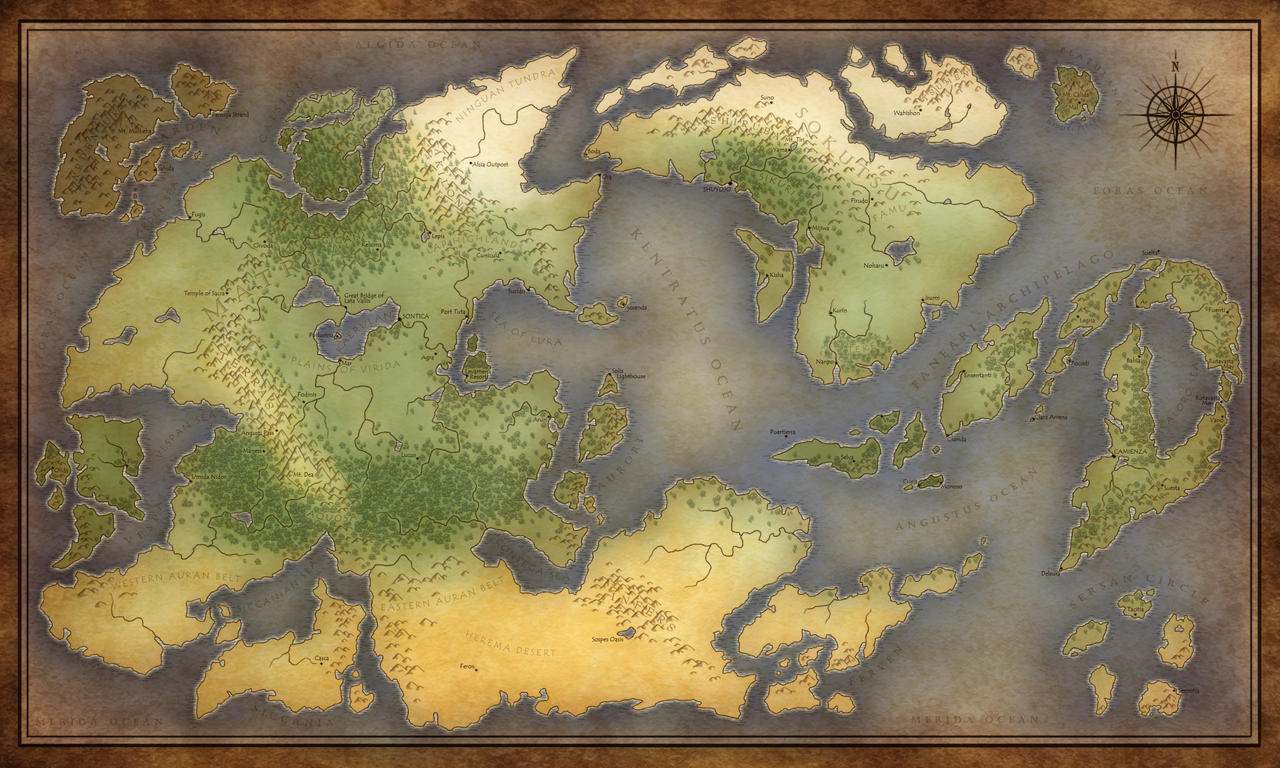
Posting location claim for now.
I can't see any borders. Do you intend to claim the entire forest area? It's a bit unclear.
Anyways, while I said to use the map in the OP, when the world map is updated I want everyone to use the one from the characters page.
Territories with not solid coloring have players who are long inactive or chose to leave the game. As a new player you can pick their territories if you want but until then I provide them a chance to return like nothing happened. Last updated in 2016.04.25.
With the lower body of a large horse and the upper torso and arms of a human, centaurs combine speed and strength in their powerful forms. A centaur is as big and heavy as a horse, standing 7 feet high and weighing about 2,100 pounds. Brown dominates most of a centaur’s coloring, the long hair on the top of the head and the glossy fur of the horse like body ranging from a light tan to a deep dark brown. A centaur’s humanlike torso has a swathy, earthy dark caramel complexion/ In some more isolated tribes the rare individuals, other colorings emerge, such as white, gray, or black but these are extremely uncommon.
The gnolls are perhaps the shakiest pillar in the alliance's claims they intend no aggression. Not even their fellow alliance members deny the amount of territorial aggression these hyena-men often stir up. However, despite their intolerance to people breaching the borders of what they consider their territory, they are also known for extreme loyalty to those that earn their trust, expecting that loyalty to be requited in equal measure.
They live in the southern plains of the island. Living off the herds of livestock there. Permanent settlements are rare due to them not being able to be sustained by farmlands. Instead, they move across the plains in a multi-year migration pattern of staggering complexity. This complexity is necesarry to grant the large herds of livestock sustainable food sources.
The Kahularians are a bipedal, simian peoples who inhabit the rugged centre of the Sunswept Isles, nominally under the charge of the Tiger-King of Thabos but operating more often as an independent patchwork of tribal states that are constantly warring with each other and occasionally operating raids out onto the Thabossian cities that dot the coast. A wholly carnivorous and ostensibly cannibalistic people, they are generally regarded as barbarians by the Thabossians, who use them both as galley slaves and forced soldiers in their armies, though in reality the Kahularians have their own language, their own customs and their own religion, which focuses on the worship of the 'Great Life Tree' Atakaru, rumoured to be located somewhere within the enormous and near impenetrable jungle of the Snapping Turtle principality, where the Kahularians maintain the strongest presence and most developed infrastructure. Short and stocky, the average female Kahularian stands at five feet, while the males are usually a few inches shorter. Their physiology is essentially humanoid except for their being covered in thick and coarse greenish black hair.
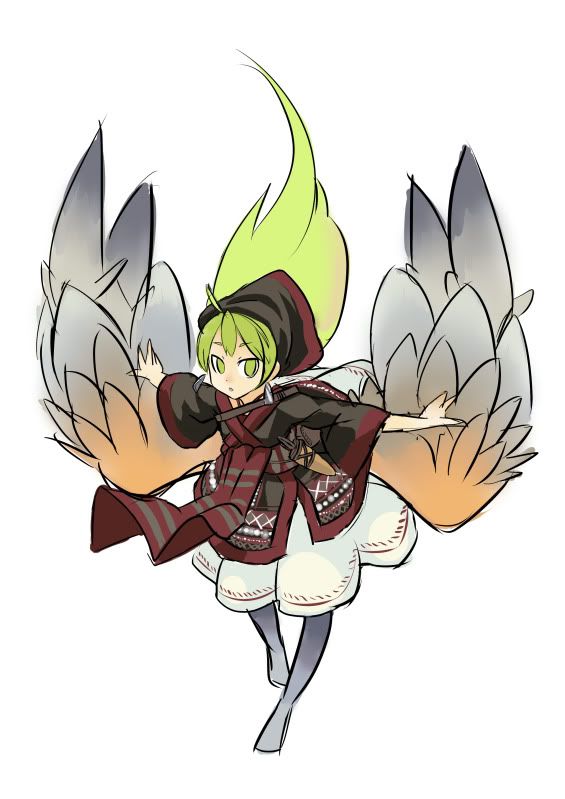
An adult male member of the species, dressed in typical clothing (also not my drawing) Vutsians, Ţá'ŕụ in their own language, are a winged humanoid species who live primarily in the Islands of Vuts. Belived to be descended of avian species from the mainland, their ancestors migrated to the Vutsian Islands approximately 2,000 years ago, and largely displaced the Humans and Elves who were living on the Islands beforehand. The Vutsians differ little in terms of Sexual Dimorphism, all members of the species are known for their feminine, youthful looks; which lead to a myth that the Vutsian Isles were inhabited entirely by women. Owing to their avian origins, the males are known to display vibrant colors in their hair, such as bright greens, reds, blues and other colors. They are capable of limited gliding using their wings, however they can no longer fly.
.
.
Bundeszwerge (meaning, dwarves of the Alliance[AKA the Bund]) is the collective name for dwarves under the Alliance of the Thirty-Three Peaks (Dreiunddreissighöhesbund, AKA the Bund) refers to themselves. Unlike many of their peers they left behind their clan-like traditional structure and became the alliance of 33 city-states situated in the same amount of mountains. Just like the typical dwarf they are of small stature but thick with both their strength and toughness being superior. Dwarves at average can live up to 200 years and renown for their craftsmanship, especially in the art of mining and metallurgy. While resisting at first the dwarves ultimately benefited from the Uruk conquest as trade revenues making them wealthier than ever. Given their natural talents it's no surprise that the Bund is one of the centers of firearm production within the empire.
.
.
Name - Daoine (elves) Appearance - Mostly human, but smaller and lighter. They have pointed ears and cat-like pupils. Natural abilities - Sharp senses. The Daoine senses of hearing and smell is comparable to that of dogs or wolves. They can also see perfectly in the dark thanks to their eyes, which can register heat down to a tenth of a degree. Lifespan - 300 years Homeland – Baile (but they exist in forests around most of the western continent)
The Daoine, elves native to the lands of Baile, live secluded from the humans and have a completely different culture. They are highly territorial, aggressive almost, and will only rarely interact with other peoples. They live in the forests of Baile and are largely left alone despite the demand for lumber. Not much is known about their religious beliefs other than that they seem to worship the stars.
The Uruk Empire conquered numerous races, including elves. Traditionally the dwellers of lush forests they are slender and beautiful humanoid creatures living in relative harmony with the nature. They live for 300 years and renown for their senses and dexterity. As said elves live in relative harmony with the nature and generally distant with cultures of different views. There is also another type of elves who went on and created a small empire on the island of Yllendthyr. They founded large cities and actively trade and interact with people. Regardless of type both elves are currently under the rule of the Uruk Empire, a nation they almost instinctively loathe. Yet most of the younger generation grew accustomed and rebellions are becoming rare nowadays.
.
.
What could be seen as the towering natives of the Slivyst Island that stand at least a dozen feet tall, Myrstrost is built upon their lands and their bodies, these giants were once considered hostiles of the highest danger. But through the use of magic and guile, some have learned how to control these towering men to serve as labor and even soldiers. Its said that the reason why Myrstrost's architecture is so grand is because it was also built to accommodate for Giants.
Alas, those days are long gone and one will never see a friendly giant anymore. Now, many of them guard old ruins and castles dutifully and attack all who dare enter. Some have managed to form their own tribes in the high mountains, but they are just as hostile as their "tamed" brethren.
The great men of the forests. The ogres have always been stereotypized as uncultured, dim-witted brutes. In actuality, they are anything but stupid. However, their ponderous movement and calm demeanour is often misinterpreted as stupidity. This makes it all the more jarring when an ogre turns violent due to agitated emotions like anger or fear. An angered ogre is a fearsome sight to behold. With an average height of almost 2 meters 50 worth of muscle and bone and the pain tolerance of a steel-plated boulder.
Ogres were recruited by blackclaw when the need for sheer physical strength presented itself. Along with that strength came great skill at hunting and the insights of a tribe that favored passive observation above reactionary impulse. The ogres live in the western forest of the black island.
.
.
Humanoids with the faces of Dragons, Dratarians or "Dragon men" live in small holdfasts in the western mountains. Standing fully 7 feet tall, with muscled builds and covered in red, green, or brown scales, they are an imposing people with a similar honor based culture. Their leaders are blessed with tails, and only one Drabarian in 500 years can grow wings. The Drabar claim they await the end of the world, and the herald of the Dragon's return. They send their offspring into the Thangor forest, and cannot come back until they have proof of a heroic kill, such as the tusks of a Demari Boar. They taught the Thangors how to work Baldr and Valdium.
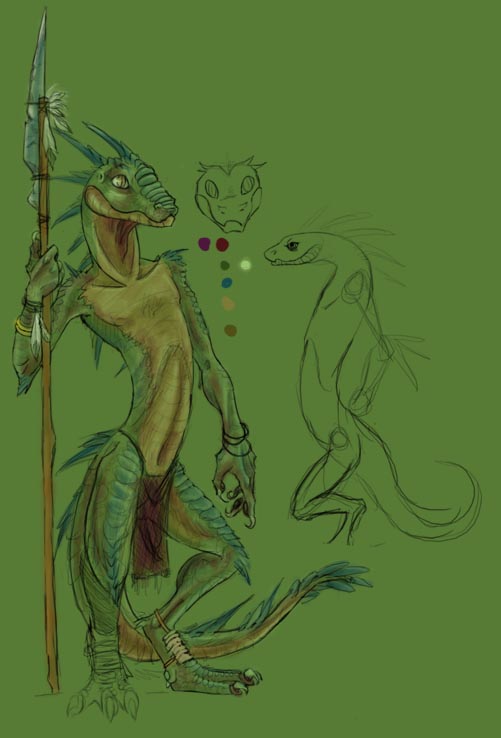
The Kashar are a race of reptilian beings that stand about five feet tall and six inches, males typically are bigger than the females who stand about two inches shorter. They typically have green scales with yellow underbellies. They are typically very thin so that they can maneuver about the savannahs without being seen. Kashar hold a high metabolism so they remain a thin frame, but it slows significantly if the body has not eaten over two days. Their diet consists mainly consists of meat and small nuts and leaves. Their mouth holds many fangs within the front half of their mouth with molars at the very back to crack nuts and chew the occasional leaf.
Kobolds, much like goblins, are rather physically weak small humanoids. Unlike goblins however, Kobolds are reptilian in nature, having an outward appearance sometimes jokingly described as fun-sized dragons. Indeed, a small amount of them exhibit qualities much like a stunted dragon, like wings, hardened scales or a natural talent for magic. This apparant relationship leads many to see them as likely to take after the habits of the flying lizards to kidnap princesses, plunder wealth and live in inhospitable lairs. In actuality, most kobolds are happy to live with a patch of land and enough food in their belly to not starve to death. They have a friendly rivalry with the goblins in the trades of mining and metalworking.
An ancient tribe of amphibious humanoid reptiles. The lizardmen were one of the first races to join Tulida blackclaw. They are fishermen and underwater farmers. Originating from the unpleasant swamps and bogs of the world, the lizardmen have never really needed to protect their own lands. Their military tradition is somewhat lacking as a result. However, they have an asset quite valuable for an island nation. Their amphibious nature and original swampland homes have made them quite proficient at building boats of all sorts. Lizardmen live in the eastern wetlands of the island. Having built communities around the streams and lakes that dot the area.
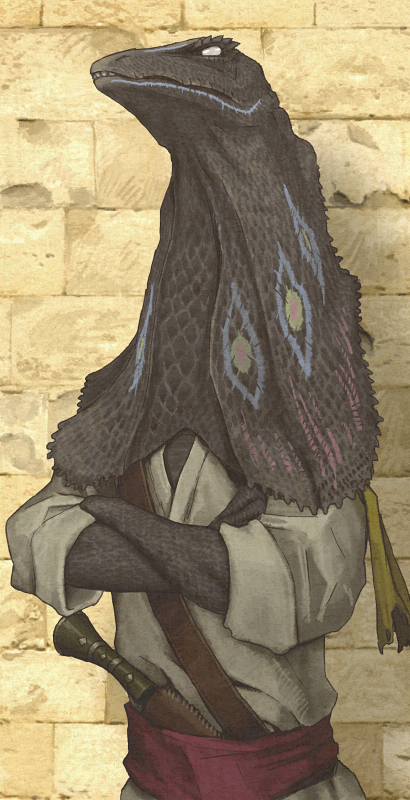
The Quexltec are a race of lizardmen that have grown adapted to the underground life style with several features that allow them to live in the desert. The Quexltec range in size from 5'4" all the way to 6'2" and they ranged in color for their scales from pure black to deep green with most also sporting several markings on their body. The main distinguishing feature of the race would be how the males have large frills around their necks roughly three feet in diameter that is able to fold up against their necks when not completely extended, the females of the species sport a spinal frill that runs from the base of their necks all the way down their backs to the end of their tails that is also able to fold up when not extended. Both males and females have a sharp row of teeth meant for tearing at their prey along with sharpened claws on their hands and feet.
Quexltec are omnivores by nature, thought their diet mainly consists of herd beast and if located closer to the ocean than there is a variety of fish that can be mixed into the diet. A special function of the race's frill is that it helps as a mating attractions as well as a way to regulate body temperature while in the surface.
.
.
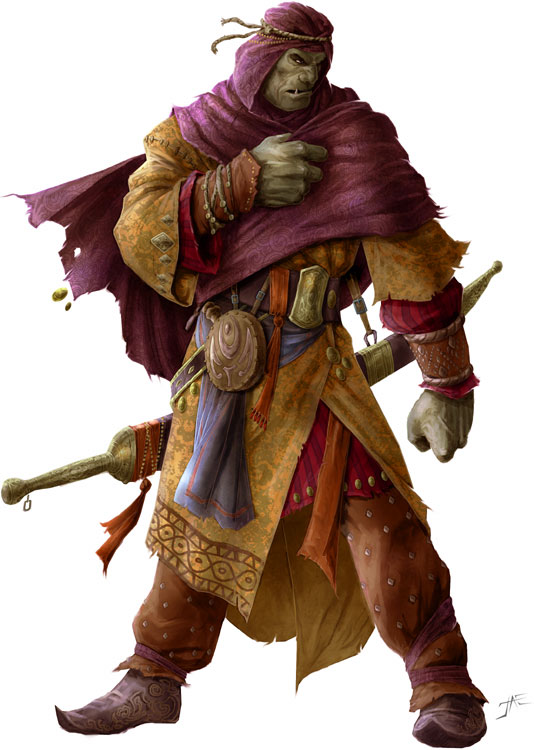
The Uruk also known as the orks/orcs are a race of humanoids dominant within the center of the main continent. They are tall, at least 6 feet at average and often highly muscular. More distinctly they have protouding jawline and foreheads, large canine teeth and skin coloration unnatural to any human. This and their legends of ferocity at times titled them as "monsters" or creatures of the devil. Yet barring certain features the orks aren't that different from humans (also proven by the fact they can interbreed to sire a half-ork). They have same maximum lifespan of 120 years. Yet so long they are physically active the Orks don't show signs of venerable age for long. At the age of 60-80 an ork could be still within his prime and thus at average orcs live longer unless they either starve or killed. Due to their higher muscle mass orks at average are 1.5 times stronger than a human and if well-fed can be twice as enduring as them. Feeding is an issue for orks as they consume more than twice as much food as humans at average. Some say orks eat humans and elves on regular basis but those are only rumors based on wild assumptions. In contrast the rumors about orks having poorer eyesight is true at least when the Sun is the brightest. On the other hand orks can see much better during low-light conditions and combined with their dark skin this made them dangerous night hunters. Speaking of which the ork skin varies just like a human's. In their case it can range from pale brown to the usual greenish brown to charcoal black. Just like for humans the skin pigmentation depends on how much one spends in sunlight thus it also can tell lifestyle and social status. In general most if not all ork warriors have black skin.
To an average human most orks look beastly and gruesome but the feeling is somewhat mutual. The Uruk sense of personal aesthetics and beauty are different from humans and especially compared to the elves. As said humans and orks can interbreed and so can with the elves. Yet the latter is extremely rare since both orks and elves consider the other to be seriously ugly. In the end some attention should be dawn to their name. Uruk is both the name of their race and nationality. The term Ork/Orc originates from "Orakbur" a contraction of the words translated as "Sons of Orakgash" which was the nickname of Orakgash's tribe before uniting all Uruk. The name survived and occasionally used between Uruk and it eventually mutated to the short version "Ork" which then become the common name of their race in foreign lands. Due to this origin no Uruk will ever be offended to be referred as Ork, albeit they might politely attempt to correct you.
Uruk religion is based on their tribal shamanistic roots. They beleive in the gods representing the four elements as well as respecting the spirits of the land, the forest, the rivers and the mountains. Their religious figures were the Laguurz which roughly translates "to do magical". They were chosen from the brightest most gifted members of the tribe and aside from listening to the spirits they also conducted numerous studies and experiments.
They were both priests, scientists and even magicians. Even in the present this didn't change. Laguurz are all taught in the Uruk religion of the four elements but then they specialize to study other arts. Not all Laguurz are gifted in the art of magic and rather many of them study as scholars, healers or even scientists. Laguurz represents the intellectual class within the Uruk society and indeed the word is used interchangeably with the meaning of genius. As such rather than shaman they are nowadays much closer to viziers and astronomers who seek knowledge.
The strongest race in the alliance, and the ones that first formed it. The orcs originate from the wild steppes of the central mainland, having been led to the black island by the warlord Tulida blackclaw. The average orc stands about a meter eigthy tall and weighs in at about ninety kilograms of muscle. Orcish society places emphasis on strength. A strength that used to be interpreted as conquest and plundering, but has been reformed under Tulida's rule to have a stronger emphasis on protecting the homeland and hierarchy based on honor. Blackland orcs are renowned for their heavy cavalry, having abandoned the raiding cavalry tactics of their past in favor of an army better suited to protecting the lands of a settled people. The orcs live in the foothills and mountains in the center of the black island in impressive fortresses built of black stone and surrounded by farmlands that grow crops to feed the machine of daily orcish life.
.
.
The finefolk are humanoids with orange fur, long arms (with big hands) and stubby legs. They have flat noses and a skull which tapers back horizontally instead of being round like our own. The finefolk have no visible cornea, instead having what appears to just be a monocolored dark pupil and their ears are extremely circular. The finefolk tend to be arboreal, a fact of which is why they tend to fear open spaces (a problem that is literally beaten out of the military-merchant class from birth, through forced exposure to open places until they stop fearing it or die from panic). Finefolk have very different levels of civilization and despite the Empire of hands claiming the whole Jade Island, there is still various hill tribes living in trees who are extremely dangerous to contend with due to being much more in touch with the tree-based roots of the finefolk kind than the "civilized" Empire of Hands is. The males tend to be orange while the females tend to be black.
A race of squat, cowardly humanoids hailing from the dark caverns and deep tunnels of the world. Goblins have a history of being pushed around by larger races due to their small stature and lacking physical strength. As a survival mechanism, many of them have developed a sense of caution against anything stronger or larger than them. Years of hiding from danger in caverns and tunnels have made them competent sappers and efficient miners. They have something of a rivalry with the kobolds over who os the best at metalworking. They live under the black mountains in vast complexes of tunnels and caves.
A small people that stand between two and four feet tall, halflings are often regarded as fat and scrawny. Though they certainly have a propensity to be rotund and are not known for their titanic strength, the little folk are surprisingly agile and are stronger than they may at first appear (though not as strong as a human, true). They are also incredibly stealthy when they wish to be, perhaps even being the most adept at hiding among the races of the known world. Those who have fought against or alongside these small ones agree they possess a surprising amount of bravery as well, and while they can't march as quick as a man or carry as long a sword, they nevertheless can be turned into capable fighters in their own right.
Halflings are famous for their very curly hair, and their feet seem to sprout a fair bit of it as well. Some halflings prefer to travel barefoot as their feet are rather durable and flexible, but others - especially soldiers - would rather have a good pair of boots just in case.
About the same as any other humans within the lands; Myrstrost's are known for much heartier constitutions given how far north the are, acute eyesight due to the Great Mist that once surrounded their home and the greater resistance to fear especially of the undead given how often and close they are with Hallows. Interesting enough, Myrstrost humans do not bleed red, but instead a silvery white
The Thabossians are a bipedal, humanoid peoples, closely related to humans. They are copper-skinned, with most of the population possessing bright red or black hair. Physiologically, they are not predisposed to gaining much muscle mass, and they are all taller than humans on average, with females averaging at 7 feet tall and the males averaging at 7 feet and 6 inches, all of which contribute to giving them a tall and willowy appearance that is accentuated by the flowing, loose-fitting robes that they wear at almost every opportunity in order to cope in the heat of the Sunswept Isles. The Thabossians are omnivorous but most remain largely herbivore due to the general dearth of livestock animals on the islands. Their ears taper to small points, and their eyes are either silvery-green or blue, with little exception.
.
.
Hallows are a special off shot of the undead which can afflict any mortal species with cases of super beings such as Dragons hallowing considered little more than extreme lies; but all lies must have started with some truth at one point. They are those who have had their intact souls returned to their bodies in such a way that they do not become mindless, obedient slaves and behave the same way which they did whence they where still truly alive.
Contrary to popular belief, there is no "Undeath Plague" that one can just catch and become a Hallow. In order to become one, one must dies in such a way which leave the body intact (so no burning or cutting up). Those who become Hallowed are often those too attached to a will to live to simply just die, and of those, the ones with the greatest will and character can prevent themselves from falling to Feral.
But no matter how alive they act, they are not considered anything more than glorified undead in most places and do not look quite like normal beings. Their bodies riddled with scars and marks, their eyes that glow like embers in the darkest shadows and the pale blood which ominously gleams.
Such beings are immortal and very difficult to kill, usually only through complete destruction of the body. However, immortality is no blessing, but a curse as all Hollows know; death is replaced by insanity as anything which would normally kill a man will cause them to be resurrected once more, each time the subject loosing their will to be living and eventually descending into madness and turning feral.
Hallows feel no pain nor pleasure, they are not alive nor undead, but yet they walk the earth as if they do. It is only through the constant pursuit of a purpose which they may retain their sanity. Sad, pitiful beings indeed. The reason why they are beckoned to Myrstrost however is unknown; some say was the Fog but more modern theory suggest that there's something else entirely on the island that calls for the souls of the undead to its shores.
Bestiarium:
Alongside the humble scorpions of this world are the rare and giant Archa. These monstrous beasts are located primarily in desert regions and are as harsh as the sands they dwell. Archa typically grow to roughly eight to nine feet long from head to tail and can weigh in excess of a ton due to their heavy plating, though the specially grown Archa of Farastine that can grow in excess of seventy feet from head to tail.
Archa possesses two heavy hitting weapons, their claws which some say have the same crushing force as a full grown dragons bite and its potent poison residing in its tail. The poison is so strong that it can actually be seen melting a man alive.
The Askari are large, flightless birds that stand at around nine-to-ten feet tall and weigh around 200-250 lbs with little difference between the male or females. These birds hold large feathers which are typically used to keep cool the beast down during the harsh days that the savannah brings. They are known for their highly aggressive behavior and resistance to training, yet, they seem to be used as mounts for the Clans of Kashar.
They breed during the rain seasons and are omnivorous in nature. Egg clusters are laid in batches of five to six at a time in a large nest that is guarded by the males. They can run at a max speed of 37 miles an hour and have a max carrying weight of around 180 pounds.
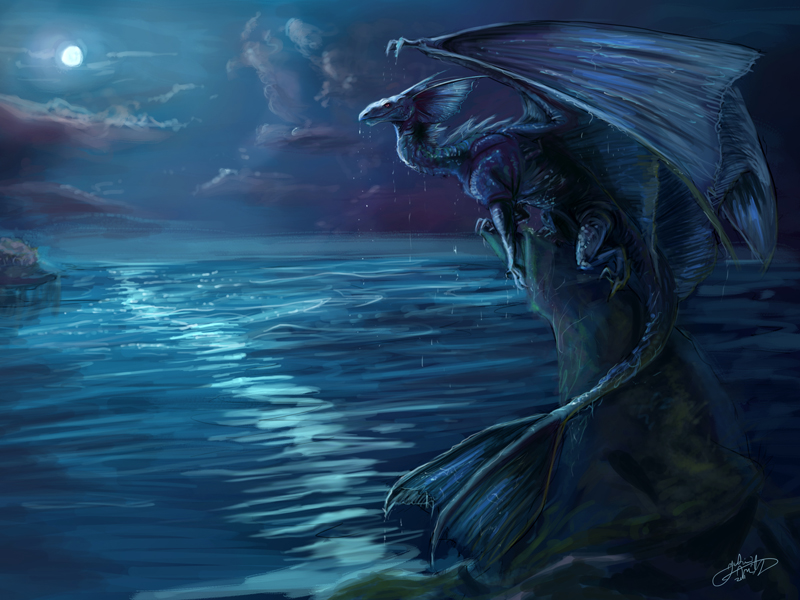
The majestic blue dragons are both beautiful and terrifying, beasts whose minds are far more canny than those of mere mortals. They are roughly 14 meters long and 5 meters tall with a wingspan between 20-30 meters. They fly overhead of the populace of Ardonia on occasion, but they are most commonly found dwelling on the Sapphire Isles. Like whales, the main diet of blue dragons is fish, though they do not shy from hunting mammals.
In times of war, these powerful creatures will lend their strength to the Ardonian armies. They are capable both of flight and of swimming underwater, making them useful in land wars and at sea. They breathe lightning, and likewise are immune to its effects, making them deadly adversaries. A breath of lightning looks and acts like a terrible bolt of lightning, making a thunderous clap wheresoever it lands. They can use this lightning breath from up to fifty meters away from their target.
These dragons also have rather sturdy scales, and indeed the collection of scales that molt off these wondrous beings produces high-quality armor in Ardonia. For the dragons, though, these scales serve as a steely defense against attacks by lesser beings. Their wings, however, are rather vulnerable, and a dragon can be permanently crippled if its wings are harmed and it does not receive speedy aid from a healer.
The best conventional weapons to use against blue dragons are ballistae and cannons, but enough arrows may bring them down. They are momentarily stunned once they strike the earth, though not seriously wounded by their fall, and if swarmed quickly can be dispatched before they rouse themselves from their unconsciousness.
A Goldmarch Destrier is perhaps the greatest war horse in the world, known for its impressive strength and stamina. Thousands of the animals are raised and cultivated across the plains of Goldmarch, and they are sold for high prices - both to Knights and to foreigners. Indeed, a man would be prepared to pay his own weight in gold, in exchange for a young Goldmarch destrier.
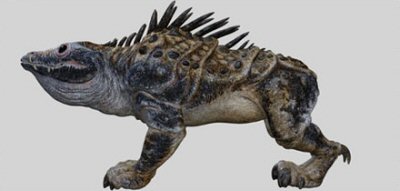
Spikebacks, or alternatively called Thornhounds, are small Canine-like reptilian beasts native to the Southern Deserts and Savannah. Named for their spiked and armored hide, the spikebacks for many centuries have been domesticated by the Southern Peoples and used as guard beasts or as hunting Companions. In the present, Spikebacks now see wide use alongside actual Canines as terror weapons for the Zhodulan Army. Spikebacks have also become quite an exotic choice of pet for Zhodulan Nobles up north.
Takodons are a common sight in the oceans of this world. They come in all shapes and sizes, with the largest arguably being the specially grown and magically altered Takodon dreadnoughts' of Farastine. Unlike the Farastinian Takodons, most of these creatures are docile and simple.
Misc:
The most durable substance known to Thangoradrim, and possibly the world. Twice as strong as Valdium, as heavy as Iron, and known to be extremely hard to fall to corrosion or rust. It takes a Drabarian or an extremely strong Thangor blacksmith to shape, and to the uninitiated, forging a sword of Baldr could take a decade. It is fairly rare, discovered by the Drabarians in the lone mountains to the southwest. Perhaps it is in other areas of the world, but so far the only known findings are in Thangoradrim. Called Drabari metal, or 'Dragonsteel'.
Whether used to reinforce shields or make coats of scale armor, blue dragonscales are strong like steel and incredibly valuable. Not only do they provide excellent protection from cutting blows, but they are also incredibly lightweight and absorb electrical spells and effects. They also can slightly dampen harmful magic, though they certainly do not provide immunity. Anyone fortunate enough to have armor made of dragonscales is a lucky man indeed.
The greatest export to leave the Heartvale is its beer. If halfling foodstuffs are famous, halfling beer is legendary. Bristle Stout, Shimmer Ale, and Little Folk Firewater are just a few examples of the stuff which foreign nations clamor for. Sure, it's not nearly so sophisticated as wine, but the flavors of halfling brews are carefully balanced, mastered over centuries of interest in the art of the beer. It helps that halflings have a very discriminating sense of taste and smell. They know just what to do to make a beer's flavor heavenly.
Karikasard is the namesake of this mixture. As the young god of violent fires is part of the Uruk Pantheon and can also considered a war god. His name combined with the word Buum (Herbs) can together be translated as "herbs causing violent fires of war" which is a rather apt description for an explosive. Karikabuum (alternatively Kabuum or Kaboom for the noise it generates) is an orkish gunpowder using a mixture of certain herbs and soil. It was first developed by shamans in order to reach a closer connection to the spirits of fire but it eventually found use as a weapon. With sufficient knowledge it's possible to produce low-grade Karikabuum (also called Palsvaj AKA Blasting Jelly) without any special equipment which made it popular and widespread by the time of Orakgash Khagn's conquest. Better mixtures are dried of water and formed into either grains, balls or stalks for better combustion while also using purer and more refined ingredients. While many other kinds of gunpowder mixtures are known the Uruk Empire relies the most extensively on Karikabuum.
Kingsland Steel is a famous resource in the fashioning of armour and weapons, and is renowned for its strength and resilience.
Mystrost's main exports are that of a magical nature, of note is Mythst. Mythst is a strange, mysterious element, only appearing in the Forgotten Kingdom as a result of the Thousand Year Mist which it had isolated the nation. It takes on a state between liquid and gas in an almost plasma-like nature although it can be hardened into a solid form. Colored like a moonlit silver, Mythst's magical properties are great, able to enhance the effects of any other type of magic as well as reinforce physical materials. When "retuned", Mythst's properties change so slightly to create Salus, a pale blue liquid not unlike the blood which flows through the veins of Hallows.
Such finds common use in the military of Myrstrost where even the simple iron or steel armor's durability and protection jumps dramatically and blades are stronger and more damage resistance. Some smiths have taken dried Mythst powder to forge items with the properties of the substance imbued in naturally.
Salus is a form of healing and the Art of Retuning which refines Salus from Mythst is considered the highest form of Alchemy normally used to create healing solves and such. However, the process making pure Salus is long and difficult, leading people to create slightly cheaper Salus Flasks; flasks with some bit of Salus mixed into the glass of the flask which provides a diluted healing effect of that of Salus. These flasks themselves are incredibly durable as the Salus which they are bolstered by still retains the reinforcing properties of Mythst. Such Salus Flasks are common amongst adventures and explorers to venture deep into Myrstrost's unknown past.
The trees of Trebuen Forest come in several varieties, but none are more revered than the Trebuen Yew. This superior breed of yew tree is a widely sought resource in the construction of the longbow. Though the weapon itself has never been utilised by the Ardonians, there are many foreign nations that have the longbow down to a fine art form, and it is these who lap up Trebuen Yew as a dog laps water on a hot summer's day.
A silver steel found beneath the sacred glades, Valdium is as strong as well forged iron, half as light, and gives off a faint glow. It cleaves through monster flesh and the flesh of magical beings easier than other metals. It lasts longer than Iron. Some say the Fey spirits blessed the metal themselves, or its properties developed by its close proximity to the glades. Either way, it is offered to Heroes and the Druids at times, when asked, by the Fey. Can be shaped as easily as Iron.
A sturdy timber that regenerates into the form that it is carved in, even after it is broken. Blessed by the Druids of the Glade, and often used for smaller buildings and items, though if enough is found, can be made to create giant ships and houses. It is a very rare tree, only found near a sacred Glade. Need a Druid to be present when carving such wood to keep it from wildly growing back.
Welcome to the world of Eleysia, a mix of late medieval world and fantasy. Magic exists even if not part of the everyday lives, humans aren't the sole sentient race on the planet and various fantastical animals and creatures are ready to be used or discovered. This is a freeform NRP where you can claim a place on the map and design your own fantasy nation. The storyline will depend on what the players will create. Alright, let's get to the guidelines.
Zee Rules:
Standard RPGuild rules, no need to repeat them
Technologically and in style the setting resembles the 14th-15th century
Magic is allowed but very expensive in general. Magic users of note are usually rare, treat them with care.
You can create any sorts of fantasy race so long their capabilities aren't over the top.
This includes both sentient races or various fantastic creatures
Fantastic materials are allowed, as well as clockpunk/dungeonpunk inventions. The more useful they are the more expensive.
When thinking about your nation's power ask this question: "Can a 15th century nation/army handle this?"
You're allowed to have "super units" so long they are rare and don't make your nation unstoppable
Make your nation claims based on the map in the character tab. We have many player candidates so don't grab too much land.
So long we have blanks on the map new players are always welcome to join and claim them.
If possible read the NS of other players and try matching your nation to them. Especially your neighbors. Try having some chemistry.
Take the time till the game starts to flesh out the setting by discussing the relations/details with each other.
Once the IC starts I wish that all nations would post their intro post first. Something that establishes your nation.
No metagaming, as in you can't use information which your nation shouldn't know to your advantage.
War is roleplayed out and the owner of the troops describes their loses. Try to keep things reasonable otherwise we've got to arbitrate for you.
Consider the timeframe. Ships crossing the waters may take weeks or months, for example. Land routes are even slower.
There's no enforced posting order but when possible please try to wait for the other players a bit. This is mostly timeline sensitive so back-and-forth posting between two leaders during a meeting is usually fine (though avoid short posts via writing collabs).
Yet above all this the main point is to have fun! Okay what can you do to become part of this game? First and foremost create your nation by filling out this profile format:
NATION NAME
(your crest, symbol or flag can go here - optional)
Location/Geography
(Pick a color representing your nation and draw up your borders on the map. Don't be too greedy! Remember that there are many players wishing to participate in this game. After that you can also describe the territory you claimed. Environment, landmarks, notable regions and so on. While you can't just say you have unbearable heat in the whitened out sections at the North you have the freedom to describe pretty much anything not obviously shown otherwise on the map.)
General Introduction
(What is your nation? What they do? How they live? etc...Anything you can think helps identifying your nation among the rest.)
History
(You can detail the history of your nation here. How they were formed? Any major events like wars, political changes or catastrophes? Really, you know better than me what you wish to write here. History is good for giving other players story hooks to establish some relationship with your nation. A good history section tries to incorporate knowledge from other NS to do exactly that, a shared history.)
Government & Society
(I decided to combine these two and maybe even several other categories because I feel they are often related. You can detail here the type of your government, who are your important people. How the people live and what's their mentality like. You can talk about religion, minorities, demographics, population. If you have an unique faith or judicial system you may also want to detail it here. And of course you can mention what is your unique races are like. First come first serve. If a player already made elves then they have priority. You can of course discuss things with that person and come to an agreement. Race/species descriptions must be always put in separate hiders so they can be easily found. Think of something like this:
Garden Gnomes are tiny humanoids at average 10-14 inches in height. Their dietary requirements include lot of grass thus they are the most frequently found in gardens and clearings. Garden Gnomes are shy and developed an unique defense mechanism. So long they're looked on they become motionless like statues. To compensate when nobody is looking Garden Gnomes are both silent and incredibly fast. If you feel you're being followed around by happy looking yet sinister dwarf statues... you probably are. Have a good night!
Economy & Industry
(What are your primary exports and imports? How much you trade? How are your craftsmen organized? How developed is your technology? What kind of unique creations you have? etc. If you haven't described your involvement with magic in the society/government section, you can do it here.)
Military Overview
(Yeah, of course you also need to tell us some about your military. Try to avoid number games and unhealthy arms races. We play this game for fun and that needs balance and sensible approach. One of the main guidelines is that your nation's military shouldn't be much better than a historical 15th century medieval army. Don't worry, I don't ask you historical accuracy. So-called "super units" can be okay if they are rare enough for their worth and don't make your army unbeatable. The point is to let you do cool things and explore your creativity but at the same time don't do it at the expense of others. Also if you have magic or magicians involved in your military then perhaps you can describe that, too.)
Are you done? Great! Discuss your nation with your fellow players, try to discuss relations with each other and establish a shared history while waiting for the game to start. Don't worry, it's going to worth it! I also plan to maintain an index/glossary for unique elements fro each nation to further promote this. Let's make Fantasy NRPs great again! Chatzy Link:us21.chatzy.com/53687590235261
Alright, slightly bad news. I promised to release the NS guide soon but it appears I operate under Valve Time. So another delay, it's past midnight here and I need a sleep. I'll be making the OOC thread tomorrow morning instead. That means about several hours later.
Yeah, not liking guns in a mid-late medieval setting is almost like not liking dwarves in fantasy and deciding to stay out of the game if they're even featured. Just like nobody forces you to have dwarves in your nation, nobody forces you to have guns. And it'll be okay during this time period.
Right, if Zell, Aristo, Hypderdrive, and NOW TMG are interested... sure I'll co-GM just so I can boss them around again. @Willy Vereb PM me what I need to know?
The long and short of it is though, that I take first priority with my current roleplay, but I'll help.
This is a freeform game. The entire setting will be built by the players. Just like most NRPs. I can handle NS judging and such. I want your help so there'd be always a GM to lean on. Anyways, I'm going to post the NS format soon.
I'll be also working on the OOC. Like I said I can handle the gamebuilding and administration parts. I just know myself enough that I'll be probably won't be always on so I need a GM who would maintain a presence there.
By how much should was the general population reduced?
I think the decades following the war are more than sufficient to restore population to their pre-war state. Or even beyond, given if you establish colonies in space or other planets. The typical limitation of population nowadays is space and sustainability rather than lack of growth.
 Member

 salamimike
 Durandals